Tag Archives: ACDS

Science education: the hidden engine of Australia’s future

To mark National Science Week 2025, the Australian Council of Deans of Science (ACDS) is urging Australians to recognise the vital role of university science education in driving innovation, boosting the economy and shaping better decisions across all sectors.

From research labs to boardrooms, science graduates bring adaptability, problem-solving skills, and critical thinking to industries as diverse as policy, law, business, and technology. And science literacy isn’t just for scientists — it’s a must-have for leaders in every field.

Read why ACDS says universities, governments, and families must back science education as a foundation for Australia’s prosperity and resilience.

Australia Needs to Revalue the Science Degree – Here’s Why

By the Australian Council of Deans of Science – August 2025

In an era defined by climate change, technological disruption and global uncertainty, Australia needs more science graduates—not fewer. Yet science degrees remain underappreciated by many students and parents, for whom a career pathway in engineering, health or law often seems clearer. This perception is misleading and dangerous. As we celebrate National Science Week 2025, let’s reframe this perception.

Science Graduates Are Everywhere

Contrary to popular belief, science graduates are not confined to laboratories. Most work in business, government, policy, education and technology. The career outcomes for science graduates are very good, with 89% of science graduates in full-time paid work three years after graduation, according to the Graduate Outcomes Survey. Many pursue further study, leading to specialised roles in research, policy and innovation.

Science degrees produce versatile thinkers. Employers value adaptability, problem-solving and digital literacy—skills embedded in science education. An exciting initiative is the introduction of STEM Stream by the Australian Public Service, a program designed to give science graduates employment experience across multiple fields.

Science Is a Civic Skill

Science literacy is not optional: it is essential for lawyers drafting environmental legislation, accountants assessing sustainability risks and business leaders navigating technological change. Yet around 90% of university students are non-science majors. Science literacy is about rigorous, creative, systematic thinking and problem-solving—attributes that are critical in every profession. We should encourage every student—regardless of discipline—to engage with science at least once during their degree.

The National Assessment Program for Science Literacy found that students who engaged more frequently in critical and creative thinking activities had significantly higher science literacy. Science isn’t just about knowledge—it’s about the ability to reason, evaluate evidence and make informed decisions in a complex world. A science-literate population will be better able to analyse data and identify misinformation, leading to better decisions on issues such as vaccination, climate change and renewable energy.

Science Tackles the Big Problems

Science graduates are at the forefront of solving global challenges. From climate modelling to food security, they employ tools like data analytics and systems thinking to shape policy and drive innovation. Programs like Monash University’s Bachelor of Science Advanced – Global Challenges and Curtin University’s Bachelor of Multidisciplinary Science are training students to apply science in business, government and community settings to address issues like climate change and sustainable development.

These graduates may not follow a linear career path—but that’s precisely the point. The problems they face are complex, interdisciplinary and evolving. So too must be their education.

A Foundation for the Future Economy

According to a report commissioned by the Office of the Chief Scientist and the Australian Academy of Science, advanced physical and mathematical sciences contribute directly around 11% of GDP annually to the Australian economy. When flow-on effects are included, the total economic impact expands to 22% of national economic activity. Science graduates are not just employable—they are essential to national prosperity.

Universities across Australia are mainstreaming interdisciplinary, project-based learning models that bring together students from science, business, health and the humanities to solve real-world problems. These approaches prepare graduates for the modern workforce, where collaboration across disciplines is key to innovation and impact.

As Deans of Science, we are continuing to evolve science degrees by enhancing professional skills such as communication, cultural competency and work-integrated learning in science courses to strengthen the foundation of life-long learning for our graduates.

A Call to Action

If we want to inspire future generations, we must reframe how we talk about science degrees. They are not fallback options or stepping stones—they are launchpads. Our political leaders should promote science as a foundational skill for all. We encourage all students in vocational degrees (e.g. law, business, education) to study at least one semester of science at university. Governments should invest in science education and career support. And parents should see science not as a career risk, but as a future-proof choice.

Australia doesn’t just need more scientists. It needs more people who think like scientists.

30 years of championing Australian university science

Image: Supplied

Welcome to Issue 13 of Australian University Science magazine, celebrating 30 years of the Australian Council of Deans of Science! Over this time, scientific discoveries have generated new knowledge and significantly impacted our society and our environment. This issue outlines many inspiring examples of how Australian university science has contributed to these outcomes.

In contemplating these developments, I reflected on my own scientific journey. As an Australian postdoc in London in 1995, I was part of a large team of scientists studying one of the genes responsible for inherited breast cancer. This was such an exciting time as discoveries about DNA and genes, along with technologies for isolating and analysing genes, were unravelling the origins of multiple human diseases, including Huntington’s disease, muscular dystrophy and cancer.

In the subsequent two decades, these discoveries seeded the establishment and growth of multidisciplinary consortiums, biobanks and genetic databases, and thriving biotechnology industries in Australia and overseas. These organisations, resources and industries translated discoveries and developed critical technologies, leading to the wide availability of diagnostics that can predict the risk of genetic disease, detect infectious agents, recommend effective treatments, enable reproduction, enhance agriculture, and support forensic analysis.

Today, university science is driving remarkable achievements in health, environment, energy, communication, education and sustainability at an astonishing pace, with discovery research, technology development and education in universities continuing to be at the heart of every success story.

As we celebrate this milestone, I extend my gratitude to all contributors to this issue, especially Ian Chubb for writing the Foreword. I hope you enjoy reading the stories and I look forward to seeing you at one of our celebratory events during the year!

Written by Professor Melissa Brown, University of Queensland
President, Australian Council of Deans of Science

The engine of progress: science in Australian universities

Image: Supplied

Science in Australian universities has been a steady engine of progress for as long as I can remember – a place where curiosity meets impact, churning out both groundbreaking research and the sharp minds we need for the future. I’ve had a front-row seat to its evolution over the past 30 years, and it’s been a remarkable journey.

Back in the day, teaching and research were funded as one; now, they’re split into distinct streams, pushing universities to chase grants and forge industry ties. Universities have also leaned into partnerships, establishing research hubs that blend academic rigour with industry needs, targeting areas like sustainability, health, and technology – proof of how universities are stepping up to solve big problems. Pursuing global research ambitions isn’t cheap, but the rewards are clear: research output has skyrocketed, and Australian science consistently punches above its weight.

One feature in the latest issue of Australian University Science (Issue 13) that celebrates 30 years of the Australian Council of Deans of Science (ACDS), ‘The rise of big data in science’ (page 10), captures one of the brightest threads in that story. It unpacks how massive datasets are reshaping university research – powering climate models, sharpening agricultural practices with geospatial data, and leaning on maths breakthroughs that birthed AI.

It’s a vivid example of how university science doesn’t just ponder the world; it changes it. I love how it ties back to why this all matters: fundamental research paired with graduates who can think critically and adapt.

Since 1995, when John Rice (Flinders University) kicked off the ACDS, the Council has been a tireless voice – pushing for quality teaching through initiatives like the Science Threshold Learning Outcomes and advocating for research that matters. It’s helped ensure our science graduates aren’t just job-ready but future-ready.

In a shaky geopolitical climate its work fostering collaboration across universities, government, and industry feels more crucial than ever. The challenges are real, but the successes keep this engine of progress humming – that’s why it’s vital the ACDS keep roaring towards their next milestone.

Written by Professor Ian Chubb AC, FAA FTSE FACE FRSN

First published in Australian University Science, Issue 13

The evolution of the ACDS

Image: ESO

The ACDS has been supporting science teaching and research in Australian universities for 30 years. Over this time, the ACDS has advocated for the development and recognition of excellent teaching, for the importance of fundamental research, for better funding in science, and for support for leadership in university science.

We acknowledge the many wonderful Deans, Associate Deans and other people who have helped make the ACDS the voice of university science. Read on to discover a selection of ACDS milestones and achievements, plus key scientific achievements driven by Australian universities.

Explore the timeline in full by reading Australian University Science magazine, Issue 13.

PRE-1995

Various Deans of Science meet as an informal network

1995

ACDS first meets as a constituted organisation, John Rice (Flinders) was the first President

1995

ACDS annual conferences commence, with Deans of Science from all universities invited to join

1998

Accelerating expansion of the universe discovered (Brian Schmidt, ANU)

2001

ACDS commissions its first report: ‘Employment outcomes for science degree holders’

2003

Establishment (first funding) of ARC Centres of Excellence and Federation Fellowships

2004

Establishment of the Australian Learning and Teaching Council (with grants and awards for enhancing the quality of learning and teaching in universities)

2005

ACDS report: ‘Who’s teaching science: meeting the demands for qualified science teachers in Australian secondary schools’

2006

Cervical cancer vaccine approved (Ian Frazer, UQ, Gardasil)

2007

Australian Synchrotron opens, with ANSTO

2008

ACDS appoints its first Executive Director (John Rice) to provide support for the operation and impact of the Council

2008

Associate Deans of Teaching & Learning in Science start meeting at an annual forum

2008

The Bradley Review of higher education recommends significant reforms to funding, regulation and participation

2010

ACDS oversees the Australian Learning and Teaching Council (ALTC) project to establish national Threshold Learning Outcomes (TLOs) for Science degrees (project led by Susan Jones and Brian Yates)

2011

Tertiary Education Quality and Standards Agency established

2012

First quantum bit creation (UNSW)

2012

ACDS report: ‘A background in science: what science means for Australian society’

2012

John Rice (ACDS) appointed to support the science networks and projects funded by the national Office for Learning and Teaching (OLT)

2013

ACDS Teaching & Learning Centre established, Elizabeth Johnson appointed as inaugural Director, various projects in T&L innovation established

2016

ACDS takes over responsibility for the annual Australian Conference on Science and Maths Education (ACSME) (pioneered by Manju Sharma, Stephanie Beams and others)

2017

Associate Deans of Research in Science start meeting at an annual forum

2017

ACDS funds annual projects focused on sector-wide innovations in T&L

2018

Launch of ACDS magazine ‘Australian University Science

2019

ACDS Teaching Fellowships established

2019

ACDS Indigenous science resources project established

2020

ACDS online resource repository to support teaching and learning established

2020

ACDS Deans of Science mentoring program established

2021

ACDS Teaching & Learning grants established

2021

Launch of ACDS Indigenous Science website and community of practice

2021

ACDS–ANSTO Graduate Innovation Forum showcases graduate research to industry

2023

Most distant fast radio burst discovered (Elaine Sadler, University of Sydney)

2023

ACDS formalises commitment to equity, diversity and inclusion via a national policy statement of principles and guidelines

2023

ACDS becomes an incorporated body

2024

ACDS continues its active program including forums, webinars, newsletters, position papers and submissions to government

2024

Australian Universities Accord recommends the reintroduction of the Tertiary Education Commission and close engagement between universities and TAFE

2025

Celebrating 30 years of the ACDS

First published in Australian University Science, Issue 13

Government calls for consultation on uni research fund

Can universities do more – or get more help – in commercialising research to drive the economic growth we need post COVID-19? And how can we facilitate more collaboration between university research and business? It might sound like a familiar refrain, after the $1.1 billion NISA (National Innovation and Science Agenda) was announced in December 2015.

But NISA petered out after 4 years, and the fact that the questions are being asked – and the consultation is happening – is being welcomed by Australia’s top bodies including Science & Technology Australia and the Australian Council of Deans of Science (ACDS).

Minister the Hon Alan Tudge released the University Research Commercialisation consultation paper on Feb 26 seeking feedback into these questions.

“I want to see new ideas on how we can increase collaboration between business and universities and put our research at the heart of our economic recovery,” Minister Tudge said.

“We want our high-quality research to better translate into the breakthrough products, new businesses and ideas we need to grow our economy and improve our society.

“COVID provides a unique opportunity to reassess university business models and better leverage research to grow our economy and generate Australian jobs.

“I will work with any university that is prepared to take a bold approach.”

It’s time to “level up”

Peak body Science & Technology Australia welcomed the initiative and said university science is ready to “level up”, calling for a $2.4 billion Science Future Fund.

“Australian science is ready, willing and able to answer that call,” said Science & Technology Australia Chief Executive Officer Misha Schubert.

ACDS joined the call for funding similar to the long-established Biomedical Research Translation Fund that fed $500m into medical research translation in 2015-2017.

“We strongly support the proposal for a non-medical research translation fund and a comprehensive long-term national plan for science and technology,” they stated in a press release.

“Such a scheme will enable the great work by University science in areas like environmental science, agriculture, chemistry and physics, to contribute to global challenges like food and water security, climate change, renewable energy and smart materials.”

Release the release here, or click here for a direct link to download the consultation paper.

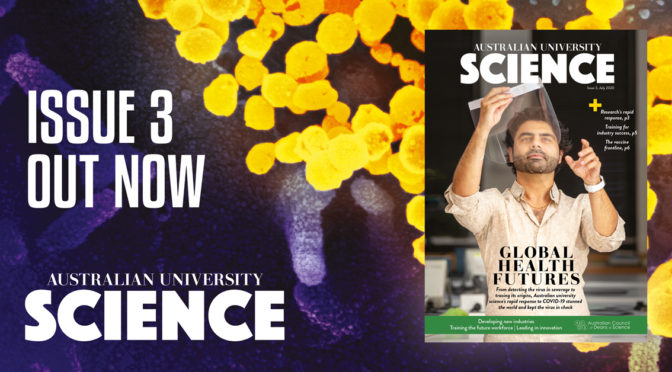
Australian universities COVID-19 response – Issue 3

When the pandemic hit, the Australian Council of Deans of Science quickly mobilised to understand Australian universities COVID-19 response, covered in the latest issue of Australian University Science.

University science research is a deep repository of knowledge and is uniquely positioned to respond to the COVID-19 crisis, through research across multiple disciplines and targeting many different problem areas.

As Professor John Shine notes in the introduction to the issue, university science in Australia is developing strong candidates for a vaccine with the support of the Centre for Epidemic Preparedness Innovations and from global biotech giant CSL, established in Australia in 1916.

But the response goes far beyond vaccine research, with a number of cutting edge molecular biology research and environmental science pivoting into the COVID-19 problem.

In addition, Australian universities COVID-19 response included university science departments utilising their unique facilities and knowledge.

They manufactured hundreds of thousands of masks and other personal protective equipment, began research into mental health effects, modelled the spread of the virus, looked at the effects on specific groups including minorities and regions, and worked with the government and schools to provide resources and expertise.

This virus is not finished, nor is the research. There will be rapidly changing approaches to testing regimes, new drugs and new vaccines. There will also be ongoing impacts, challenges and setbacks.

As this latest issue of Australian University Science goes to show, as the virus continues to change our world, university science research will be at the frontline in helping us to understand, adapt and respond to this crisis.

Heather Catchpole, Editor, Australian University Science & Head of Content, Refraction Media. @hcatchpole

About Australian University Science

Australian University Science is produced by STEM-specialist publisher, Refraction Media (publishers of ScienceMeetsBusiness.com.au), on behalf of the Australian Council of Deans of Science.

Australian University Science highlights the collaborative work of the science community in this third edition, and profiles the roles graduates play in industry.

To provide feedback or suggestions to the editors, subscribe to this publication or order additional copies, email info@refractionmedia.com.au.

Australian University Science: university science, universal impact

Australian universities have a critical role in research innovation and technological change. A new publication reveals the impact of university science on innovation, entrepreneurship and employment in future energy technologies.The bi-annual publication is published by Refraction Media on behalf of the Australian Council of Deans of Science (ACDS).

The first issue, launching on 9 September 2019, focusses on the hydrogen economy. The first hydrogen fuel exports to Japan (through Queensland University of Technology’s Redlands Facility) left Australia in March this year. It’s just one of the ways that universities are delivering on this potential multi-billion dollar economy. Australia is also well positioned to become a net exporter of hydrogen, an opportunity expected to create 16,000 new Australian jobs by 2040.

“University science is a fundamental source of disruptive ideas, and a partner for their translation into innovation,” says Executive Director of the ACDS, Professor John Rice. “The emerging hydrogen economy and energy futures are a great example.”

“Australian University Science provides a critical insight into how university science informs, partners and drives innovation domestically and internationally,” says Professor Rice.

The publication highlights a multitude of collaborations with other research institutions and government, CRC partnerships, the CSIRO and private corporations. Some of the hydrogen technologies showcased include artificial photosynthesis (Australian National University), hydrogen-producing bacteria (Macquarie University) and crystal catalysts for solar-produced hydrogen (Curtin University). 

“University science now engages at every stage of the cycle in which knowledge is turned into new and better ways of doing things,” says Australia’s past Chief Scientist, Professor Ian Chubb. 

“University scientists and students do more than explore, uncover and discover. They also use their knowledge to work closely with the people who produce the new technologies and practices that a changing world needs,” he says.

“Whenever there is a great new kind of technology, advances in clean energy, or smarter ways to diagnose and treat disease, you can be sure that university science lies somewhere behind it.”

The publication is free to order and download here.

This image has an empty alt attribute; its file name is ACDS-issue1-twitter-1024x563.jpg