All posts by Heather Catchpole

Why do women leave STEM careers?

Why is the subject of Women in STEM (science, technology, engineering and mathematics) so important right now?  To answer this, it might be useful to analyse the issue on two levels: national and personal.

At the national level

Australia needs far more young people taking up careers in STEM. According to our Prime Minister, 75% of our fastest-growing industries require skills in STEM.  But women are greatly underrepresented in this sector. Hence the Australian Government’s new Women in STEM and Entrepreneurship grant program, which commits $8 million to encourage women to choose and develop a STEM career.

There are other national programs now running to increase the numbers of women in STEM. For example:

Unfortunately, the engineering profession has been slow to promote the excitement and opportunities for men and women who choose engineering careers. Engineers typically focus on solving problems and improving everyone’s quality of life, rather than promoting their own profession. The catchy video clip Your World. Made by Engineers. sponsored by eight universities and Engineers Australia should be shown to all school students, careers counsellors, teachers and parents.

At the personal level

Women are just as ambitious and competent as men in STEM. Their under-representation in the sector has a number of causes. One obvious one is that too few girls choose science and maths subjects at school, thereby preventing them from later choosing a career in STEM. But the sector also suffers from too many women leaving STEM careers early. Research on this subject shows that women leave for a multiplicity of reasons:

  • hostility in the workplace;
  • isolation associated with being the only woman in a team;
  • difference in work styles between men and women;
  • inflexible and long working hours;
  • lack of career advancement;
  • lack of self-confidence.

A current topic in the gender space is unconscious bias. This is a less obvious reason for too few women in STEM and women leaving STEM careers. There is no doubt that women in academia and business suffer from people with both unintentional (unconscious) and deliberate (conscious) gender bias, and the common misunderstanding that unconscious bias training eliminates this bias is unfortunate. The reality is that such training is useful, but is only the first step to managers and staff members making less biased decisions about their people.

Read more about why we need to come to terms with unconscious bias here.

Dr Mark Toner

Chair of ATSE’s Gender Equality Working Group and Consultant at Gender Matters

Read next: Gemaker’s Dr Julie Wheway explains why you’re biased but don’t know it (and how to fix it).

People and careers: Meet women who’ve paved brilliant careers in STEM here, find further success stories here and explore your own career options at postgradfutures.com.

Spread the word: Help Australian women achieve successful careers in STEM! Share this piece on women leaving STEm careers using the social media buttons below.

More Thought Leaders: Click here to go back to the Thought Leadership Series homepage, or start reading the Graduate Futures Thought Leadership Series here.

Bias, both conscious and unconscious

It’s hard to believe that, in 2016, there is still a chronic underrepresentation of women in science, technology, engineering and maths (STEM) at senior levels. It’s recognised that family constraints, perceived lack of promotion opportunities, lack of mentorship and culture play a huge part. But to what degree does bias – often unconscious bias – inhibit women’s progress in STEM?

Unconscious bias refers to a bias we’re unaware of, which happens automatically, and is triggered by our brain making quick assessments of people and situations. Unconscious bias is influenced by our own background, cultural environment and personal experiences.

Everyone has subconscious biases, including you. They are simply the brain’s way of coping with and categorising all the information we receive every day. Our tendency to discriminate against a group or type of person may not be intentional, but we can do something to change it.

Science suffers from a perception of masculinity

In STEM, there is often an association of science with maleness, and scientists with masculinity. A quick Google Images search for ‘scientist’ yields many more pictures of men in lab coats than women. We’ve all been to conferences with all-male panels, and entire sessions with only male speakers. These messages and experiences at the back of our brain influence our decisions, and we don’t even know it.

Studies have shown that male students are more likely than female students to underestimate the strengths of their female classmates, despite similar grades. This bias against women can follow individuals from the classroom to the workplace. In research meetings, it’s sometimes assumed women are there in an administrative capacity, rather than being highly skilled, PhD-qualified researchers. My own sister, who has a PhD in machine learning and statistics, is often asked by men at conferences, “How comfortable are you with mathematics?”

So how can we improve things? It’s heartening to hear that the Australian Research Council has announced in their new gender equality action plan, which involves appointing more women to the grant application review committee. They’re also considering measures to help panellists become more aware of unconscious bias. In the US, some universities run programs on unconscious bias as a professional development opportunity for graduate students.

Five ways to fight unconscious bias

If you’re reading this – male or female – you can help by taking the following steps:

  1. Be aware

Recognise that bias exists – we all have it!

  1. Learn more

Learn about your implicit bias by taking the implicit association test (IAT).

  1. Take steps to address biases

If you find you have biases (most people do), address them. Actively learning more about female scientists and engineers, and having positive images of women in science in your workplace, classroom or home can help to ‘reset’ your biases.

  1. Call it out

If you’re at a conference devoid of women as speakers or panel members, say something. Ask why there is so little female representation.

  1. Showcase talented female scientists

The idea that merit is compromised if gender is considered is still a huge barrier to progress. There are so many amazing female scientists out there – we just need to give them platforms to be heard.

Dr Julie Wheway

Manager, Strategic Engagement, gemaker

Read next: Head of the School of Computer Science at the University of Adelaide, Katrina Falkner, reveals why Australia is on the verge of change for women in technology.

People and careers: Meet women who’ve paved brilliant careers in STEM here, find further success stories here and explore your own career options at postgradfutures.com.

Spread the word: Help Australian women achieve successful careers in STEM! Share this piece on unconscious bias using the social media buttons below.

More Thought Leaders: Click here to go back to the Thought Leadership Series homepage, or start reading the Graduate Futures Thought Leadership Series here.

On the cusp of mass cultural change

The Australian Computer Society has estimated that an additional 100,000 new information and communications technology (ICT) professionals will be needed in Australia over the next five years alone. While this industry continues to grow and impact upon the Australian economy, only 2.8% of females choose ICT as their field.

In my role as head of the School of Computer Science at the University of Adelaide, I hear every year from young women who have been told by someone important in their lives – perhaps a teacher, a family member or a careers counsellor – that computer science is not a job that women do. However, we know that companies with strong gender diversity are more likely to be successful and have higher financial returns. We need to broaden participation in creating and driving technology innovation in our country so that it is reflective of the diverse perspectives and voices that represent our community.

How can we address this gender imbalance within ICT? I believe that the answer lies in our new Australian curriculum and in increasing support for our education system.

Australia is on the verge of a significant change – all Australian students will soon be learning the fundamental concepts of computer science, and will move from being users of technology to creators of their own technology. This is an incredible opportunity for us as a nation to change our culture for women in technology, and more broadly, women in science, technology, engineering and maths (STEM).

Changing stereotypes in STEM on screen

Children start forming their views on what careers are, and whether they are for a man or a woman, from an early age. These views are reinforced by messages from all directions. Very few family films show women in positions of power, or with active careers; only 45% of females in family films are shown to have careers, while STEM male roles outnumber STEM female roles by five to one.

These unconscious biases impact how we, and our children, develop our understanding of who we are, and who we can be. We urgently need to address this if we are to see the diverse technology community that we need.

Connecting STEM professionals with schools

Australian teachers need ongoing support from our industry and university sectors. We need to collectively engage with our schools to help teachers understand and guide technology creation.

Programs such as CSIRO’s Scientists and Mathematicians in Schools program, FIRST Australia and Code Club Australia, among others, provide valuable opportunities to volunteer and support your local communities in understanding STEM. These programs help explore the amazing ability of technology to solve community problems, and work to engage our students. All of our students.

Associate Professor Katrina Falkner

Head of School of Computer Science, University of Adelaide

Read next: The University of Newcastle’s Dr Nikola Bowden addresses misconceptions about the biggest issues for women in STEM.

People and careers: Meet women who’ve paved brilliant careers in STEM here, find further success stories here and explore your own career options at postgradfutures.com.

Spread the word: Help Australian women achieve successful careers in STEM! Share this piece on women in ICT using the social media buttons below.

More Thought Leaders: Click here to go back to the Thought Leadership Series homepage, or start reading the Graduate Futures Thought Leadership Series here.

Not just a ‘pipeline’ problem

It is well documented that the number of women in STEM at senior levels in Australia are low. This is not a new problem, it has been reported for decades. The only thing we can be certain of is that it is not just a ‘pipeline’ problem anymore.

Women are embarking on careers in STEM at the highest rates ever seen. There is still room for improvement, but the bigger problem is that women leave STEM careers at the formative early to mid-career stage. They never get to senior levels, not because they don’t want to, but largely due to a system where opportunities aren’t  on offer.


“If we do nothing, we will be having this conversation again in another 10 years.”


Despite the assumption that the main problem is women having children, there are much bigger issues in STEM. For example, at a recent meeting of STEM academics, the moderator asked for ideas or insights into what would help women’s careers to progress. The first person to raise their hand was a senior male professor. He announced that flexible work conditions and financial support for housework and childcare are needed to support females in STEM. Perfectly reasonable suggestions many would say, but the unintended consequences of him speaking gets straight to the heart of the issue.

Firstly, he and everyone else in the room thought it was acceptable for him to speak on behalf of entire portion of the STEM workforce that he will never be a part of. Secondly, after he spoke not one female academic offered any of their own suggestions. By speaking first he immediately set the discussion to focus on carer and home responsibilities, reaffirming that women bear the burden of these activities and have no other major issues.

Why do we continue to let this happen? I wonder if he had not spoken first, would we have been given the chance to raise bigger issues women in STEM face?

Recognising and promoting women

After many workshops, symposia, conferences and focus groups for women in STEM the same theme resonates: women in STEM need to be recognised and included.

Women are rarely promoted rapidly up the ranks, do not easily promote themselves and do not feel entitled to recognition – they will not ask to be an author on a paper, to be lead investigator on a large collaboration or to apply for leadership positions. Men find all of this easier to do, therefore women continue to leave STEM careers rather than promote themselves based on ‘merit’ or ‘excellence’.

Should we attempt to change the innate, instinctive behaviours of males and females who happen to work in STEM? Or should we change the structure and systemic biases that funnel men to the top and women out of a career in STEM?

We need to do both to achieve real change.

It is exciting times in STEM in Australia as the Science and Gender Equity (SAGE) pilot aims to do this over the next two years. Organisations such as Women in STEMM Australia, Franklin Women and Male Champions of Change are giving a voice to women.

The time has come for the STEM sector to move on from just acknowledging the problem, to intentionally including women. If we do nothing, we will be having this conversation again in another 10 years.

Dr Nikola Bowden

Research Fellow, School of Medicine and Public Health, University of Newcastle

Read next: Managing Director of the Dow Chemical Company Tony Frencham talks about the changing corporate culture for Women in STEM.

People and careers: Meet women who’ve paved brilliant careers in STEM here, find further success stories here and explore your own career options at postgradfutures.com.

Spread the word: Help Australian women achieve successful careers in STEM! Share this piece on recognising and promoting women using the social media buttons below.

More Thought Leaders: Click here to go back to the Thought Leadership Series homepage, or start reading the Graduate Futures Thought Leadership Series here.

Research commercialisation awards

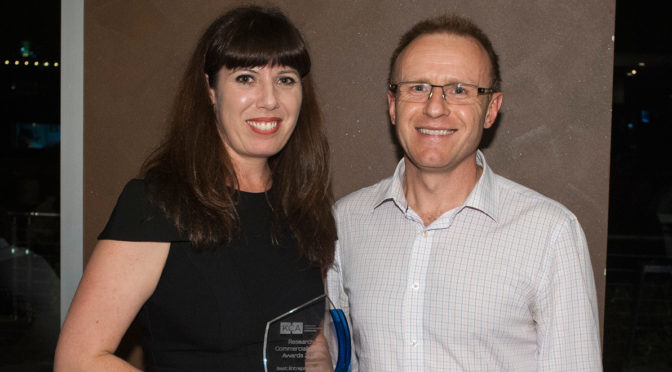
Featured image above: Dr Alastair Hick, KCA Chair and Jasmine Vreugdenburg (UniSA), winner of the Best Entrepreneurial Support Initiative and People’s Choice Award at KCA’s Research Commercialisation Awards. Credit: KCA

The University of New South Wales (UNSW), Curtin University (WA) and the University of South Australia (UniSA) were winners at the Knowledge Commercialisation Australasia (KCA) Research Commercialisation Awards, announced at its annual conference dinner in Brisbane.

Success lay with UNSW which won Best Commercial Deal for securing $20 million capital investment from Zhejian Handian Graphene Tech; Curtin University for the Best Creative Engagement Strategy with The Cisco Internet of Everything Innovation Centre; and UniSA won Best Entrepreneurial Initiative and the People’s Choice Award for its Venture Catalyst which supports student led start-ups.

“These awards recognise research organisations’ success in creatively transferring knowledge and research outcomes into the broader community.  They also help raise the profile of research organisations’ contribution to the development of new products and services which benefit wider society and have the potential that develop the companies that may grow new knowledge based industries in Australia,” says KCA Executive Officer, Melissa Geue.

KCA Chairman and Director of Monash innovation at Monash University, Dr Alastair Hick, says it is important that commercialising research successes are celebrated and made public.

“KCA member organisations work incredibly hard at developing new ways to get technology and innovation out into industry being developed into the products and services of tomorrow. These awards recognise that hard work and also that we must develop new ways of improving the interface between public sector research and industry.

“I am also excited that KCA members are playing an increasing role in helping the entrepreneurs of tomorrow. It is essential that we help develop their entrepreneurial skills and give them the opportunities in an environment where they can learn from skilled and experienced mentors,” says Hick.

Research Commercialisation Awards – winning initiatives

Best Commercial Deal

Zhejian Hangdian Graphene Tech Co (ZHGT) – University of New South Wales (UNSW)

This is an initiative to fund and conduct research on cutting-edge higher efficiency voltage power cables, known as graphene, and on super-capacitors. With $20M capital investment by the Chinese corporation Hangzhou Cable Co., Ltd (HCCL), and UNSW contributing intellectual property as a 20% partner, the objectives are to execute the deal through research and development; manufacturing of research outcomes in Hangzhou; and finally commercialisation.                                                                                                             

Best Creative Engagement Strategy

Cisco Internet of Everything Innovation Centre – Curtin University

The Cisco Internet of Everything Innovation Centre, co-founded by Cisco, Curtin University and Woodside Energy Ltd, is a new industry and research collaboration centre designed to foster co-innovation. With a foundation in radioastronomy, supercomputing and software expertise, it is growing a state-of-the-art connected community focused on leveraging data analytics, cybersecurity and digital transformation network platforms to solve industry problems. The Centre combines start-ups, small–medium enterprises, industry experts, developers and researchers in a collaborative open environment to encourage experimentation, innovation and development through brainstorming, workshops, proof-of-concept and rapid prototyping. By accelerating innovation in next-generation technologies, it aims to help Australian businesses thrive in this age of digital disruption.

Best Entrepreneurial Initiative

Venture Catalyst Program – UniSA

Venture Catalyst supports student led start-ups by providing up to $50k to the new enterprise as a grant. The scheme targets current and recent graduates who have a high tolerance for risk and an idea for a new business venture that is both novel and scalable. The scheme takes an ‘IP and equity free’ approach and encourages students to collaborate with different disciplines and externals to encourage a diverse skill set for the benefit of the new venture. Venture Catalyst is a collaboration between the UniSA and the South Australian Government, and is supported through UniSA Ventures as well as representatives from industry and experienced entrepreneurs.

This year’s Research Commercialisation Awards were judged by commercial leaders of innovation:  Erol Harvey, CEO, MiniFab, Dan Grant, PVC Industry Engagement, LaTrobe University and Anna Rooke, CEO, QUT Creative Enterprise Australia.

About Knowledge Commercialisation Australasia (KCA)

Knowledge Commercialisation Australasia (KCA) is the peak body leading best practice in industry engagement, commercialisation and entrepreneurship for research organisations. They achieve this through delivery of stakeholder connections, professional development and advocacy.

This information was first shared by Knowledge Commercialisation Australasia on 2 September 2016. See all finalists here

Eureka Prize Winners of 2016

Featured image above: Winners of the 2016 UNSW Eureka Prize for Scientific Research, Melissa Little and Minoru Takasato from the Murdoch Childrens Research Institute. Credit: Australian Museum

Regenerating kidneys, smart plastics, artificial memory cells and a citizen science network that tracks falling meteors. These and many other pioneering scientific endeavours have been recognised in the 2016 annual Australian Museum Eureka Prizes, awarded at a gala dinner in Sydney.

Having trouble with a kidney? It may not be long before you can simply grow a new one. This is the ultimate ambition behind the research of the 2016 UNSW Eureka Prize for Scientific Research winners, which was awarded to Melissa Little and Minoru Takasato from the Murdoch Childrens Research Institute.

They have developed a method of growing kidney tissue from stem cells, and their kidney “organoids” develop all the different types of cells that are needed for kidney function. The kidney tissue is currently used in the lab to model kidney disease and to test new drugs, but one day the technique could be developed to regrow replacement kidneys for transplant.

For his work using the latest in 3D printing and materials technology develop a world centre for electromaterials science, Gordon Wallace, from the University of Wollongong, received the 2016 CSIRO Eureka Prize for Leadership in Innovation and Science.

Some of the materials he and his team are developing include structures that are biocompatible, meaning they can be used inside the body without causing an adverse reaction. These structures can be used to promote muscle and nerve cell growth. Other cells include artificial muscles using carbon nanotubes.

The CSIRO’s Lisa Harvey-Smith has been one of the most vocal and energetic proponents of science in the media and the general public, especially amongst Indigenous communities. It is for her work as the face of the Australian Square Kilometre Array Pathfinder (ASKAP) and communicating astronomy to the public that Harvey-Smith was awarded the 2016 Department of Industry, Innovation and Science Eureka Prize for Promoting Understanding of Australian Science.

Have you ever seen a meteor streak across the sky and wondered where it landed? Phil Bland, from Curtin University, certainly hopes you have. He and his team set up the Desert Fireball Network, which allows members of the public to track meteors as they fall, helping them to identify where they land, and where they came from.

For this, Bland and his team were awarded the 2016 Department of Industry, Innovation and Science Eureka Prize for Innovation in Citizen Science.

But not all the awards went to seasoned researchers. Some were reserved for the next generation of scientific pioneers.

Hayden Ingle, a Grade 6 student from Banksmeadow Primary School in Botany, received the 2016 Sleek Geeks Science Eureka Prize for Primary Schools for his video production, The Bluebottle and the Glaucus. It tells the remarkable tale of a little known sea predator, the tiny sea lizard, or glacus atlantica, and its fascinating relationship with the bluebottle.

Speaking of predators, a video by Claire Galvin and Anna Hardy, Year 10 students at St Monica’s College, Cairns, won the 2016 Sleek Geeks Science Eureka Prize for Secondary Schools for exploring the eating habits of the Barn Owl.

They examined “owl pellets”, which contain the indigestible components of the owl’s last meal, and used them to identify its prey.

Other winners of the 2016 Eureka Prize

Ewa Goldys from Macquarie University and the ARC Centre of Excellence for Nanoscale BioPhotonics and Martin Gosnell from Quantitative Pty Ltd have been awarded the ANSTO Eureka Prize for Innovative Use of Technology for their development of hyperspectral imaging technology, which enables the colour of cells and tissues to be used as a non-invasive medical diagnostic tool.

For his discovery and development of novel treatments for serious brain disorders, Michael Bowen, from the University of Sydney, is the winner of the Macquarie University Eureka prize for Outstanding Early Career Researcher. His research has established oxytocin and novel molecules that target the brain’s oxytocin system as prime candidates to fill the void left by the lack of effective treatments for alcohol-use disorders and social disorders.

For developing a new generation of armoured vehicles to keep Australian soldiers safe in war zones, Thales Australia and Mark Brennan have won the 2016 Defence Science and Technology Eureka Prize for Outstanding Science in Safeguarding Australia.

Davidson Patricia Davidson is Dean of the Johns Hopkins University School of Nursing in Maryland, and has mentored more than 35 doctoral and postdoctoral researchers, working tirelessly and with passion to build the capacity of early career researchers, an achievement that has won her the 2016 University of Technology Sydney Eureka Prize for Outstanding Mentor of Young Researchers.

For taking basic Australian research discoveries and developing them into a new cancer therapy that was approved by the US Food and Drug Administration in April this year, David Huang and his team from the Walter and Eliza Hall Institute of Medical Research has win the 2016 Johnson & Johnson Eureka Prize for Innovation in Medical Research. The drug, venetoclax, was approved for a high-risk sub-group of patients with Chronic Lymphocytic Leukemia and is now marketed in the US.

For creating a three part documentary that portrayed both the good and the evil of uranium in a series seen around the world, Twisting the Dragon’s Tail, Sonya Pemberton, Wain Fimeri and Derek Muller, won the 2016 Department of Industry, Innovation and Science Eureka Prize for Science Journalism.

Sharath Sriram, Deputy Director of the A$30 million Micro Nano Research Facility at RMIT University, has won the 2016 3M Eureka Prize for Emerging Leader in Science for his extraordinary career – during which he and his team have developed the world’s first artificial memory cell that mimics the way the brain stores long term memory.

For bringing together a team with skills ranging from mathematical modelling to cell biology and biochemistry, Leann Tilley and her team from the University of Melbourne have won the 2016 Australian Infectious Diseases Research Centre Eureka Prize for Infectious Disease Research. They have uncovered an important life saving mechanism by which the malaria parasite has developed resistance to what has been previously a widely used and successful malarial treatment.

For recruiting an international team of scientists to measure trace elements in the oceans from 3.5 billion years ago to the present day to understand the events that led to the evolution of life and extinction of life in the oceans, Ross Large from the University of Tasmania and researchers from as far as Russia and the US have won the 2016 Eureka Prize for Excellence in Interdisciplinary Research.

For conducting the world’s first survey of plastic pollutants which has given us a confronting snapshot of the impacts on marine wildlife of the 8.4 million tones of plastic that enters the oceans each year, Denise Hardesty, Chris Wilcox, Tonya Van Der Velde, TJ Lawson, Matt Landell and David Milton from CSIRO in Tasmania and Queensland have won the 2016 NSW Office of Environment and Heritage Eureka Prize for Environmental Research.

The Functional Annotation of the Mammalian Genome (FANTOM5) project produced a map that is being used to interpret genetic diseases and to engineer new cells for therapeutic use. The team led by Alistair Forrest from the Harry Perkins Institute of Medical Research has won the 2016 Scopus Eureka Excellence in International Scientific Collaboration Prize.

– Tim Dean

This article on the Eureka Prize 2016 winners was first published by The Conversation on 31 August 2016. Read the original article here.

Career breaks in STEM

Taking career breaks from science, technology, engineering and maths (STEM) jobs can give you an opportunity to re-engage with the workforce in new ways, say industry leaders.

Maintaining support networks, using transferable skills from postgraduate study and setting effective productivity goals are all essential skills in regaining career credibility after time away from work, say highly ranked women leaders at the national Women in STEM summit in Sydney.

Megan Baldwin, CEO and Managing Director of Opthea Ltd, a biotech company specialising in the factors leading to eye diseases, says it’s also important to realise that no one will judge you if you are going to walk out of the office at 5.30 or 6 at night instead of 8pm.

“You will be judged on how well you do your work. There are always a million things on your calendar. And it’s important to build your network, but you also need to learn to say ‘no’ if it’s not directly relevant to you.”

Deborah Rathjen, CEO and Managing Director of drug discovery and development company Bionomic Ltd says there’s lots of opportunity to come back and re-engage with your work after career breaks or shifts, and these are opportunities that can benefit an organisation.

“There are so many paths to having a productive life and a productive career.”

For example, in moving from academia to biotech, the skills she learnt as a postdoc science student, such as networking, were really important, she says.

“If you are on short term contracts with endless grant writing, that kind of grind is quite intense. You’re stuck between a rock and a hard place. Maintaining your networks and maintaining your supporters during this time is really important,” she says.

Taking career breaks in STEM

Career breaks can be anything from family leave to academic sabbaticals or time spent in another industry, all increasingly diverse pathways that are particular true for women working in STEM, the summit heard.

“It costs a lot of money to recruit and train people,” says Rathjen. “If people then resign because the company is inflexible there is lost time and productivity in that. It’s about having links into the community so you can find replacements for short term contracts but also creating the environment so that people feel like they have the ability to return to work.”

IP Australia, the national patent office which employs 400 scientists and engineers, creates this environment through developing flexibility as a “mainstream way of working”.

“Young people who have come to us from the private sector really value flexible time, the ability to take career breaks such as leave without pay, or even taking time off to work in startups,” says Patricia Kelly, Director General of IP Australia. “Developing methods for young people to work in mobile ways makes the workforce more attractive,” she says.

Alison Stone, Deputy Director General of Land and Natural Resources at the NSW Department of Primary Industries says that some people love 9-5 hours, while others “literally work 7 days a week”.

“But everyone has hours dedicated to their family. For me it’s about keeping to your routine, whatever that is.

“Even though I’ve been in government for 30 years I worked in the private sector also. I’ve found that you often have to re-establish who you are.

“One of the tricks I’ve established is to think about how you’d like to come back to work. In those career break experiences, whether that’s having a child or a sabbatical, it’s an opportunity to come back with a defined objective.”

Leadership in women

“Collaborative leadership is critical,” says Rathjen, who heads a company of 140 staff at Bionomics Ltd. “Your business will wither if you don’t collaborate with academia, and industry. A lot of these skills you learn as a postgraduate. Networking and developing links in Australia and overseas was a big opportunity for me that I took into leadership and that progressed me through my career.”

Megan Baldwin from Opthea Ltd adds that the other key message is to recognise that everyone comes from a different perspective.

“You do need to assert yourself though and you need to be comfortable in those shoes. You need to be true to how you want to lead, but also be authoritative.

“But everyone comes with their own life experience and their own priorities and you need to be attuned to that also.”

“One of the best pieces of advice I had was to take time for ‘thinking’,” says Rathjen. “That’s been a life saver for me. Whether that’s strategy or realising I haven’t touched based on a particular project, it’s about freeing up your mind to look at the big picture.”

– Heather Catchpole

Is commercialisation the dark side?

As an avid Star Wars fan I’d like to explore the topic of research commercialisation using terms that a Jedi Knight would recognise.

The Federal Government is seeking a better return on its sizeable investment in research through:

  • better commercialisation of research
  • more engagement between researchers and industry, and
  • changing the requirements for funding for research institutions and the incentives for researchers.

To some, this push for a more commercial and applied approach to research is like the Emperor urging Luke Skywalker to embrace the dark side of the force.

Like a Jedi apprentice, I began my science degree because of my love of science and desire to make a difference. I was not interested in doing a business degree or any degree that would purely maximise my salary prospects.

I chose an honours project close to my heart, involving ‘cis-platinum’ chemotherapy for breast cancer, with which my aunt had been recently diagnosed. Unfortunately the project was given to a student who was less passionate about it, but had a higher grade point average than me.

I was forced to find an alternative project. Seeking something with a practical application, I changed universities and chose a project sponsored by a company seeking a solution to a problem. My honours thesis titled ‘The wettability of rough surfaces’ looked at why roughening a surface could make it more hydrophobic for practical applications in non-stick surfaces.

When I started work at ANSTO, in a role that was half research and half business development, I was tasked with creating a spin-off business involving one of the research instruments.

As I was introduced to other research staff, a term came up that I was familiar with, but not in a work context. Some researchers referred to me as having moved to the “dark side”.  This was said as a joke, but it stemmed from an underlying belief that anyone associated with commercialisation, or engaging with industry regularly, was doing something wrong.

The implication was that there was something suspect about me for being involved in this type of activity, ‘tainted’ by commerce.

Being older and – I’d like to think – somewhat wiser, I now reflect that, had I continued along the pathway of medical research into breast cancer, perhaps I would have made an amazing discovery that could have saved many lives. But for my research to result in a cure would require the involvement of commercialisation experts – the kind of person I have become.

Between a cancer research discovery and a cured patient lies the long and arduous process of commercialisation which requires a team-based approach, where research and commercial staff work collaboratively.

I know now that being responsible for industry engagement, or commercialisation of a project rather than the research, does not mean my work is any less important, pure or noble. I’m using my strongest skills in the best way to have a positive impact for humanity, in my own way.

Commercialisation experts are not the Sith, we bring balance to the force by forging new Australian industries and actively training young researchers in the ways of industry, for research alone cannot achieve a better future.

I believe commercialisation is not the Dark Side, it is A New Hope.

– Natalie Chapman, Managing Director, gemaker

commercialisation

Natalie Chapman is a commercialisation and marketing expert with more than 15 years of experience turning innovative ideas and technologies into thriving businesses.

She co-founded her company gemaker in 2011 after almost a decade leading business development and marketing projects at ANSTO and, in 2013, won a Stevie Award for Female Entrepreneur of the Year in Asia, Australia and New Zealand.

Natalie specialises in mining, new materials, environmental and ICT technologies. She takes technologies from research through to start-up, assisting her clients with commercialisation strategy, building licensing revenue, securing funding grants, tenders and engaging with industry.

Natalie also heads corporate communications at ASX-listed mining and exploration company Alkane Resources and is responsible for attracting investment, government relations and marketing communications.

Natalie has a Bachelor of Science with honours (Chemistry) from the University of New South Wales and a Master of Business Administration (Marketing) from the University of Wollongong.

Innovation breathes new life into old business

Featured image above: the Minister of Industry, Innovation and Science delivering his address at the AFR National Innovation Summit 

Innovating isn’t just about creating new businesses – it’s also about transforming the old.

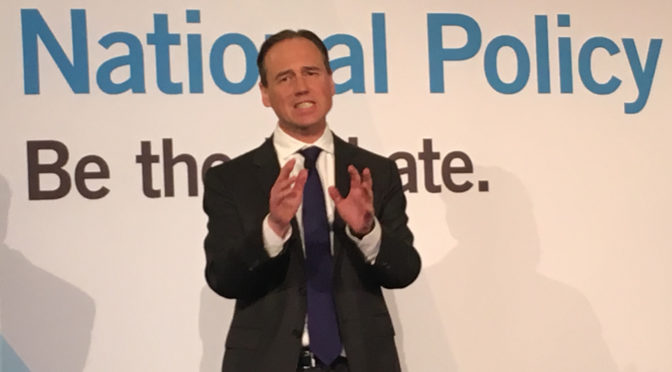
This message formed the crux of the Hon Greg Hunt’s speech at the Australian Financial Review’s 2016 National Innovation Summit as he presented plans for his portfolio as Minister for Industry, Innovation and Science.

“Innovation is about the new firms absolutely, unequivocally…but also the existing firms,” said Hunt, insisting that the latter should be innovating through “new or improved goods or services, new processes or new business models.”

Pointing to Dulux, CSL, Telstra and BlueScope as examples of Australian veterans who are thriving through investments in R&D, the Minister warned that less-savvy business won’t be bailed out.

“We can’t prop up existing, failing services,” he said. “They have to be able to compete.”

The need for speed

According to other leaders at the AFR Innovation Summit, the window of opportunity is closing for some of Australia’s oldest and largest corporations.

Data61 CEO Adrian Turner says he returned to Australia after 18 years in Silicon Valley because he was concerned about Australia’s pace of change. He believes Australian businesses don’t have long to get on board the age of digital and data-led markets.

“We have a five to 10-year window,” says Adrian.

Chairman of the Australian Advanced Manufacturing Council, John Pollaers, pointed out that although the world has moved into the fourth industrial revolution – the merging of the physical and cyber worlds – many companies are still working their way through the second and third industrial revolutions of electrification, automation and IT.

“If we underestimate technology we will fail,” says Pollaers. “If we underestimate the resistance to change and innovation, then we’ll also fail.”

Maile Carnegie believes companies need to stop ‘hand-wringing’ and start taking action.

“Our financial institutions, if we don’t get them moving, are in for a world of hurt,” says the former Google MD, who recently joined ANZ as Group Exec of Digital Banking. “Banking is a massive data play – those industries are getting disrupted.”

“We know what we need to do so we need to move the conversation to doing it…At the end of the day strategy is all about making some choices.”

So how can old businesses achieve innovation?

“Fail fast, fail cheap, pivot,” suggests Suzana Ristevski, Chief Marketing Officer and Head of Strategy & Growth for GE Australia, New Zealand and Papua New Guinea.

With speed and agility considered vital to innovation but difficult in large businesses, CommBank has turned to partnering with startups.

“They have the agility, we have the scale, so it’s a pretty great marriage,” says Tiziana Bianco, head of the CommBank’s Innovation Lab.

Corporate law firm Gilbert and Tobin have also invested in ‘self-disruption’ to avoid becoming obsolete, positioning themselves as a ‘market disruptor’ and increasing their stake in startup LegalVision to 20% at the start of August.

BHP Billiton, who was forced to cut its dividends by 75% in February this year, has moved to a five-point plan (see The big three drivers to job growth).

  1. Hastening production
  2. Accelerating technology competencies
  3. Creating innovation hubs to address innovative solutions to specific challenges
  4. Setting up programs to build from the inside the company
  5. Forging partnerships with unis, CSIRO, and CRCs

When asked at the AFR Innovation Summit what would happen to jobs if they innovated through automation, BHP’s CTO Diane Jurgens said her company is upskilling existing workers; taking them off machinery and teaching them to operate machines from the safety of a control room.

Group CEO & Managing Director of Domino’s, Don Meij, told the summit’s audience that if we don’t take our skills ‘upstream’ in this way, we will simply miss out on the market altogether.

– Elise Roberts

Research commercialisation is push and pull

‘It’s not me, it’s you’, is the message from universities to industry in terms of success in partnering and commercialisation of research and development.

Dr Leanna Read, Chief Scientist of South Australia and the founder and former CEO of TGR BioSciences, says universities are unfairly “bagged” for not pulling their weight in collaborating with industry and in fostering the development of research commercialisation partnerships.

“Our surveys have shown there is a strong interest in commercialisation and a willingness [in university research] to engage with industry,” she told the Australian Financial Review’s Innovation Summit in Sydney today.

“One of the issues is the nature of our industry sector. We are dominated by small to medium enterprises and we tend to be low in the level of innovation happening at this level. We have a problem here where research has all the will in the world to knock on doors of industry – the trouble is they’re not going to get a terribly good reception,” she says.

“We need to grow an innovative culture in these companies.”

TGR BioSciences focuses on drug discovery assay technologies and applies its core skills in cell biology to the development of new biodetection technologies.

Universities willing to engage

Emeritus Professor Jim Piper AM, President of Science and Technology Australia, and previously from Macquarie University, says there is a “high awareness” in universities to “encourage commercialisation”.

“There are impediments, however.

“One of the issues is the silo-isation of research which has been aided and abetted by the funding mechanism of universities.”

Many people forget that the university system is a service industry driven by international reputation, Piper points out. International students choose universities based on their impact factor and international reputation, and Australian universities rely heavily on liquidity from international students.

Shifting to a focus towards research commercialisation-based funding, or key performance indicators based on partnership success, the so-called ‘partner or perish’ is a massive shift in this context, he says – but one that universities are willing to make.

“One thing you can say about university researchers is they really chase the money. If that is in collaboration, then that is where they will chase it.

“One of the issues with unis is that, in most cases, commercialisation officers don’t have critical mass and there are challenges.”

For example, there are challenges in sharing and applying intellectual property (IP), he says.

“At Macquarie University, students at the start are invited to assign their intellectual property rights to the university so the uni can negotiate on their part. Often [in other universities] students keep their IP and this can be very complicated,” he told the summit.

Practice makes perfect

The problem may lie in experience in negotiations, says Professor Ian Frazer AC, Chair of the Medical Research Future Fund and inventor of the cervical cancer vaccine.

“We probably aren’t experienced enough at this negotiation [between academia and industry],” says Frazer. “There are excellent examples of industry-uni partnerships working, but there needs to be a lot of talk to make this happen.

“We’ve got to change both sides of the equation, for industries and universities. For example, the health sector relies on unis to provide input to research. We need to ensure that there is engagement between health researchers and industry, but industry needs to realise that research is critical to what it does,” he says.

Dr Steve Jones, global head of research and development at Australian R&D spin off cancer company Sirtex – a medical device company providing a radioactive treatment for inoperable liver cancer – agrees that universities have “had a rough ride” to make dramatic changes to the way they incentivise research to promote collaboration and research commercialisation.

Sirtex has approached universities to work on research but found that it worked best when they had an identifiable problem to take to the researchers, he told Science Meets Business.

Unis have work to do too

Read acknowledges that universities also have work to do, with funding for projects traditionally focussed on research project grants rather than looking to the issues faced by customers, the business approach controversially emphasised by CSIRO CEO Dr Larry Marshall, who also spoke at the summit.

“We need more of a ‘what is the problem and how do I solve it’ approach – this is what Cooperative Research Centres do well and we need more of that kind of research,” says Read.

More pull less push towards research commercialisation

Chief Defence Scientist Dr Alex Zelinksy says any successful negotiation “needs to be win-win” for both university and industry.

“There is a push and a pull element. There is a pioneering spirit (do it yourself) rather than an entrepreneurial spirit in terms of business and commercialisation of research. We need everyone to come together.”

He agrees that one of the barrier is around intellectual property. “Access to IP needs to be on fair and commercial terms.”

– Heather Catchpole

Read more: Collaborate or Crumble

What are the big three drivers to job growth?

Increased collaboration, stability of policy and acceleration of commercialisation are three main drivers of innovation and job growth that must be addressed to accelerate Australia’s economy in the next 15 years.

The top three drivers were identified at the AFR National Innovation Summit today by Chairs of the boards of Telstra, BHP Billiton and Innovation and Science Australia.

The panel warned that fears around the effects of disruption on jobs must be part of the conversation, and that the effects of digital disruption through automation, and artificial intelligence were inevitable.

This disruption will affect people and jobs whether they are “in Woomera or Sydney”, says Bill Ferris, Chair of the board of Innovation and Science Australia.

“In five years we’ve seen the rise of Uber and Instagram, and the collapse of the mining boom. What is coming towards us will dwarf the change of pace [in disruption] to date,” says Dr Nora Scheinkestel, Chairman of Macquarie Atlas Roads and Director of Telstra Corporation and Stocklands Group.

Policy and R&D tax incentives

Crucial to Australia’s ability to innovate is the stability of policy such as the R&D tax incentive, which aims to encourage private investment in Australian R&D.

Along with Chief Scientist Alan Finkel, Bill Ferris was part of a team that reviewed the incentive for government to evaluate how much investment the incentive has created and the scheme’s effectiveness.

“I agree it is valuable and should be continued,” says Ferris. “Can it be improved? I think so. It’s been a $3 million cheque and the largest there has been. But there is nothing in the scheme that requires collaboration, whether CSIRO or academia.”

Incentivising collaboration is a no-brainer next step, says Ferris.

“I don’t think business is trying as hard as academia. Universities are getting on with business, creating spin-offs like QUT’s Spinifex, and Ian Fraser’s cancer vaccine. It’s very impressive.”

Stability of the R&D investment scheme is key to its success, says Carolyn Hewson AO, Director, BHP Billiton, Stockland Group and Federal Growth Centres Advisory Committee.

Hewsen says BHP Billiton was ‘deeply’ affected as a company by the collapse of the mining boom this year. “Every company is under pressure to innovate.” (See “How big companies can innovate)

“There is a role for government to address the KPIs they set around research funding.

KPIs need to move to speed of commercialisation rather than publication in tier 1 journals.”

“My concern is it is very easy for government with 3-year time horizon to make decisions on funding over a long term investment. Research projects extend out many years. To be subject to be changing regulation of government regulated by short-term political cycle is very worrying.”


How big companies can innovate

– Carolyn Hewson AO, Director of BHP Billiton, Stockland Group and Federal Growth Centres Advisory Committee

  • Hastening production
  • Accelerating technology competencies
  • Innovation hubs working to address innovative solution to specific challenges, eg. automation of trucks and drills
  • Step-up programs to build from the inside of the company
  • Partnerships with universities and CSIRO, CRCs on engineering and remote operations

Collaborate and commercialise for job growth

Ferris is optimistic about Australia’s ability to respond to the challenge to grow jobs by 2030. Agribusiness, aquaculture, cybersecurity, environmental services, renewables, and new materials were all strong potential job growth areas, he says.

“A lot more work needs to be done by business on reaching in. If we can’t commercialise around our inventiveness we won’t create the jobs that we could and that we deserve.”

Scheinkestel says the ecosystem is essential to drive innovation and job growth.

“The big message from Israel is the ecosystem created between business and academia, and in their case the military, where young people are taught strong leadership skills. They commercialise or adapt tech they have been looking at, get the backing of VC, which are supported by consistent policies from government around tax regimes.

“Again in Silicon Valley, you are talking about an ecosystem, a constellation of start-ups with shared resources and again consistency in policies and tax incentives.”

Hewson agrees that work skills are essential to our future and that there is concern about workforce skills in Australia across a number of advanced manufacturing, mining and medical sectors.

“We want to enhance global competitiveness and build on strategic collaboration within these sectors,” she says.

“It’s not just about growth, it’s about survival,” adds Scheinkestel.

Heather Catchpole

Science graduates high risk or high reward?

The employment prospects of science graduates are called into question by a report published by the Grattan Institute.

Studying science will get you a job – just not the job you might expect.

Industry and high placed academics have decried the results of a report declaring science to be a ‘high risk’ degree.

Such results fail to represent career prospects for those working outside of traditional science roles, say a cohort of Australia’s leading science experts.

Last week the respected Grattan Institute think tank’s Mapping Higher Education report warned that science was a ‘high risk’ study choice and that many recent science and information technology graduates are failing to find full-time work.

It’s not wrong, but it is near-sighted, say university and industry experts.

The report, released last week, concludes that a bachelor science degree is “high risk for finding a job” with “poor employment outcomes”, warning 51% of science graduates looking for full-time work in 2015 had found it four months after completing their course, 17 percentage points lower than the national average.

There has been a 20-year decline in participation in science at college.

But thinking of science as a one-track path to the lab fails to take into account the broader benefits of a science degree, says Minister for Industry, Innovation and Science, Greg Hunt.

Professor Les Field, Senior Deputy Vice-Chancellor of UNSW Australia and Secretary for Science Policy at the Australian Academy of Science, says STEM-based education gives students a “versatile, flexible, problem-solving, technology-literate grounding, which is what you need for life and employment in the modern world”.

Science graduates have higher rates of employment

The Chief Scientist’s March 2016 report, Australia’s STEM workforce, shows that over the medium term, people with STEM qualifications have higher rates of employment than graduates from other disciplines, Field points out.

“A survey of 466 employers across various sectors [STEM Skills in the workforce: What do employers want? March, 2015] have also shown that many employers expect to employ many more STEM graduates over the next five to 10 years, and around a quarter are already struggling to recruit people with appropriate STEM qualifications,” says Field.

“There is some mismatch between employer requirements of STEM graduates and the skills and experience with which they are coming out of universities. We should advocate that more industry placements and internships form a stronger part of university education.”

“Not a lot of opportunities”

Zara Barger, a first-year biomedical engineering student at the University of Technology, Sydney (UTS) admits that she is “a little worried” about her prospects. “In Australia it seems as though there is not a lot of opportunities. As part of my degree I have to do two 6-month internships and I think that will give me insight and connections.”

Alecia Newton, a UTS Bachelor of Science student, agrees. “I’m a little bit concerned. I’m planning on getting some experience by volunteering so fingers crossed that will get me a job. But science is a good starting ground – it will give me good knowledge and if it doesn’t work out I will do a Masters in high school teaching,” she says.

Grattan report “surprising”

“It’s surprising to see the Grattan Institute’s claims that are contrary to other reports both here and overseas,” says Jackie Randles, state manager for Inspiring Australia, the Federal Government’s national strategy for engaging communities in STEM.

“The World Economic Forum estimates that 65% of children entering primary school today will ultimately end up working in completely new job types that don’t yet exist. By 2020, more than a third of the core skill sets of most occupations will be those that are not yet considered crucial today and likely to involve STEM,” says Randles.

“Closer to home, Australia’s STEM skills shortage continues to be a major risk to our economy with business joining government and academics in calls to redress a worrying skills gap.”

Graham Durant, Director of Questacon, the National Science and Technology Centre, says graduates with a “good science degree and a balanced portfolio of skills, knowledge and abilities will continue to have good employment prospects but not necessarily as academic researchers.

“The STEM disciplines, including art and design provide very good training for the world of work but degrees should not be regarded as vocational training. A good background in STEM disciplines opens up many opportunities in careers that may not necessarily be regarded as STEM careers.”

Professor Merlin Crossley, Deputy Vice-Chancellor of Education at UNSW and former Dean of Science agrees that the longer term prospects for science graduates are excellent.

“With slightly more people studying science, obviously slightly fewer people will get jobs at once. Science still provides opportunities – all doors remain open to science graduates.”

Heather Catchpole

Biophotonics pioneer

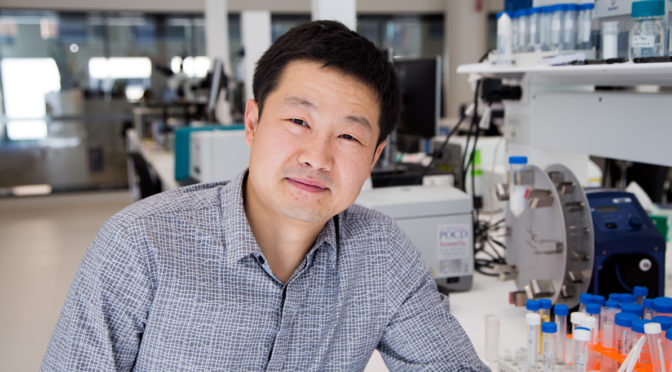
Featured image above: biophotonics Professor Dayong Jin. Credit Vanessa Valenzuela Davie

Professor Dayong Jin envisions a future where portable diagnostic devices will be as ubiquitous as smartphones, where scientists can peer inside individual cells, and where diseases can be detected before they infect our bodies.

A pioneer in the emerging field of nanoscale biophotonics at the University of Technology Sydney (UTS), it’s a future Jin is working hard to create.

“The nanoscale is really the fundamental level on which biological molecules operate,” he says. “It’s the scale of the original disease.”

Jin engineers functional nanoparticles – invisible to the naked eye – which harness light to probe our cells, detect diseases and deliver drugs in perfectly measured doses.

Transforming the biomedical industry with biophotonics

Jin was recently named the Director of a new A$3.7 million Australian Research Council Industrial Transformation Hub. The hub’s objective is to develop portable diagnostic devices with vastly improved detection capabilities.

These easy-to-use devices, which incorporate nanomaterials and photonic technologies developed by Jin and his colleagues from UTS and the University of South Australia, can analyse incredibly small samples of substances including breath, saliva, urine and blood, to find markers of disease.

Jin says these point-of-care technologies will ease the burden on hospitals and align with the demands of consumers: real-time health monitoring, and faster treatment options.

“In the near future, prostate cancer patients who have gone into remission will have a handheld device at home to analyse their urine samples,” he says. “It will be able to tell them whether their cancer is recurring.”

The hub is also working with industry partners to develop an improved roadside breath-testing device for police forces to detect traces of illicit drugs.

Over its five-year lifespan, Jin expects the hub to generate a number of new portable diagnostic devices, which can be tailored to specific applications to detect everything from cancers to infectious diseases and environmental pollutants.

Super Dots diagnose diseases inside the body

Jin is also helping improve disease diagnosis from inside the body itself.

Cancers and infectious disease outbreaks all originate from a single cell, he says.

“The current challenge is that we don’t have a method to find this very rare cell from the earliest stage.”

Jin was part of an Australian research team that developed a technology known as Super Dots, which won a prestigious Eureka Prize in 2015. These nanoparticles can find a needle in a haystack, detecting individual diseased cells from a population of millions.

The particles are made from a nanocrystal material that can absorb invisible infrared light and emit higher energy, visible light, says Jin.

Once the nanoparticle has found the target cell inside the body, or a blood sample, it can be stimulated by researchers with a harmless, skin-penetrating infrared light.

The dot then emits a visible flash, which causes the diseased cell to light up.

“It’s like you have the diseased cell glowing in the darkness,” says Jin. “This allows you to achieve the ultimate detection sensitivity.”

Beyond medicine, Super Dots can be encoded with “secret signatures” and used for the anti-counterfeiting of passports, banknotes and drug labels, says Jin.

There are also applications for more efficient solar cells and 3D display screens.

Biophotonics pioneer featured video above: Superdots, WINNER 2015 Eureka Prize for Excellence in Interdisciplinary Scientific Research.Credit: Australian Museum.

Breaching the blood-brain barrier

Jin is hopeful that another class of his nanoparticles will serve as a versatile drug delivery vehicle, capable of breaching the protective blood-brain barrier.

Delivering drugs to individual neurons in the brain is a “holy grail problem” in neurological research, says Jin.

“There are many drugs already developed to treat Alzheimer’s and Parkinson’s quite effectively outside the body,” he says. “But the blood-brain barrier prevents more than 99 per cent of drugs from accessing the brain from the blood circulation system.”

Jin and his colleagues have created a library of 800 types of nanoscale drug carriers with specific shapes, sizes and surface functionality. Importantly, they have developed a process to replicate these carriers exactly, according to any design.

“We’ve solved the problem in terms of developing the material,” he says.

“If the tailored drug carrier can tell the blood-brain barrier that the carriers are the friend and not the enemy… we can open a gate into the brain.”

Super-resolution microscopy breakthrough

biophotonics

Super resolution image of the single cell nuclear membrane pores. Credit: Professor Dayong Jin.

Jin’s research has led to a recent breakthrough in the field of microscopy.

With colleagues at Georgia Institute of Technology in the US and Peking University in China, Jin has developed a simple but highly effective way to see individual cells in 3D – overcoming a major barrier. Instead of growing cells on transparent glass slides, the team grew their cells on specialised mirrors. As reflected light passed through the cell while being viewed under a super-resolution microscope, researchers could see new structures in exquisite detail.

“This simple technology is allowing us to see the details of cells that have never been seen before,” says Jin. “We can see the tiny little hole on the cell nucleus’ membrane – that hole is the entrance and exit for single molecules.

“When the cell wants to express a signal, or send a message outside the cell, this is the gateway – and we now have the tool to see what that looks like.”

By understanding how cells behave, communicate and how diseases arise inside them, researchers can develop more effective treatments.

Jin and Professor Peng Xi from Peking University hold a patent for their invention, and Jin says they are currently exploring opportunities to commercialise the technology with leading imaging companies such as Olympus and German firm Leica.

Multiculturalism trumps geography for Australia

It was love that brought Jin to Australia from his home in northeastern China, near the border with inner Mongolia. His future wife, Lisa Li, came to Sydney to study accounting in 2002, and he followed.

Jin ended up at Macquarie University in the laboratory of Dr Jim Piper, a renowned expert in lasers, optics and photonics. Under his guidance, Jin developed a system to detect trace amounts of pathogens in water.

Jin says the postgraduate scholarship in Australia was more comprehensive and generous than what was offered to his Chinese peers who chose to study in the US.

Jin says he and his family had planned on returning to China or finding a postdoctoral position in the US after his PhD, but ultimately decided to stay in Australia.

He says the decision has been good for his career: “Geographically, Australia looks like it’s isolated,” he says. “But we are actually well connected.

“The Australian research community is very multicultural, and these ‘soft connections’ have created a lot of opportunities for my research collaborations.”

Jin says multidisciplinary knowledge and collaboration is vital to realising the healthcare future he envisions – and going even further beyond.

In addition to his many breakthroughs in biophotonics, one of the prospects Jin is most excited about is that of truly personalised medicines.

At present, people with the same diseases are all treated with the same drugs, which might be totally ineffective for a proportion of the population, says Jin.

“But future medicines will have a tool to decode the unique molecular signature of a patient,” he says.

It means when two people have the same disease, they could be treated remarkably differently – with dramatically improved outcomes.

This is where we’re heading, he says.

– Myles Gough
This article on the biophotonics pioneer, Professor Dayong Jin, was first published by Australia Unlimited on 9 August 2016. Read the original article here.

Diagnosing dysphagia without radiation

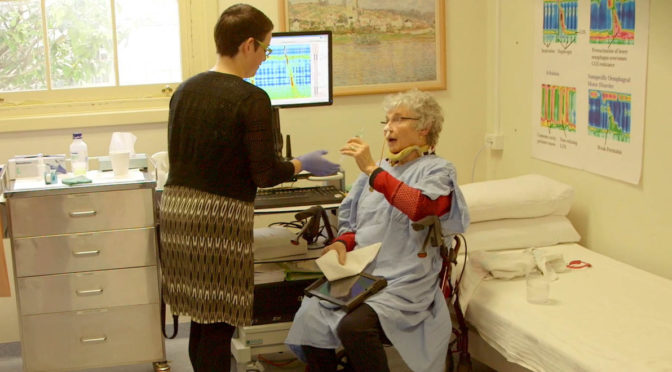
Featured image above: research nurse Alison Thompson diagnosing dysphagia using the AIMplot software with a Motor Neurone Disease patient.

AIMplot Collaborative Software was developed by researchers from Flinders University in South Australia to give clinicians the ability to accurately assess patient swallowing at the bedside.

AIMplot developer Taher Omari says the new program was a standard above contemporary techniques because current methods involved x-rays, which took a long time to process and exposed patients to radiation.

“If you are looking at x-rays you are not actually measuring anything you are just visualising what is happening. What our method is doing is putting some numbers onto that,” he says.

“The analysis simplifies it for clinicians and allows them to get some immediate results that tells them how well someone is swallowing.

“The big advantage is that it doesn’t require radiology, you don’t’ need exposure to x-rays. Our technique can be done at the bedside and you can take the system to the patient and get a measurement done in a ward.”

Clinicians use a highly robust catheter with multiple pressure sensors placed along the length of the tube to measure muscle contractions and pressure flow.

The catheter is introduced via the naval cavity until it reaches the upper oesophagus sphincter and then patients are given a variety of different substances to swallow.

Data is immediately sent to a computer with the AIMplot software installed and the information is translated into a simple analysis.

Clinicians can determine whether the problem is muscular, related to the nervous system or if there are any blockages in the throat.

Dysphagia or difficulty swallowing, is a common symptom for people who deal with neurological conditions such as strokes, motor neuron disease and Parkinson’s Disease.

According to the World Gastroenterology Organisation stroke is the leading causes of dysphagia and are present in up to 67%of patients.

“Normally you need about three or four people to get the assessment. But with our biomechanical method you can do (the procedure) with just one or two,” says Omari.

“You are measuring the swallowing biomechanics as a opposed to just looking at images.”

diagnosing dysphagia

Associate Professor Taher Omari with the AIMplot software

The new software for diagnosing dysphagia is currently being trialled by three major medical centres: Saint George Hospital in Sydney, University Hospitals Leuven in Belgium and Flinders Medical Centre in South Australia.

Omari says a commercial version could be available internationally within the next six months.

Dr Charles Cocks who is a gastroenterologist at Flinders Medical Centre says dysphagia affects about 60% of nursing home residents worldwide and AIMplot could help accurately differentiate different cases.

“The contemporary methods are open to interpretation whereas this (AIMplot) is a lot more objective,” he says.

“It’s quite simple once you know how to interpret it. It’s also very reproducible. If you take it from here to somewhere else, other people will get the same results.

“Including the x-rays, it (a contemporary method) takes about 45 minutes. With the software we can do the analysis in about 15 minutes. I definitely think this is the way to go – this is the way of the future in terms of ease and accuracy of diagnosis.”

– Caleb Radford

This article about diagnosing dysphagia was first published by The Lead on 9 August 2016. Read the original article here.

NASA’s Women in STEM

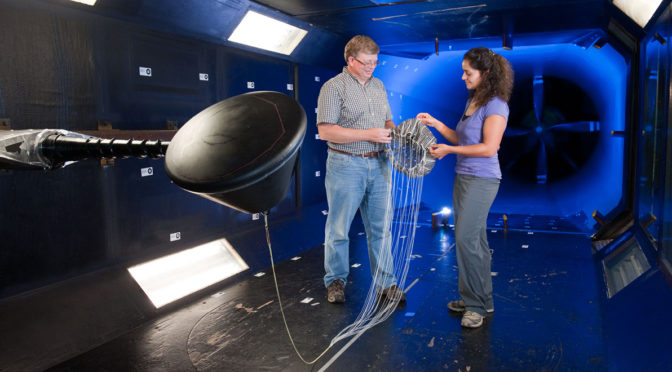
NASA’s Women in STEM featured image above: Anita Sengupta and Donn Liddle stand with a subscale test model of NASA’s Orion spacecraft and its parachute in the low-speed wind tunnel at Texas A&M University. The Orion spacecraft is being designed to take humans farther into space than ever before. Credit: NASA/James Blair

It’s not often that the lead characters in a blockbuster film have careers as particle physicists and nuclear engineers – and even less often that those roles are played by women. But the new “Ghostbusters” film, which features an all-female team of scientists and engineers, busts not just ghosts, but also some of the tropes about what it means to work in science, technology, engineering and maths. It’s an idea that has scientists and engineers at NASA’s Jet Propulsion Laboratory (JPL) excited about how it might inspire the next generation.

So if they don’t spend their days bustin’ ghosts, what do JPL’s “Ghostbusters” do? Here are the stories of three of NASA’s women in science and engineering at JPL whose jobs, much like their “Ghostbusters” counterparts’, are to explore new realms, battle invisible forces and explain the mysteries around us.

Meet NASA’s Women in STEM


The Leader: Anita Sengupta

NASA women

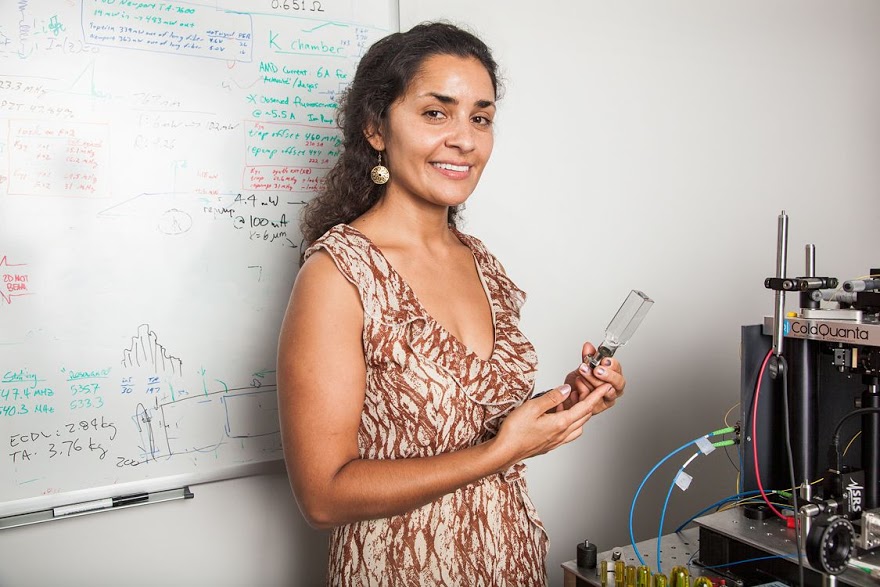
Anita Sengupta at JPL. Credit: JPL, NASA

Job title:

Project Manager, Cold Atom Laboratory

What she does:

In a team of professional ghostbusters, Anita Sengupta would most certainly be the enthusiastic and multi-talented leader. She’s already taken on roles developing launch vehicles, the parachute that famously helped land the Mars rover Curiosity, and deep-space propulsion systems for missions to comets and asteroids.

NASA’s Women in STEM featured video above: Sengupta and other members of the entry, descent and landing team for NASA’s Mars rover Curiosity discuss the nail-biting details of the August 2012 landing.

Most recently, she’s carved out a niche as the project manager for an atomic physics mission, called the Cold Atom Laboratory, or CAL.

Since the mission was proposed in 2012, Sengupta has been leading a team of engineers and atomic physicists in developing an instrument that can see the unseen. Their mission is to create an ultra-cold quantum gas called a Bose-Einstein condensate, which is a state of matter that forms only at just above absolute zero. At such low temperatures, matter takes on unique properties that seemingly defy the laws of thermodynamics.

To achieve the feat, the team’s device will be installed on the International Space Station in July 2017, where the microgravity of space will keep the Bose-Einstein condensate suspended long enough for scientists to get a look at how it behaves. Observing this behaviour could lead to groundbreaking discoveries, not least of which is a better understanding of how complexity arises in the universe. The facility could also provide new insights into gravity, super fluidity and dark-matter detection.

“We are opening the doorway into a new quantum realm, so we actually don’t know what we’re going to see,” says Sengupta. “That’s what’s so exciting. It’s about discovery.”

Career trajectory:

Sengupta’s career has been defined by her unique ability to take on challenges in new realms of science and engineering. It’s a trait that closely mimics the fictional character who inspired her as a child: Doctor Who.

“I saw the character of the doctor, who was this very eccentric, but loving, kind and brilliant person,” says Sengupta.

“I decided I would like to be a person who travels in space, who understands and can apply all fields of science and engineering. That motivated me to be involved in space exploration and, of course, get my doctorate.”

After considering majors in astrophysics, astronomy, biology and aerospace engineering, she settled on aerospace engineering because, she says, “I loved fixing things, and the idea of knowing how to build spacecraft just blew my mind.”

She doesn’t regret the decision. It seems she would have stretched the boundaries of whichever path she chose. Currently, she’s serving multiple leadership roles on the Cold Atom Laboratory team while also teaching astronautical engineering classes as an associate professor at the University of Southern California. And she still manages to carve out time for her other passions, which include driving sport motorcycles, snowboarding and flying planes.

On STEM in pop culture:

“It’s important for young people to understand that to be an intellectual or a scientist does not necessarily correspond to being socially awkward or geeky,” says Sengupta. “You have all varieties of people.”

“A lot of people at JPL are musicians or athletes or I’m a motorcyclist. There are people who have these hobbies and interests outside of doing something traditionally nerdy, so it’s a disservice to STEM to paint people in any particular light.”


The Engineer: Luz Maria Martinez Sierra

NASA Women

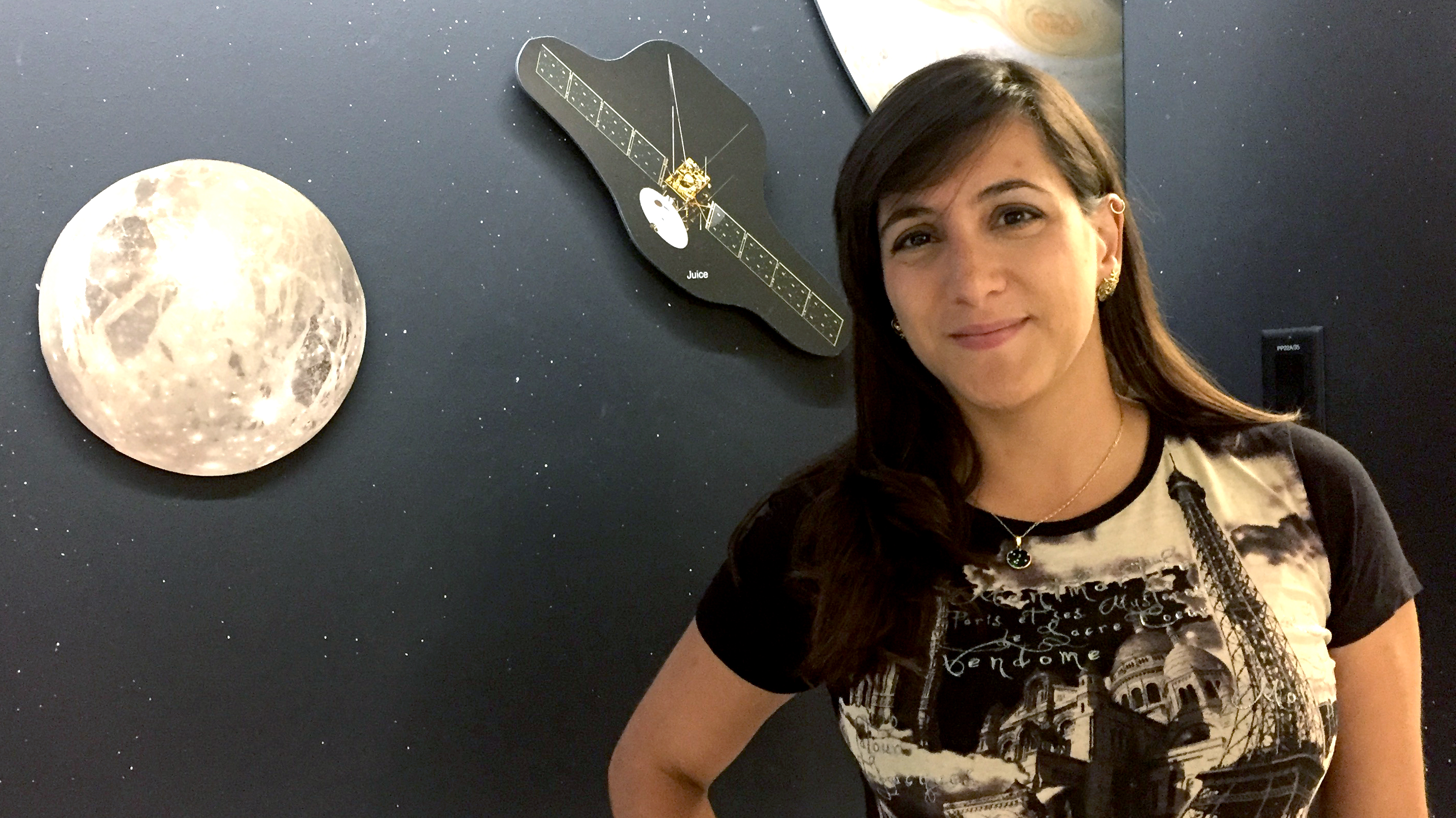
Luz Maria Martinez Sierra at JPL. Credit: JPL, NASA

Job title:

Technologist, Natural Space Environments

What she does:

As a nuclear engineer, Luz Maria Martinez Sierra has never built a ghost-bustin’ proton gun, but she does design defences against invisible forces. In her case, it’s protecting spacecraft from the intense radiation around planets like Jupiter.

“Space is a very hostile environment, and there are a lot of particles and radiation that can be very dangerous to the spacecraft,” says Martinez Sierra. “It’s very important to make sure everything is shielded accordingly, so we run all these simulations to determine, ‘Ok, you will need to protect this and you need to make sure this survives by putting it behind the solar panels.’”

NASA’s Women in STEM featured video above: Part of Martinez Sierra’s work is designing radiation defense systems for spacecraft like the one created for the Juno mission shown in the animation above. Juno arrived at Jupiter on July 4, 2016 and will fly closer to the planet – and its intense radiation – than ever before. Credit: NASA/JPL-Caltech

In addition to shielding spacecraft against radiation, she designs devices that can analyse it to reveal hidden details about planets, moons and other bodies. By looking at the radiation signatures of these bodies, scientists can better understand what they’re made of and whether they might be home to, for example, the ingredients for life.

Career trajectory:

To the unacquainted, a career in nuclear engineering might seem oddly specific, but Martinez Sierra is quick to point out just how many applications it has, even just at NASA. Nuclear engineers might design systems to protect astronauts venturing to places like Mars, build instruments to study the sun and other stars, or work with spacecraft powered by radioactive materials.

For her part, the career path evolved through a love of physics that traces back to high school in her native Colombia.

“I always loved science, even at a young age,” says Martinez Sierra. “And when I took physics in high school, it just clicked. I loved how everything could be described by physics.”

She started attending local astronomy events and later earned a bachelor’s and master’s degree in engineering physics. In 2014, she was accepted into an internship with the laboratory’s Maximizing Student Potential in STEM program, which “taught me how to be part of a working environment, solving problems with a team and making sure that I belonged in this field,” she says.

Soon after Martinez Sierra was hired on at JPL, she parlayed her internship experience into a mentorship role with the National Community College Aerospace Scholars program.

NASA's Women

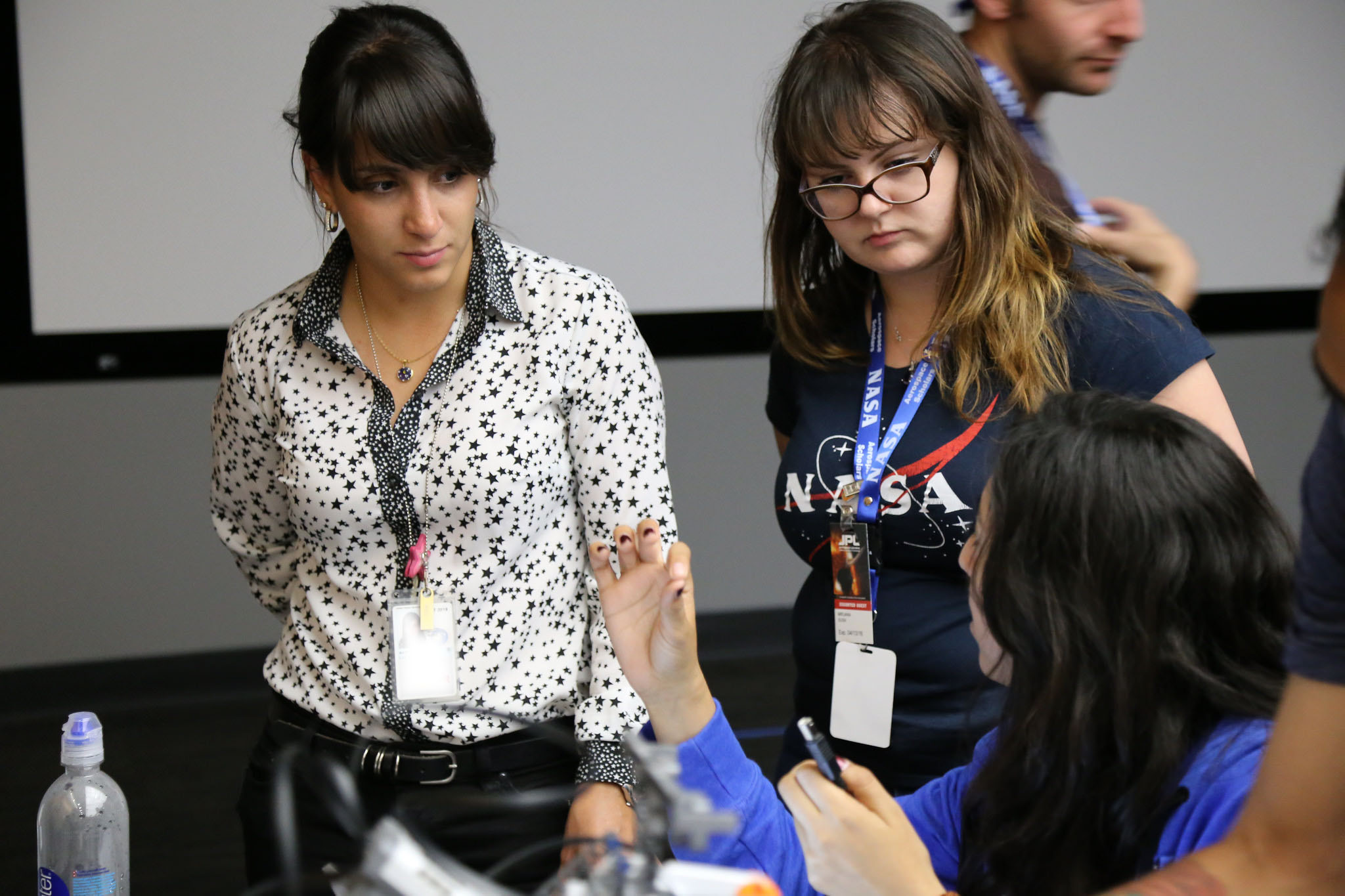
Martinez Sierra mentors a team of students competing in a Mars rover challenge as part of the National Community College Aerospace Scholars program. Credit: NASA/JPL-Caltech/Lyle Tavernier

“I see myself in them,” says Martinez Sierra of the students she mentored during the program.

“I was lost. I didn’t know what I wanted to study or what I wanted to do in my career or how you go from being in college to being a professional. You don’t see that connection easily. It’s important to help students realise it’s not just magic. You have to pursue it. You have to be proactive.”

That she is. On top of her full-time job and serving as an occasional mentor for students, Martinez Sierra is also earning her doctorate in nuclear engineering.

On STEM in pop culture:

“There are so many different types of engineers and scientists, even at JPL,” says Martinez Sierra. “But they’re always portrayed as the same person in movies and TV shows. I like how in the new ‘Ghostbusters’ movie, the characters are portrayed as these cool people. They’re not boring. They get to play with cool toys and make cool things.”


The Scientist: Jean Dickey

NASA's Women

Jean Dickey in her office at JPL. Credit: JPL, NASA

Job title:

Scientist, Sea Level and Ice

What she does:

While the applications have evolved over her 36-year career at JPL, Jean Dickey’s specialty has always been explaining the mysteries that surround us. Her research focuses on the forces and processes that affect our home planet – everything from Earth’s gravity to changes in length-of-day to its evolving climate. She has published more than 70 papers, which include findings of a possible molten core on the moon and a method for predicting the variations in Earth’s rotation.

“Right now, I’m looking at changes in sea-level rise using data from the Jason and GRACE Earth satellites. There are pockets of warm ocean that explain why Earth’s sea-surface temperature was increasing at a lower rate,” says Dickey, referring to a previously unexplained hiatus in the otherwise strong uptick in surface air temperature. “It’s because the heat was going down deep in the ocean and was not accounted for.”

Data streams in from Earth satellites, airborne missions, and on-the-ground observations, and Dickey’s job is to make sense of it all. It’s a crucial part of understanding what’s happening on our home planet – and beyond.

Career trajectory:

Inspired early on by the success of the Sputnik satellite and the ensuing Space Race, and equipped with an affinity for maths and science, Dickey was the only one of six siblings to study science. When she graduated from Rutgers University in 1976 with a doctorate in physics, she was well accustomed to being the only woman in her classes and on research teams, but she never let that fact stop her.

She chose to specialise in high-energy particle physics, because as she describes it, “it was finding the essence, the basic building blocks of the universe. The quirks, colours and flavours.”

As a postdoc at Caltech, Dickey analysed data from particle experiments that were performed at Fermilab, a particle accelerator just outside of Chicago. She studied the dynamics of particle collisions and interpreted the findings, which meant using specialised software to analyse enormous data sets.

After three years at Caltech, she took on a new role at JPL analysing a much different set of data, but one that was no less intriguing. By studying the round-trip travel time of lasers shot between observatories on Earth and reflectors left on the moon by the Apollo astronauts, Dickey made new discoveries about how the moon oscillates and the Earth rotates, and how small variations can have big impacts on weather, sea level and even space exploration.

NASA's women

Dickey’s first job at JPL was analysing data from lunar-laser ranging experiments, in which lasers were shot between observatories on Earth (right) and reflectors on the moon left by the Apollo astronauts (left). Credits: NASA

It was a big change from particle physics, but Dickey was hooked.

“I was fascinated by Earth rotation and the processes ongoing here on Earth.”

Ever since, her research has revolved around the undulations, variations and wobbles that influence Earth’s climate, processes and its place in the solar system.

On STEM in pop culture:

“I like to see women in STEM portrayed as smart, caring people,” says Dickey. “I really dislike roles that show women as ‘space cadets,’ so to speak. I think we should be well represented in movies and in the culture.”

– Kim Orr

This article was first published by NASA’s Jet Propulsion Laboratory at the California Institute of Technology. Read the original article here.

Research infrastructure makes industry impact

The National Collaborative Research Infrastructure Strategy (NCRIS) was conceived in 2004 by the Australian Government in response to the increasing costs and complexity of research facilities. Guided by the 2006 NCRIS Strategic Roadmap, the original investments began 10 years ago, strategically funding Australian research infrastructure across a wide range of fields including health, biosecurity, physics and the  environment.

Since then, the Australian Government has provided $2.8 billion to the program, alongside $1 billion co-investment from state and territory governments, universities and industry. The investment is now recognised as a key driver of Australia’s research innovation in recent years.

“NCRIS has helped Australian researchers collaborate with colleagues in over 30 countries. It has paved the way to our involvement in other great projects, like the Square Kilometre Array. And it has brought remarkable people who I am proud to know into the circle of Australian science,” says Australia’s Chief Scientist Dr Alan Finkel AO in support of NCRIS earlier this year.

The 27 current NCRIS projects include 222 institutions employing over 1700 technical experts, researchers and facility managers. More than 35,000 researchers, both in Australia and abroad, use these world-class facilities.

Many NCRIS-funded projects are household names in the scientific community, such as the high profile particle accelerator, the Australian Synchrotron, and the Atlas of Living Australia, which inventories the natural history of our unique flora and fauna.

research infrastructure

The Atlas of Living Australia, a project funded by the National Collaborative Research Infrastructure Strategy

There’s the Australian National Fabrication Facility where materials such as metals, ceramics or polymers can be manipulated, and many more state-of-the art facilities.

NCRIS recognises the need for data-intensive research in order to take on major challenges. The initiative funds a wide range of data-intensive facilities, as well as the specialist data services required to support them (including ANDS).

Australia now has two high-performance supercomputing centres funded by NCRIS, which includes the Pawsey Supercomputing Centre in Perth and the National Computational Infrastructure (NCI) at the Australian National University.

Sophisticated data storage and access facilities are also supported by NCRIS. The Research Data Storage Infrastructure (RSDI) project (succeeded by Research Data Services, or RDS), has produced cost-effective, scaled up, shared storage services in order to improve research collaboration.

The National eResearch Collaboration Tools and Resources project (Nectar) provides an online infrastructure that supports researchers to connect and collaborate with colleagues in Australia and around the world using virtual research laboratories and a national research server.

Data gathering infrastructure also plays a vital role in Australia’s research community by collating data to make it more coherent.

The Australian Data Archive and the Population Health Research Network are two such organisations funded by NCRIS.

International recognition

The projects and collaborations supported by NCRIS are gaining Australia international recognition when it comes to data management and new discovery.

“Overall, Australia plays a disproportionately large and useful role in global data sharing, and much, probably most, of that work is supported through NCRIS,” explains Mark Parsons, Secretary General for the Research Data Alliance.

Australian researchers “have made huge contributions to global data infrastructure,” he says.

An expert working group of eminent Australians led by Dr Finkel is currently working on the 2016 National Research Infrastructure Roadmap to support future investment decisions and “position the
nation to respond to the world’s big research challenges.”

The industry impact of the National Collaborative Research Infrastructure Strategy

A snapshot by Dr Tim Rawling, CEO of AuScope

Earth and geospatial scientists are heavy users of data products. When industry geologists access spatial data from the field and the exploration office they require data products that are discoverable, searchable, interoperable and attributed with robust metadata.

research infrastructure

Dr Tim Rawling. Credit: AuScope

Over the last decade AuScope has utilised NCRIS funding to provide a variety of data products including geophysical data (reflection and passive seismic, magnetotellurics and gravity), GIS layers from state and national geological survey organisations, hyperspectral core logging (National Virtual Core Library) and time-series geospatial data from GNSS and VLBI instruments – all delivered using AuScope GRID technologies based on the Spatial Information Services Stack (SiSS).

Perhaps one of the best examples of collaboration to deliver data products to industry users is the national Mineral Library. Working with researchers at Curtin University’s John de Laeter Centre and ANDS, AuScope has also supported the development of a Laboratory Information Management System (LIMS). The project has produced an entirely new workflow, based around a TESCAN TIMA field emission scanning electron microscope, that allows metadata to be collected and recorded from the sample collection and preparation right through to data delivery and publication.

This process has facilitated the scanning of a large stockpile of mineral samples from across Western Australia that will produce a state-wide Mineral Library, allowing mineral explorers to better understand the composition of critical rock outcrop samples from all over the state.

This new NCRIS supported initiative provides a dataset that underpins both academic and applied research programs and is important for the economic future of Australia. Mining companies do a lot of heavy mineral analysis in research and development but, because there isn’t a baseline for mineralogy across each state, it is difficult to have full confidence in the heavy mineral data. This creates an issue for pinpointing where the next major mineral deposits are.

Having solid baseline data will help improve targeting, which in turn reduces the costs associated with exploration and supports new discovery.

This article was first shared by the Australian National Data Service (ANDS) in August 2016 . Read the original article and find out more about NCRIS here.

Collaboration platform welcomes universities

The Australian National University and the University of Western Australia have become the first research institutions in Australasia to join IN-PART, a global university-industry collaboration platform.

Researchers at these universities will have access to a growing community of 2000+ R&D professionals from over 600 businesses in Europe, Oceania, the UK, and the USA, who use IN-PART to collaborate with universities in the commercialisation of academic research.

“The potential of the output from world leading research at Australian institutions is huge, but the limited industrial base means that it is essential we partner with corporate world leaders to realise that potential”, said Professor Michael Cardew-Hall, Pro Vice-Chancellor of Innovation at The Australian National University.

“The ANU has strong links with many partner research institutions worldwide and strategic partnerships with major corporations. However, developing new partnerships that are mutually beneficial is a key strategy for the University”.

The Australian National University (ANU) and the University of Western Australia (UWA) will join 70 universities from the UK, USA, Japan, and Europe — including Cambridge, Cornell, and King’s College London — who currently use IN-PART to publish innovation and expertise from academics who are actively looking to interact with industry.

“We’re very excited about being able to profile our projects to targeted people in relevant industries, and to show people that UWA and Australia are the home of some amazing innovations. Just as our researchers rely on collaborating locally and internationally, tech transfer offices need to look further afield for development partners with particular expertise and routes to market”, said Simon Handford, Associate Director of Innovation at the University of Western Australia.

“Hopefully, IN-PART can help us meet future R&D partners and give more projects the chance of being translated into something that can be put to use”.

Launched in January 2014, IN-PART has facilitated the first point of contact for a range of university-industry collaborations that include licensing deals, co-development projects with joint funding, academic secondments, and long-term research partnerships.

This information was first shared by IN-PART on 11 August 2016.

Australia’s biosecurity future

Australia needs to take a fresh approach to its plant biosecurity science system according to the Australian Farm Institute’s Mick Keogh.

In a report released on 12 August– A sustainable and nationally coordinated plant biosecurity RD&E system for Australia – Keogh states that the establishment of a standalone plant biosecurity corporation, as a joint venture between the Australian Government, state governments and plant industries, should be a priority.

The report states: “The structure should have the flexibility to bring in other partners (for example the New Zealand Ministry for Primary Industries) and also to enter into joint-venture projects with other industry participants, such as grain or horticulture trading corporations.

Additionally it recommends that the structure be led by a dedicated, skills-based board, elected or appointed by contributing organisations or governments and have annual funding levels approximately equal to the current Plant Biosecurity Cooperative Research Centre (PBCRC) (around $25 million per annum).

The focus should be on strategic and cross-sectoral plant biosecurity  research, development and extension (RD&E) projects and providing enhanced opportunities for the training and development of younger researchers.

Keogh says with no future sustainable plant biosecurity RD&E system yet described for Australia, resources for Australia’s biosecurity RD&E and surveillance on the decline, and the potential for major plant disease incursions increasing, there is a perfect storm brewing.

The Report, commissioned by the PBCRC, follows significant consultation with government, industry and research providers.

“Consultation confirmed broad support for a new approach to biosecurity RD&E, revealed a range of interpretations about how the current system works, and varying views on the best vehicle to drive a future RD&E system,” says Keogh.

Dr Michael Robinson, CEO of the PBCRC, observed there were many issues that were agreed upon by stakeholders.

“Through the consultation processes stakeholders were unequivocal in recognising the need for biosecurity to support Australian agriculture, growing its market and trade opportunities. We all agree on the need for nationally funded and coordinated plant biosecurity RD&E – for that we have consensus. Full stop. Consensus.”

“We also agree on the need to move now. The CRC has played an important cross-sectoral role over the past decade and any lapse between the CRC finishing in 2018 and a new system will leave a gaping hole in the plant biosecurity RD&E effort, not just for Australia but in the region and beyond,” says Robinson.

Tony Mahar, Chief Executive of the National Farmers’ Federation reiterated the importance of biosecurity in a recent blog saying: “it is one of the highest priorities for Australian Government services to both the Australian community at large and to farmers in particular. Our biosecurity system has a high level of research, development and extension capability in the plant and the livestock industries.”

Shenal Basnayake, CEO of NT Farmers said it is crucial that any future framework for plant biosecurity R&D involves and integrates industry and on-farm biosecurity within the overarching biosecurity R&D system. “Robust, peer reviewed, verifiable and science based R&D which is globally accepted will be key to maintaining a vibrant plant industries sector within Australia,” writes Basnayake in a PBCRC blog post.

Robinson says the Plant Biosecurity CRC is committed to leading the process, knowing that a long-term, nationally-coordinated research effort is essential for all agricultural interests.

“However, we can’t do it alone. We know there is no ‘correct’ answer on a future plant biosecurity RD&E structure, nor an ‘optimal’ structure from every stakeholder’s perspective but we firmly believe that through collective and constructive leadership we can avoid this potential perfect storm.

To find out more about Australia’s biosecurity future, click here to read the two-page Summary Paper, or access the full final report here.

This article was first published by the PBCRC on 12 August 2016. Read the original article here

Undervaluing STEM skills

“The Mapping Australian higher education 2016 report just released by the Grattan Institute should not be used as an argument to undervalue the contribution that Science Technology Engineering and Maths (STEM) skills make to our economy and future workforce,” says Australian Industry Group (Ai Group) Chief Executive, Innes Willox.

“In highlighting that science graduates find difficulties in obtaining employment the report potentially misrepresents the broader value of STEM skills.

“The STEM debate is not just about science, but it often gets reduced to this, and there is an important distinction between STEM skills and STEM occupations as illustrated by the following observation from the World Economic Forum’s Human Capital 2016 report:

Most new jobs will have a technology component to them. This does not mean, however, that all young people everywhere should simply move into core STEM fields or computer programming. What will be increasingly needed in the 21st century is good training in basic technology competence, asking the right questions, critical thinking, analysing concepts and leading a purposeful life – creativity, collaboration and non-cognitive skills.

“The fact that science graduates have difficulty securing employment does not reduce the importance of STEM skills, which are more pervasive. The difficulty that science graduates experience securing employment may well relate to their lack of employability skills. Technical skills obtained through degree studies are only part of what is required. Employers want graduates to have employability skills and some familiarity with workplaces to more effectively enable them to apply their skills in real workplace situations.

“Looking at the employment rates of STEM graduates today in isolation would be like assessing IT employability skills before the internet was developed – it is very much about the future and creating that future and putting STEM among the mix of skills graduates obtain,” says Willox.

– The information in the Undervaluing STEM article was first published by the Ai Group on 8 August 2016. Read the original article here

Quinoa processing removes bitter defence

Featured image above: Golden grain after quinoa processing. Credit: Essence Photography.

The challenge posed by removing a chemical compound from their ‘superfood’ crop to create a market for Western Australian quinoa led three innovative farmers to build Australia’s largest quinoa processing plant in the state’s south-west.

Highbury farmer Ashley Wiese, Dumbleyung farmer Megan Gooding and Narrogin agronomist Garren Knell began trialling quinoa (Chenopodium quinoa) in 2009 to diversify into a more profitable cereal.

C. quinoa originated in the Andean mountains and has been cultivated for thousands of years.

The grain’s popularity surged between 2006 and 2013 after being touted for its nutritional value, with prices tripling and the United Nations General Assembly declaring 2013 International Year of Quinoa.

However, Wiese says it’s an extremely difficult crop to grow.

“Quinoa is very set in its way—you have to give it what it wants or it will give you nothing,” he says.

quinoa processing

Three Farmers Ashley Wiese, Megan Gooding and Garren Knell. Credit: Essence Photography

While Narrogin’s winter is similar to an Andean summer in temperature and rainfall, quinoa won’t set seed under hot conditions.

On the upside, quinoa is drought and frost resistant and has developed a chemical defence mechanism called saponin.

Saponin is a bitter coating that acts as a natural insect and bird repellent.

It’s a soap-like substance and specific washing and drying processes are required to make the grain edible.

Narrogin’s low-lying altitude means the golden quinoa variety has high saponin levels, to protect the grain against more birds and insects than found at elevated altitudes.

quinoa processing

Quinoa crop prior to processing

The trio chose to build mainland Australia’s first quinoa processing plant—Tasmania has a smaller facility—instead of shipping their crop offshore.

The $1.5 million facility in Highbury, 15km south of Narrogin, began operations in January.

Wiese says it’s been a steep learning curve but rewarding.

“There’s been a lot of trial and error in developing our own machines to remove the saponin without damaging the grain.”

Their system involves softening the saponin through scarification, removing about 70% in a dry dust form, then washing, rinsing and drying the seed.

They currently process 400 tonnes of quinoa a year but have the capacity to expand tenfold.

Their grower network of 16 farmers between Kununurra and Esperance has ramped up plantings from 200 hectares three years ago to 1700 hectares this year to meet growing demand.

Three Farmers’ first quinoa hit supermarket shelves in April.

Since then, Coles has replaced imported quinoa with the WA product, which Wiese says is very encouraging for the future of the emerging Australian crop.

– Lisa Morrison

This article was first published by ScienceNetwork WA on 27 July 2016. Read the original article here.
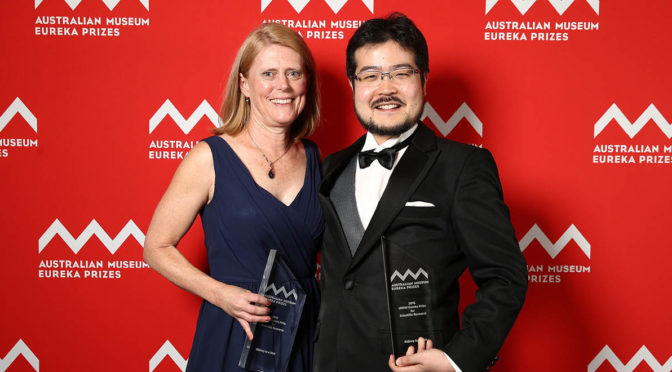
Combat simulation accelerates

Researchers from the University of South Australia have developed combat simulation software so lean that it is the fastest in the world at modifying existing combat strategies to improve established doctrine.

Software developer Matt Selway says his programming could reduce the time it takes to run large-scale military simulations from a month to a week.

He says the increased speed comes from the software’s automated analysis of text documents.

“Having it (the simulation) run faster allows them to run the event multiple times and figure out what the best option is for various aspects of their operations,” he says.

“They could start off with documentation that describes the simulation that they want to run and the behaviour of the different entities that they want to have execute throughout the simulation.

“You can put in information about different types of equipment, if they are comparing some of them or deciding on which to purchase. It could help them with weapons, vehicles, and communications equipment.”

The combat simulation software registers what’s known as text understanding methods. This allows the system to quickly interpret written descriptions of different real-world scenarios and develop improved procedures.

It is able to analyse the behaviours of individual units, squads and brigades at the same time and performs the actions of the different entities inside the simulation.

The simulation also aims to analyse and evolve contemporary military doctrine to produce optimal results.

“The basic doctrine for example could be a response to when you come under fire,” Selway says.

“Normally you take cover and return fire, but the documentation covers broad aspects of operations and depending on the situation could help improve the doctrine further.

“It’s more of a preparation tool but one of the things about being able to improve the amount of time to set up the simulation is that eventually they will be able to use it in an unfolding scenario.”

Users are able to continue running through simulations and calculate the averages of different outcomes. They are then able to figure out what strategies or equipment produce better results in different situations.

After the text documents are inserted into the simulator they are run on a flat platform screen, which creates a visual representation of each scenario.

John Stewart, the CEO of industry group Simulation Australasia, said the ability to rapidly adapt to the changing battle dynamic was crucial for the modern war fighter.

“Defence and military forces worldwide are going to rely so heavily on the new technologies,” he says.

“The military have been the leaders in (simulation) this for years. For something like the software to come out of South Australia and to be at the forefront, around the world, is very exciting.”

The combat simulation project was led by the University of South Australia’s Advanced Computing Research Centre, one half of the Australian government’s Defence Science and Technology Group.

The Defence Science and Technology Group is the Australian government’s lead agency responsible for applying science and technology to safeguard Australia and its national interests.

– Caleb Radford

This article was first published by The Lead on 25 July 2016. Read the original article here.
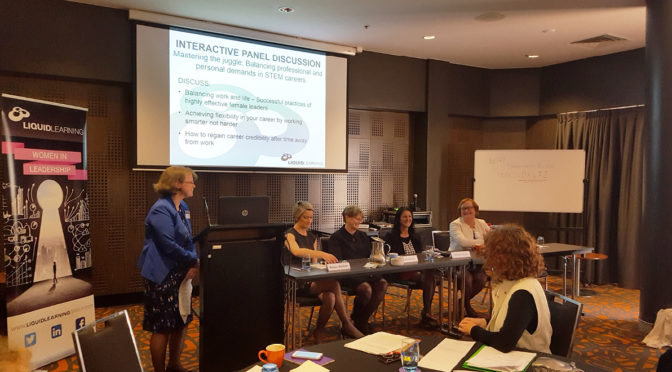
Tasmania boosts tourism research

Featured image above: A bright future for Tasmania through tourism research

Visitors to Tasmania are being asked to carry tracking devices to help researchers learn more about where they go and what they do when visiting the island.

The Sense-T Sensing Tourist Travel Project, based at the University  of Tasmania (UTAS), uses real-time data to follow the movements of holidaymakers and answer key questions about their travel behaviour. Using a bespoke app pre-loaded onto a smartphone, researchers can find out exactly how long different cohorts spend walking the coast, looking at art or shopping –  gold-plated data for the state’s booming tourism industry.

The project’s primary focus is on two types of visitors: Australian interstate travellers and tourists from China. Volunteer participants are recruited at the island’s three main entry points – Launceston and Hobart airports and the Spirit of Tasmania – and tracked for up to  10 days.

With tourism accounting for over 8% of the state’s economy, an intelligent and robust understanding of visitor behaviour is crucial to the continued growth of the sector in Tasmania.

The project is being jointly led by two researchers from UTAS, Dr Anne Hardy and Professor Richard Eccleston.

“The project will provide a proof of concept that app-based tracking can replace more traditional surveys of visitor experiences,” says Hardy. “It was designed in conjunction with the Tourism Industry Council of Tasmania, Federal Hotels and Tourism Tasmania, and a wide range of  industry stakeholders have been consulted as part of the project’s design.”

The Sense-T partnership is a collaboration between UTAS, CSIRO and the Tasmanian Government, with funding also contributed by the Federal Government. In addition to the tourism project, it runs sensor-based research on health, agriculture, finance and other key drivers of the Tasmanian economy, with  the aim of “creating a digital view of Tasmania”.

Over 330 tourists took part in the Sensing Tourist Travel Project. The tourism research data collection ended in May 2016 and results are expected by September.

This article was first published by the Australian National Data Service in May 2016. Read the original article here.

Australia’s most innovative women engineers

Featured image above: Captain Mona Shindy, Head of the Guided Missile Frigate System Program Office in the Royal Australian Navy and one of Australia’s Most Innovative Engineers in the General Industry category. © Engineers Australia

Australia’s Most Innovative Engineers 2016


Professor Veena Sahajwalla

innovative engineers

© Engineers Australia

Innovation: Smart recycling

Director, Centre for Sustainable Materials and Research Technology (SMaRT), UNSW and one of Australia’s Most Innovative Engineers in the Academia and Research category.

PhD (Mat Sc & Eng), University of Michigan (USA)

Professor Veena Sahajwalla has been focusing on turning waste glass and plastic from cars into value-added material. She says that by “mining” rubbish dumps and landfills, you can access “ores” of various materials more concentrated than in greenfield mine sites.

Traditionally, they have been difficult to recycle because the materials are mixed with other materials and require separation. However, Sahajwalla’s innovation is using high temperatures (over 1500 degrees Celsius) that trigger reactions which create new products by releasing the materials’ elements from their original structures, enabling them to reform.


Marita Cheng

innovative engineers

© Engineers Australia

Innovation: Vision through artificial intelligence

Co-Founder, Aipoly and one of Australia’s Most Innovative Engineers in the Young Engineers category.

BE (Mech), University of Melbourne

Aipoly is a smartphone app which helps blind people identify objects. The app and the company developing it are less than a year old. It grew out of a program at Singularity University in California where entrepreneurs and technologists work together on team-based technology solutions for widespread global challenges.

Australian roboticist Marita Cheng was teamed with Italian Alberto Rizzoli and Swede Simon Edwardsson. Their current version can recognise about 1000 objects and the trio are working on the next version of the algorithm, which is able to recognise 5000 objects.

Cheng says the unique thing about the app is that all the computation happens on the phone, meaning it detects objects in real-time rather than having someone take a photo then send it over the internet to a cloud server. “All you have to do is hold your phone, pass it over the various objects, and in real time it recognises chairs, the floor, tables, different colours,” says Cheng. “A blind person would be able to have a much richer experience of the world through this kind of technology.”


Monika Balicki

innovative engineers

© Engineers Australia

Innovation: GPU Models for Rivers

Director, Water Modelling Solutions and one of Australia’s Most Innovative Engineers in the Utilities category.

M.Sc. (Environmental Eng), Technical University of Denmark

Australia is one of the best places to see the advantages of graphics processing unit (GPU) modelling, according to Monika Balicki. A prime example is her work in Toowoomba in 2015 as part of an update to the region’s planning scheme, a massive project covering nearly 13,000 sq km that includes the Condamine River floodplain in Queensland.

The council saw a need to update its model, as new technology only available in the last two years would improve flood-mapping accuracy.

New light detection and ranging (LiDAR) survey data, in addition to advances in GPU technology, made it possible to develop a comprehensive map of flood elevation surfaces, velocities and depths, as well as flood hazard and hydraulic categories for a full set of modelled events.

GPU 1D and 2D flexible mesh modelling allowed Balicki to adjust the resolution to be more detailed in areas of interest, such as towns.


Prof Fariba Dehghani

innovative engineers

© Engineers Australia

Innovation: Advanced active food packaging

Professor, University of Sydney and one of Australia’s Most Innovative Engineers in the Academia and Research category.

PhD (ChemEng), University of NSW

Advanced active food packaging is a ‘greener’ approach to food packaging that prolongs the shelf life of foods by offering lower oxygen and water-vapour permeability than other polymers (plastics) currently used.

The existing biodegradable plastic, polypropylene carbonate has properties favourable for use in food packaging, but contains metallic catalysts.

Extracting these impurities results in a ‘greener’ plastic for food packaging and with the additional coating of the surface with a natural extract, creates antibacterial qualities.

Prof Fariba Dehghani is the inventor of the technology and project leader of its development.


Sabina Shugg

innovative engineers

© Engineers Australia

Innovation: Women In Mining And Resources WA

National Lead, Mining Performance, KPMG Australia and one of Australia’s Most Innovative Engineers in the Community category.

Western Australian School of Mines (Mining Eng)

Sabina Shugg was the first woman in the state to gain the WA first class mine manager’s certificate of competency, and the first to work as an underground mine manager in WA.

She had a unique and varied career in remote mining communities, but at times found that she was more isolated than her male colleagues. So she established a networking group for women working in the mining industry, Women in Mining and Resources WA (WIMWA).

It gives women mining professionals a forum to share their experiences and extend their networks. The WIMWA Summit and Conference in September 2015 attracted 550 women from the mining industry in WA.

The group recently branched out into mentoring programs and matches pairs of 35 to 40 mentees with mentors.


Kirsty McInnes

innovative engineers

© Engineers Australia

Innovation: A Bit of Engenuity for Tourism

Director, UNO Management Services and one of Australia’s Most Innovative Engineers in the Community category.

BE (Env), University of Western Australia

The Northern Territory Adventure Park decided to use a bit of engineering and innovation (what they termed engenuity), and in the process recycle materials to build new projects and reduce waste to landfills.

Kirsty McInnes was project manager, builder and engineer on the project. “The innovation was all in the design,” she said. “Construction items needed to be envisaged and designed before the materials had been sourced. For example, we recognised we needed to build an event space but did not realise this would be transformed from trampolines and truck jibs.”

She said designs had to be ‘fluid’ and ‘adaptable’ with an image of the constructed form, but not the key materials.

Through innovative design processes and careful project management, the result is an award-winning tourism business created with 52 t of waste and saving almost $500,000. It demonstrated that materials can be ‘repurposed’ rather than disposed to landfill at the end of their life, and challenges engineers to take another look at the materials they could use.


Dr Marianne Foley

innovative engineers

© Engineers Australia

Innovation: 50 Martin Place Fire Design

Principal, Arup and one of Australia’s Most Innovative Engineers in the Consulting category.

PhD (Fire Safety), University of Leeds and University of Edinburgh

Fifty Martin Place is a landmark heritage building in the heart of Sydney’s financial district. Recently transformed as the new global headquarters of Macquarie Group, it is the largest heritage property to achieve the Green Building Council of Australia’s 6 Star Green Star rating, and to date the only building in Australia registered for WELL Building Standard.

Dr Marianne Foley devised a performance-based fire engineering design, which enabled the preservation and revitalisation of the building’s original heritage aesthetic, the creation of new spaces and features, and ensured the highest levels of occupant safety.


Danya Mullins

innovative engineers

© Engineers Australia

Innovation: Perth’s daily population

Associate Principal, Arup and one of Australia’s Most Innovative Engineers in the Consulting category.

BE (Civil), University of Melbourne

The City of Perth has been undergoing a rapid transformation over recent years. The impacts of these changes are difficult to pinpoint without understanding the baseline population of people using the City on a daily basis for various purposes.

Very little information exists on how many people are in the City typically, which makes it increasingly difficult to plan the City, new transport infrastructure and develop business cases to support new projects. Danya Mullins managed the project for Arup. One of the key challenges to overcome was the fact that no new data was to be collected to inform the calculations. This meant that the approach needed to be tailored to available datasets, but also to make sure that secondary data sources could be kept independent to allow validation of the population calculation.

This required innovative thinking, as many of the datasets were collected for entirely different purposes. For instance, the number of cyclists using shared paths into the City, or needed to be sensibly adapted as they were old (eg 2011 Census statistics).


Captain Mona Shindy

innovative engineers

© Engineers Australia

Innovation: Rethinking defence leadership

Head, Guided Missile Frigate System Program Office, Royal Australian Navy and one of Australia’s Most Innovative Engineers in the General Industry category.

BE (Elec), University of NSW

Captain Mona Shindy was last year named the Telstra Australian Business Woman of the Year, largely in recognition of her work in charge of the availability, maintenance and upkeep of front-line warships, associated logistics and engineering enhancements.

“Effecting necessary change, in business practice or community attitudes, requires strong leadership by example,” says Shindy.

“It requires creating environments where people are encouraged to collaborate and innovate, where all contributions are respected and valued, where there is a strong sense of belonging and personal responsibility, then people and organisations are empowered to be their best and to give their best.”


Stephanie Moroz

innovative engineers

© Engineers Australia

Innovation: 3D Nanostructured Materials

CEO, Nano-Nouvelle and one of Australia’s Most Innovative Engineers in the Manufacturing category.

Engineering Physics, University of British Columbia

Stephanie Moroz is working on tin-based anodes for lithium-ion batteries. Nano-Nouvelle has developed a 3D nano-porous conductive membrane that can boost the energy storage capacity of lithium-ion batteries by as much as 50%. Most of the current work is focusing on changing the active particles and trying to get them to bind better to the foil. Moroz is attacking the problem from a different angle.

“Our material, coated with copper, replaces the foil,” she says. “Instead of having the flat foil we have this porous, high surface area.” Rather than having the current collector placed next to the active material, the Tin Nanode is throughout the active material. The current collector has far greater surface-area contact with the active material, offering new efficiencies. The company was selected as one of the 2016 Top 50 Tech Pioneers in Australia and New Zealand.


This is an extract from the article that originally appeared in the July 2016 issue of create ̶  Engineers Australia’s member magazine. © Engineers Australia

Virtual shopping now a reality

Virtual shopping featured image above: credit COMSALUD via Compfight cc

Top retail and eCommerce brands are beginning to leverage virtual reality (VR) technology to offer a cutting-edge, immersive virtual shopping experience to consumers.

In May 2016, eBay launched what they claim is the world’s first virtual reality department store, built in partnership with Australia’s largest department store group, Myer.

To step into this virtual shopping space, shoppers wear VR headsets sold by eBay Australia. These devices, called ‘shopticals’, allow eBayers to browse more than 12,000 items from a dedicated app on their smartphone. With Ebay’s Sight SearchTM technology, a shopper can select a desired item simply by holding their gaze on the product, which appears to float towards them for further inspection.

“Your eyes can move so quickly… Sight Search in a VR world of retail feels very sensible,” said eBay’s senior director of marketing and retail innovation Steve Brennen to Mashable Australia. “How much customers use it, do they love it, is where we’ll get to next.”

This technology is expected to become prevalent across markets in Australia, the USA and the UK. The 2016 Future of Retail Study carried out by Walker Sands reveals that more than one in every three Americans are open to the idea of purchasing more online if VR technology gives them ‘a more realistic feel of the product’.

virtual shopping

Virtual reality headsets enable virtual shopping apps used on smartphones.

Virtual shopping for the home

eBay and Myer aren’t the only retailers working to integrate VR into their digital shopping experience. In early April 2016, Swedish megastore IKEA announced the launch of a pilot VR app for the HTC Vive virtual reality headset. The app, which is still in its beta stage, promises to transform the home furnishing retail experience.

“Australians are known for embracing the latest technology and innovations, so virtual reality has the potential to transform the way people interact with our products in the home,” says IKEA Australia’s range manager Tim Prevade. “We look forward to hearing our customers’ feedback on the experience as we continue to explore this space.”

Deal-finding service Retale also announced the launch of a new VR app that will work using Oculus Rift – a headset created by virtual tech company Oculus. While focusing on Rift for the initial release, Retale plans to expand the app to function on multiple platforms.

The future of virtual shopping

Although virtual reality experiences have been on the market since the 90’s, experts still consider the technology to be in early in its development.

“Right now, VR commerce is still in its infancy stage, and like most new technologies, is also still in the novelty stage,” said Worldpay’s Vice President of Innovation and Design Joe Kleinwaechter to Mobile Commerce Daily.

Most VR headsets still require mobile and other computing devices to function, such as Gear VR by Samsung, which relies on the power of its paired Galaxy smartphone.

But according to Samsung’s head of R&D software and services, Injong Rhee, the company plans to develop a standalone headset that provides seamless virtual reality experiences without the need of its paired device.

“We are working on wireless and dedicated VR devices, not necessarily working with our mobile phone,” says Rhee.

Samsung will be competing against Google who are racing towards the same goal, which will transform VR headsets from accessory items to standalone personal devices.

Virtual payments

The rise of virtual reality isn’t just transforming the digital shopping industry. It is also opening up opportunities for financial technologies, such as virtual currency Bitcoin and alternative virtual payment systems.

Virtual currency Bitcoin. Credit: zcopley via Compfight cc

Virtual currency Bitcoin. Credit: zcopley via Compfight cc

Gaining mainstream status, Bitcoin is now being sold at newsagents in Australia. Encrypted currencies called cryptocurrencies are also gaining popularity in the USA and European countries as an alternative payment method in real shopping environments, and could be applied to the virtual shopping arena to offer consumers a more convenient mode of payment.

The adoption of virtual currencies by consumers would help to complete the virtual shopping experience through to checkout.

– TechEverywhere