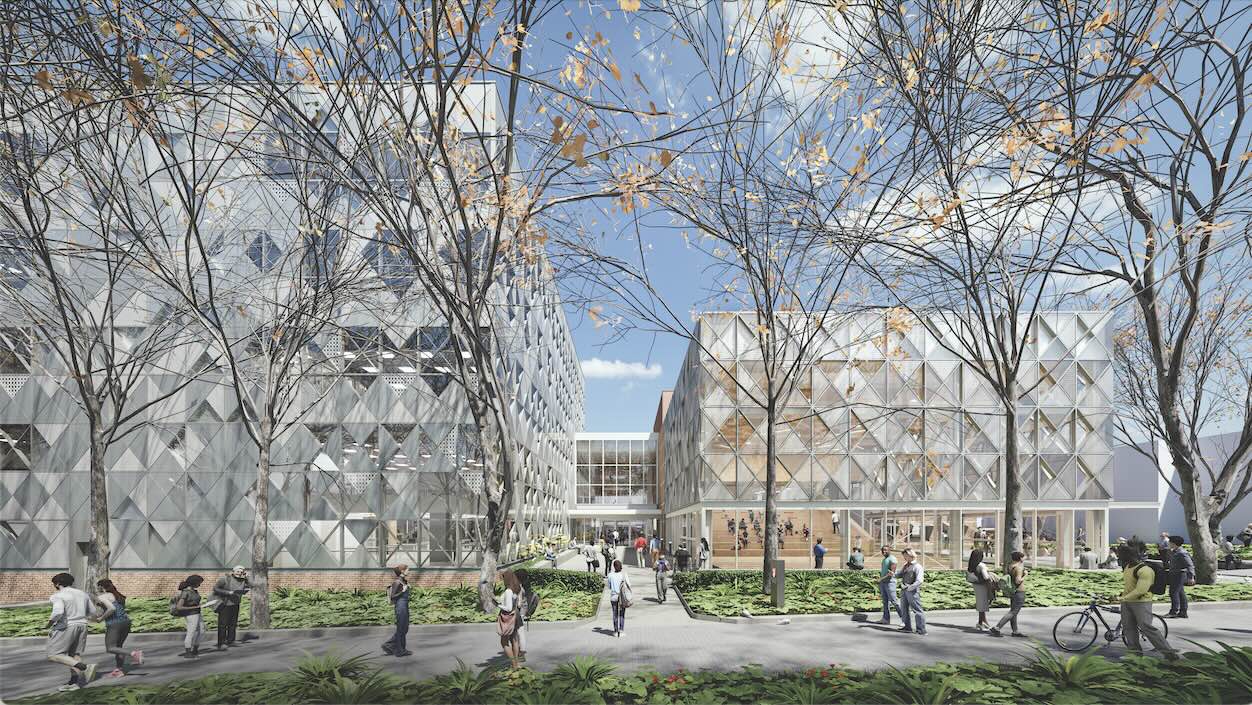
Image: A vision of the future of Macquarie University, as itputs the finishing touches on its new Engineering and Australian Astronomical Optics (AAO) Building. Supplied
University science education is being disrupted by changes in technology, including AI, and by changes in student and employer expectations.
Training versus education
A key part of evolving the Bachelor of Science (BSc) is navigating the balance between vocational training and broader education, according to Brian Yates, emeritus professor at the University of Tasmania and ACDS executive member. While training equips students with job-specific skills for a smooth transition into the workforce, education in a research-led environment fosters more adaptable capabilities like problem-solving and teamwork.
At the moment, Yates sees a strong focus on producing “job-ready” graduates, with curricula packed with industry-relevant knowledge. However, as specialised information becomes
more accessible, he suggests the emphasis might shift from “having knowledge” to developing the skills needed to find and apply it.
University, with students
It’s a view that Professor Ingo Koeper, associate dean of learning and teaching at Flinders University shares, in part.
“I think we need both. We need a solid understanding of foundation in the discipline, but then you have to be able to extrapolate or take that and apply it to various different concepts,” he says.
Job-ready graduates
The problem that Koeper identifies is that science graduates don’t all follow the same career trajectories. Some go into academic research, some go into commercial science, some wind up in unexpected places, such as banking, “because they have critical thinking and analytical brains”.
Therefore he says teaching “job-ready” is a balance
between vocational knowledge and transferable skills.
He believes the BSc of the future could dispense with traditional lectures and move to online or face-to-face workshops, supplemented by in-person practical classes where students can gain hands-on experience in their
chosen discipline of science.
Workshops are a more active form of learning, says Koeper, but they come with a cost. Mass lectures are a financially efficient way of teaching lots of students and are well-suited to identifying important information. More active forms of learning take up more lecturer resources. But the move from mass lectures also opens opportunities.
Personalised learning
Victoria University (VU) has embraced the new hybrid-learning environment with a trial of a new assessment protocol. In recent years VU developed the Block Model, where subjects are run for a four-week intensive block, and students are enrolled in only one subject at a time, so they concentrate and consolidate their learning in one area. Joshua Johnson, chair of the Assessment Taskforce, says that the new “two-lane” assessment embraces AI-assisted learning in the open assessments lane. But in the secure assessments lane, the focus is on practical skills.
“For science education specifically, this includes hands-on experimental work, live data analysis and real-time scientific communication,” he says. Johnson says the framework strikes
a balance between collaborative, hands-on learning essential to science while preparing students for a workforce where technological fluency is paramount.
Macquarie University in Sydney is putting the finishing touches on its new Engineering and Australian Astronomical Optics (AAO) Building.
The $150 million facility – due to be officially opened around February 2026 – will house AAO which designs instrumentation and software for the world’s largest telescopes.
“Students will be going to classes there, but they’ll be walking past a group of professionals that are building an instrument that’s going to go for an international client on a giant telescope in Chile,” says director of the AAO and acting dean of engineering, Richard McDermid.
“I think that it’s great for the students to get exposure to
how professional work happens.” McDermid speculates that the defining feature of the future BSc might be personalised learning, with students able to mix and match their skills or knowledge acquisition, tailored to their personal career trajectory.
Multiple self-directed online units might be pre-prepared so that students can gain relevant skills while the impost on
teaching resources is minimised.
In this vision of the future, practical experience with industry professionals, such as that offered in the new AAO building will be essential. McDermid says students should graduate feeling like they didn’t just spend three years getting information they could have looked up online, but come out feeling that they understand how their potential industries work, because they’ve had experience in them.
“So they stand in an interview situation and talk from experience rather than theory,” he says.
But Macquarie’s edifice is being completed at a time when universities are increasingly exploring the advantages of online learning. The question now is what lessons science schools can take from Macquarie’s engineering co-location project, what a BSc will look like, and whether facilities like the AAO building will be required as we transition to the future.
Written by Sara Phillips