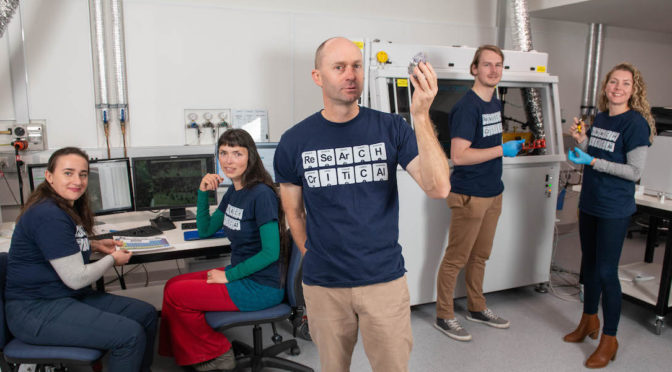
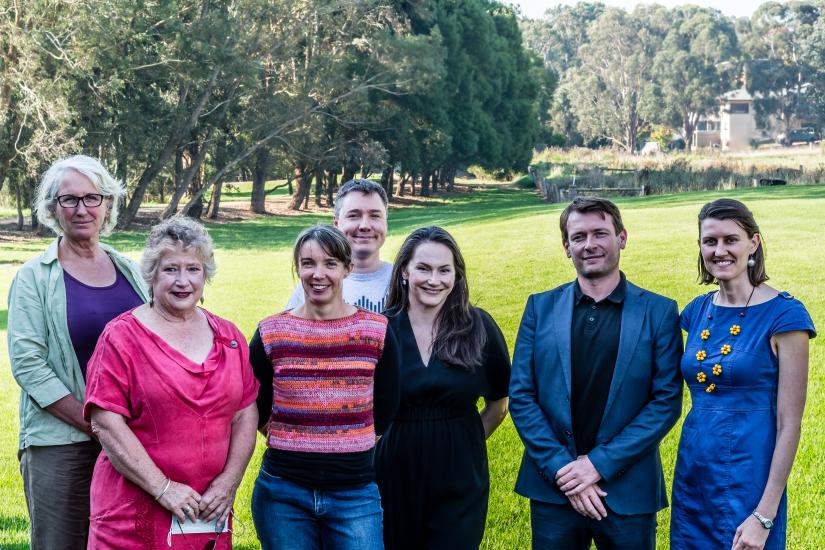
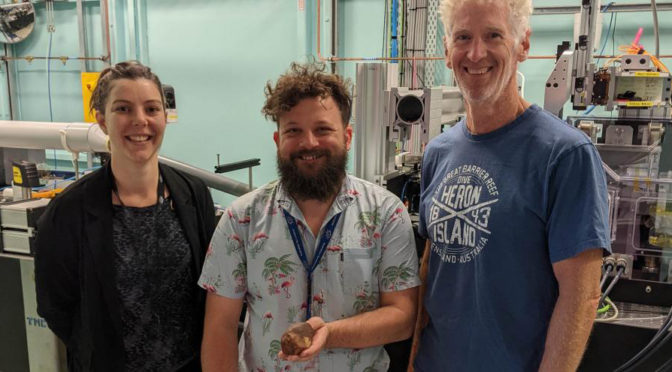
Image: The Australian Critical Minerals Research Centre is part of a drive towards sovereign capability in critical minerals. L-R: Diana Zivak, Fun Meeuws, Carl Spandler, Jarred Lloyd, Jess Walsh
Critical minerals are essential for tech we use today and for the green economy. Accessing these elements is thanks to innovation in Earth science research.
The critical minerals boom is driven by a transition to green energy and appetite for tech such as smartphones. Australia is well positioned to play a leading role in finding and extracting them.
“For decades, university scientists have studied rare minerals in rocks to understand ancient geological processes,” explains John Mavrogenes, professor of economic geology at Australian National University (ANU).
“Now these minerals are critical ingredients in the technologies we increasingly rely on in phones, batteries, electric vehicles, wind turbines and more. Looking forward, demand for critical minerals is only going to go up,” he says.
The term ‘critical minerals’ is used to describe naturally occurring elements that are essential for modern technologies, economies and national security, and for which supply-chain vulnerability exists. Well-known examples include silicon (used in solar panels), lithium (for batteries) and cobalt (used in magnets). Geoscience Australia (GA) lists 45 minerals as critical in the Australian context, including 15 metals called the Rare Earth Elements (REEs).
Despite their name, REEs are not actually that rare in the Earth’s crust. However, to date they have been relatively hard to access, as they don’t typically occur in deposits rich enough to support traditional mining approaches.
Better understanding of REE deposits – such as how they formed and why they occur in particular locations – will improve commercial opportunities and ensure reliable sovereign sources.
Acheiving this requires a complex interplay between university science and mining.
“The best exploration companies think very much like geologists at universities, and they fund people within universities to work on certain problems,” Mavrogenes explains. But the exchange goes beyond a ‘pay and find’ mentality. Fundamental university science is driving a discovery process that will completely change the way we search for these critical minerals into the future.
World-leading isotope science
University of California, Los Angeles’ (UCLA) Distinguished Professor Mark Harrison is renowned worldwide for his expertise in isotope geochemistry. He undertook his PhD at ANU in the late 1970s and was director at ANU’s Research School of Earth Sciences from 2001–06.
“In the 1960s–80s, ANU was the global leader in isotope science — that’s where the methods were being developed most aggressively,” Harrison says. “Now, those techniques university scientists started more than 40 years ago have absolutely blossomed into the capabilities for critical minerals exploration we have in universities and geological industries today.”
A lab technique known as mass spectrometry is particularly vital for critical minerals research. It can identify forms of elements known as isotopes, which have subtly distinct masses due to differing numbers of neutrons.
Measuring the relative abundance of isotopes gives scientists clues about how minerals formed millions of years ago.
“At ANU in the 1970s, we developed a mineral dating technique based on measuring two isotopes of argon, which is still widely used across the globe,” Harrison says.
In the early days, spectrometry was used to date the geological evolution of the Earth. The world-first SHRIMP (Sensitive High-Resolution Ion Micro Probe) for spectrometry was created at ANU, revolutionising dating of minerals by removing the need for scientists to chemically process rocks and minerals before analysis.
“SHRIMP offered a way around all the tedious chemistry we’d had to do up to that point,” says Harrison.
SHRIMP and more advanced isotope and dating technologies soon became established at other universities, but remained largely the domain of academia due to the persistence of some lengthy procedures and reliance on separate techniques for different elements.
Analysing a whole mineral at once
In recent years, however, isotope science has become more commercially viable, thanks to important improvements in mass spectrometry.
A common approach is laser ablation ICP-MS (Inductively Coupled Plasma Mass Spectrometry), in which samples are scraped off with a laser; the resulting individual elements are converted into ions (charged particles) and then analysed in one step.
“This lets us perform accurate isotope analyses from one sample in just a couple of minutes, fundamentally changing the way minerals exploration can be done,” says Associate Professor
Carl Spandler, director of the Australian Critical Minerals Research Centre (ACMRC) at the University of Adelaide. ACMRC was formed in 2021 to build expertise and knowledge around discovery of critical minerals.
It’s part of a larger movement building critical minerals capacity in Australia. The government’s 2020 Modern Manufacturing Strategy includes critical minerals processing as one of its national manufacturing priorities.
“Critical mineral discovery, separation and extraction – all of this requires the right techniques and an educated workforce,” Mavrogenes says. “There’s really important research still to be done on the rocks that carry critical minerals in Australia.”
Mineralisation of REEs
ACMRC postdoctoral researcher Dr Jessica Walsh is studying REEs in an ARC Linkage Project. Working with ANU scientists, state geological surveys, GA and Northern Minerals Ltd, Walsh aims to understand how mineralisation of REEs takes place, focusing primarily on geological formations in the Northern Territory and Western Australia.
ARC Linkage Projects are designed to bring skills, knowledge and ideas from the university sector across to industry. Walsh brings mineral samples to the University of Adelaide labs and applies laser ablation ICP-MS to quantify REEs and measure isotopes of uranium and lead, so she can assess the age of the formations. “It’s incredibly fast – you can get a phenomenal amount of geochemical data really quickly,” she says. Exploration companies will use the data to help them understand the geology of their exploration sites, and to better target prospective areas to drill test for ore discoveries.
Professor Caroline McMillen AO, Chief Scientist for South Australia. Image: Supplied
Decarbonisation relies on the deep science capability present across our universities and the ability to train the next generation to enable one of the world’s biggest industrial shifts — towards net zero.
This issue of Australian University Science could not be more prescient. The most recent World Economic Forum Global Risks Report found that respondents ranked “climate action failure” as the number one threat with the most likely severe impact on the world in the next decade. In this context, industry sectors in countries not focussed on decarbonisation will face increasing costs of carbon and significant difficulties trading in global markets. As the world gears up to meet net zero commitments, metals and mining companies are positioning to drive this massive technological transition.
Critical minerals are at the heart of decarbonisation and electrification as we harness renewable energy, fuel-cell-based electric vehicles and scale green hydrogen production. These changes will drive significantly increased demand for raw materials such as copper, nickel, lithium, cobalt, tellurium, neodymium and others. Most of the tellurium used in solar panels is collected from electrolytic copper refining, and while copper demand may increase, its mine supply may not expand at the same rate to meet this demand.
In this context, the world and Australia face both opportunities and challenges. As summarised in Australia’s 2022 Critical Minerals Strategy, we have some of the world’s largest recoverable resources of critical minerals such as cobalt, lithium, vanadium and Rare Earth Elements. As also highlighted in the Strategy, Australia’s real asset is that of the scientific and technological know-how built over decades in fields spanning extractive metallurgy, analytical, macromolecular, materials and physical chemistry, materials engineering, geology and geochemistry digitisation — to name just a few.
It is the value chain created by long-standing collaborations forged between energy, mining and manufacturing companies with Australia’s remarkable university scientists that have delivered the innovation and translation outcomes that drive our supply chains and are key to meeting the challenges of the future.
Australia is well positioned as a trusted global leader to overcome the challenges of a global energy, industrial and economic transition and to reduce the risks highlighted by those respondents to the Global Risk Report. Now is the time to back the best of Australian science and to support the next generation of scientists coming through our university system, who carry the weight of the planet’s future with them.
Professor Caroline McMillen AO, Chief Scientist for South Australia
Luckily thanks to initiatives like The Hatchery’s Public Sector Women in STEM Leadership Summit, emerging female leaders are being nurtured and celebrated – and the opportunities for career growth are huge.
Professional development
Running virtually this September (21-22), the Public Sector Women in STEM Leadership Summit is an opportunity for up-and-coming female leaders to get inspired by some of the most successful women in STEM.
Over two days the event will cover a wide range of topics from networking, to mentoring and transitioning into leadership. And the benefits for your career? Seriously huge.
Boost your confidence and understand the most common learnings of senior leader
Gain advice on key topics for women in STEM, including working in male dominated environments, leading diverse and high performing teams and uncovering the power of networking and mentoring
Hear from exciting VIP and international keynotes, valuable case studies & in-depth panel discussions
Learn from new role models who established their careers in male-dominated fields
Inspiring speaker line-up
Up there with some of the biggest names on the program are:
Dr Sian Proctor – geoscientist, explorer and diversity in STEM advocate, SpaceX Inspiration4 crew pilot
Prof Lisa Harvey-Smith – award-winning astrophysicist and author, Australian Government Women in STEM ambassador
Sabra Horne – Entrepreneur in Residence, BMNT, former Chief, U.S. Cybersecurity and Infrastructure Security Agency Innovation Hub
Short answer? Any STEM professionals interested in busting stereotypes and increasing diversity in the workforce!
The program is perfect for current and emerging female leaders in STEM, those with technical roles as well as officers and managers through to directors and SES, HR, diversity and capability professionals and leaders, and learning and development leaders.
Keen to attend? Use the code CAREERSWITHSTEM and save $100 off your conference registration. Additional discounts are available for group bookings too.
Engineers in Melbourne have discovered a way to replace 100% of conventional aggregates in concrete – such as gravel and crushed rock – with rubber from discarded tyres that meets building codes, promising a boost for the circular economy.
The team from RMIT University says the new greener and lighter concrete also promises to reduce manufacturing and transportation costs significantly.
Small amounts of rubber particles from tyres are already used to replace these concrete aggregates, but efforts to replace all of the aggregates with rubber have produced weak concretes that failed to meet the required standards – until now.
The study published in the Resources, Conservation & Recyclingjournal reveals a manufacturing process for structural lightweight concrete where the traditional coarse aggregates in the mix were completely replaced by rubber from used car tyres.
Lead author and PhD researcher from RMIT University’s School of Engineering, Mohammad Momeen Ul Islam, said the findings debunked a popular theory on what could be achieved with recycled rubber particles in concrete.
“We have demonstrated with our precise casting method that this decades-old perceived limitation on using large amounts of coarse rubber particles in concrete can now be overcome,” Islam said.
“The technique involves using newly designed casting moulds to compress the coarse rubber aggregate in fresh concrete that enhances the building material’s performance.”
Greener, cheaper and lighter building materials
Study co-author and team leader, Professor Jie Li, said this manufacturing process will unlock environmental and economic benefits.
“As a major portion of typical concrete is coarse aggregate, replacing all of this with used tyre rubber can significantly reduce the consumption of natural resources and also address the major environmental challenge of what to do with used tyres,” he said.
Used tyres in Australia cannot be exported, making new methods for recycling and reprocessing them locally increasingly important. About 1.2 billion waste tyres will be disposed of annually worldwide by 2030.
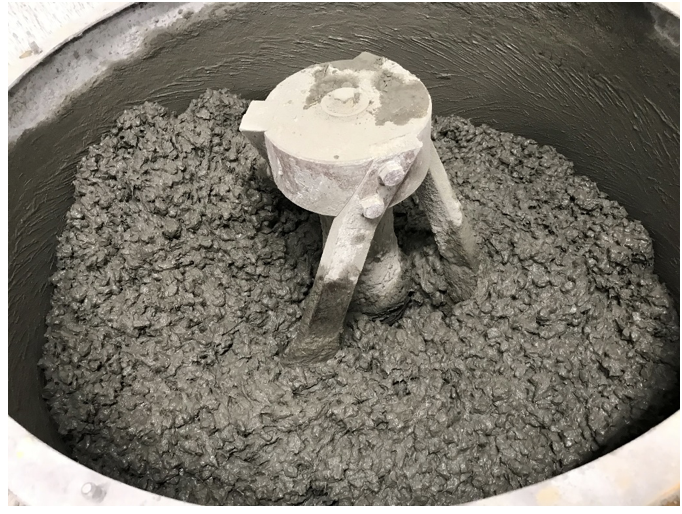
Concrete mixing using recycled tyre rubber particles for the complete replacement of traditional coarse aggregates. Credit: Mohammad Islam, RMIT
The greener and lighter concrete could also greatly reduce manufacturing and transportation costs, Li said.
“This would benefit a range of developments including low-cost housing projects in rural and remote parts of Australia and other countries around the world.”
Next steps
The team’s manufacturing process could be scaled up cost effectively within a precast concrete industrial setting in Australia and overseas, Islam said.
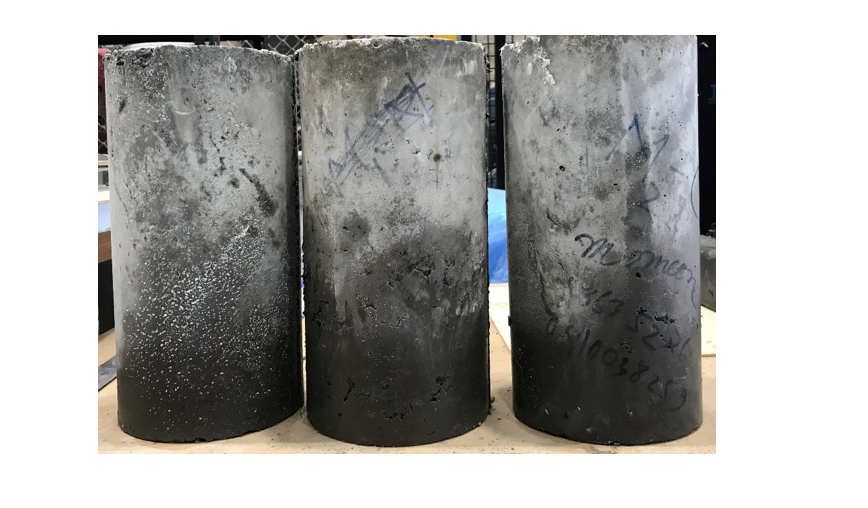
The RMIT team’s new casting technique generates structural lightweight concrete from used tyre rubber. Credit: Mohammad Islam, RMIT
Following successful testing in the workshop, the team is now looking into reinforcing the concrete to see how it can work in structural elements.
The RMIT research team also includes Professor Yu-Fei Wu, Dr Rajeev Roychand and Dr Mohammad Saberian.
From healthier snacks to more sustainable food production, advances in new technologies play a key role in helping improve global access to safe, secure and high-quality food.
Getting fruits and vegetables from seed to plate is an obstacle course that involves navigating climate change, pests and diseases, soil and water pollution, desertification and ultimately high-level controls to ensure food is safe for consumption and export. For all of these challenges, nuclear science offers proven, effective solutions.
Nuclear applications in agriculture rely on the use of isotopes and radiation techniques to combat pests and diseases, increase crop production, protect land and water resources, ensure food safety and authenticity, and increase livestock production.
In food science, nuclear science is at the forefront of developing healthier/lower fat foods and producing less digestible starches and oleogels, which are gels that attempt to replicate fat texture but without saturated fat.
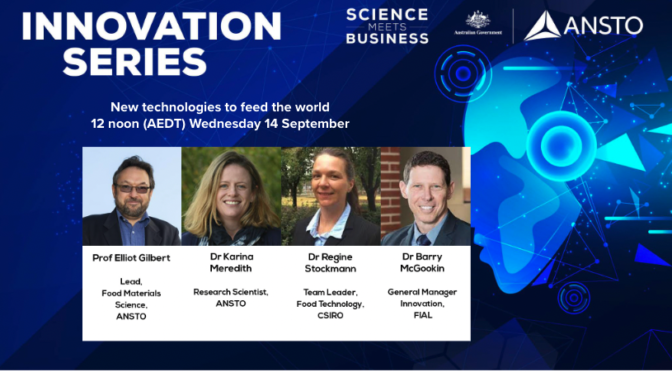
Meet four food technology industry experts and hear how researchers, government and industry are collaborating to ensure Australia leads the world in food security using cutting-edge technology.
Professor Elliot Gilbert, an instrument scientist at ANSTO. Elliot also devised, initiated and leads the Food Science project that applies materials science approaches to examine structure-property-process relationships in food-based systems.
Associate Professor Karina Meredith is a Principal research scientist and currently leads the Environment Research Theme at ANSTO. Karina holds a PhD from the University of New South Wales in isotope hydrogeology and her work has taken her to some of the most remote and beautiful environments in the world.
Dr Barry McGookin is the General Manager, Innovation at Food Innovation Australia (FIAL). He’s spent 30 years in the food manufacturing industry and has held senior technical, innovation and commercial leadership roles in companies with key food manufacturing companies in Australia.
Dr Regine Stockmann is the Principal Research Scientist/Team Leader Food Technology at CSIRO Agriculture and Food.
This webinar is FREE to attend and registration is essential. Secure your spot by clicking the button above.
The ANSTO Innovation Series
The ANSTO Innovation Series is a virtual and hybrid meet-up that focuses on the key capacities of ANSTO’s people, partners and facilities and how they are meeting global challenges in sustainable industries, medicine, advanced manufacturing and in accelerating small business.
Delivered as a quarterly webinar, the ANSTO Innovation Series features an expert panel exploring the latest science, industry and start-up opportunities, including innovations in food, energy storage, nuclear medicine and health, engineering new materials and accelerating deep tech business.
The ANSTO Innovation Series is produced in partnership with STEM-specialist publishers, Refraction Media, publishers of Science Meets Business, and hosted by leading science journalist, Lee Constable.
About ANSTO
The Australian Nuclear Science and Technology Organisation (ANSTO) is the home of Australia’s most significant national infrastructure for research. Thousands of scientists from industry and academia benefit from gaining access to state-of-the-art instruments every year.
ANSTO researchers work on global science and technology challenges, and operate landmark research infrastructure including one of the world’s most modern nuclear research reactors, OPAL; as well as a comprehensive suite of neutron beam instruments at the Australian Centre for Neutron Scattering; the Australian Synchrotron; the National Imaging Facility Research Cyclotron; and the Centre for Accelerator Science. ANSTO also hosts the nandin innovation centre, one of Australia’s few deep technology hubs facilitating industry engagement and research translation.
Blockchain technology researchers from Australia and the Pacific region, led by Monash University, are among ten global winners of the Algorand Centres of Excellence (ACE) Program, sharing US$50 million to strengthen blockchain technology, education and innovation.
The five-year Sustainability Informatics for the Pacific Project, the only Australia-led ACE, will involve multidisciplinary researchers from seven universities and two not-for-profit organisations across Australia and the Pacific headed by the Monash Blockchain Technology Centre.
Project lead and Monash Blockchain Technology Centre Director, Associate Professor Joseph Liu, said the project aims to develop sustainable and innovative blockchain technology for the Pacific region keeping in mind the unique needs of the community.
The Project will be connecting with Pacific and Australian communities through consultation and training workshops, hackathons, community meetups and competitions in order to provide support, opportunities and resources, and to ensure long-term community sustainability beyond the lifetime of this ACE.
“The goal is to create a significant real-world impact in the region built on a foundation of research, education and community-led participation and support,” Associate Professor Liu said.
“Though associated primarily with cryptocurrency, blockchain technologies can actually be used in diverse sectors such as strengthening renewable energy optimisation, providing a fair platform for carbon trading, creating robust supply chains for food and agriculture, securing financial technologies and ensuring cultural sustainability for heritage art and music.
“As part of the Pacific family, we want to ensure that Australia and the region benefit from the best collaborative research for stronger and sustainable technological resources.”
The ACE Program is an initiative of the US-based Algorand Foundation, whose mission is to grow the ecosystem of Algorand, a carbon-negative blockchain invented by Turing Award winner and Massachusetts Institute of Technology Professor Silvio Micali.
Algorand Foundation Principal Researcher and ACE Program Head, Dr Hugo Krawczyk, said the selection process for the final winners of the program was incredibly difficult, given the number of applications received.
“We are delighted to see how many bright, talented people around the globe recognise the ability of blockchain technology to fundamentally change and better the world we live in, and we are very much looking forward to seeing the amazing work the grant recipients do in the coming months and years,” Dr Krawczyk said.
The ACE on Sustainability Informatics for the Pacific Project includes researchers from the University of Queensland, the University of Sydney, Swinburne University of Technology, the University of Fiji, the University of the South Pacific, the Hong Kong Polytechnic University, the Oceania Cyber Security Centre and ClimateWorks Centre, led by Monash University.
Australians overwhelmingly trust in science and scientists – and we strongly fear negative consequences for our society if people don’t value science enough, new research finds.
But a rising tide of public wariness about social media misinformation risks fuelling scepticism in science, the new data released to launch National Science Week reveals.
A major new study finds Australians see science as indispensable, say it was our salvation in the pandemic and is the key to tackling existential threats such as climate change.
Industry & Science Minister Ed Husic MP officially launched National Science Week at an event delivered by Science & Technology Australia for the Australian Government. The launch theme is Celebrating First Nations Sciences.
The 3M State of Science Index measures public attitudes to science in 17 countries. More than 1000 Australians were surveyed for the global poll in early 2022.
Science & Technology Australia Chief Executive Officer Misha Schubert said: “Australians strongly value and trust science, and we see clearly how important science is to our safety and prosperity.”
“Science has saved us time and again during the COVID-19 pandemic – and Australians appreciate science’s key role to help us tackle major threats including climate change, which is causing more frequent terrifying extreme weather like floods, cyclones, megafires, droughts, and heatwaves.”
The survey reveals Australians have very strong levels of trust in science – higher than in many other nations – with nine in ten of us saying we trust science and scientists.
Four in five Australians say they want to hear more from scientists about their work.
The survey highlighted Australians’ fears about what might happen if people don’t value science, with three in five believing it would lead to more public health crises and more than half believing it would lead to greater division in society.
The survey also shines a light on public fears around science misinformation and a growing scepticism about scientific information shared in the media and on social media platforms.
Three in four Australians believe there is now widespread misinformation (on all topics – not specifically on science) in mainstream news, and nine in ten Australians think there is widespread misinformation on all topics on social media.
Against that backdrop, the public level of scepticism around science has risen slightly from 25 per cent in 2021 to 32 per cent in 2022.
“We live in an era of general wariness and distrust of information – especially on social media – which is feeding into a rising tide of concern about social media misinformation that risks fuelling public scepticism in science unless we all act to safeguard it,” Ms Schubert said.
“It’s more important than ever that we all help Australians to find credible, accurate and verified sources of scientific facts from reputable science experts, which highlights the hugely important role of trusted science organisations to share science with the public.”
Eleni Sideridis, Managing Director of 3M Australia and New Zealand, said science is viewed as essential to shaping, strengthening and improving Australia.
“The last few years have shown Australians the true value of science. We have seen a global pandemic unfold, the impacts of climate change and increasing weather events firsthand. The people of Australia know that science holds the solutions to many of these issues,” she said.
“The results of the 3M State of Science Index demonstrates how we as a nation recognise misinformation. It shows the importance of science communities, such as those within Science and Technology Australia and 3M being present in the public eye to ensure transparency and clearly communicated solutions to Australia’s biggest problems. Only then will we have a prosperous future for our country.”
The International Atomic Energy Agency (IAEA) has a comprehensive system to monitor and verify that nuclear facilities around the world are fulfilling their commitments to nuclear non-proliferation.
Those nuclear facilities have obligations under comprehensive safeguards agreements, which are continuously monitored.
That’s where the IAEA steps in. To safeguard against nuclear weapons proliferation, it has a network of specialised laboratories around the world, including ANSTO’s Centre for Accelerator Science.
Samples collected by IAEA inspectors at nuclear facilities are sent to selected laboratories in the network for assessment and analysis.
Australia is a strong and consistent supporter of the Nuclear Non-Proliferation Treaty and has been a State party since 1973.
ANSTO Scientist Dr Michael Hotchkis said the samples are sent to ANSTO blind, where ANSTO’s Centre for Accelerator Science team conducts rigorous analysis.
“This effort requires highly specialised and dedicated facilities and staff to maintain a capability at the cutting edge of international best analytical practice,” Dr Hotchkis said.
The analysis can be performed on soil, sediment, vegetation, water, or surface swipes collected from equipment within monitored facilities.
“The samples are prepared and analysed in ANSTO’s specialist laboratories to extract radioisotopes, such as plutonium and uranium. An expert team at the IAEA assesses the results,” Dr Hotchkis said.
In partnership with the IAEA, ANSTO is also deeply involved in international efforts to improve analytical practices and detection capabilities for safeguards signatures in the environment.
A new radiation and detection imaging technology CORIS360® developed at ANSTO can be used in monitoring environments to support compliance with non-proliferation.
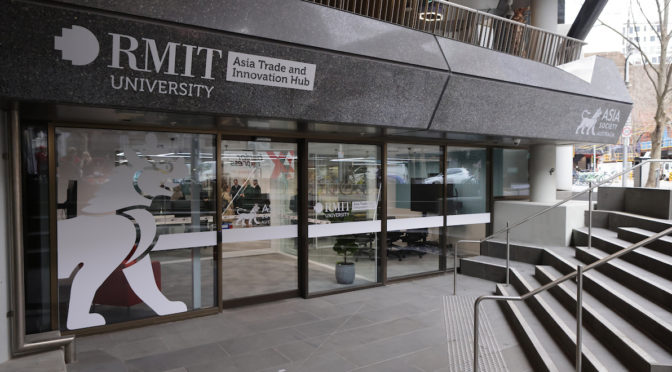
Asia Society Australia’s new headquarters in Melbourne and the Asia Trade and Innovation Hub has opened as a partnership between Asia Society and RMIT University.
The new facility sees Asia Society Australia located at RMIT’s CBD campus, bringing together its global think-tank and convening capabilities with the University’s world-class research, teaching and infrastructure.
The launch of the new Asia Trade and Innovation Hub is one of the key activities underpinned by a strategic partnership between Asia Society Australia and RMIT formed in October 2021.
At the official opening, Victorian Minister for Tourism, Sport, Major Events and Creative Industries, the Hon. Steve Dimopoulos digitally connected with guests from Vietnam, Singapore and Hong Kong, highlighting the partnership’s combined global network and the Hub’s focus on creating a virtual gateway to Asia.
The Asia Trade and Innovation Hub is now open in the heart of Melbourne’s academic and innovation precinct, providing a physical and digital ‘front door’ for Victorians to engage in the region.
Celebrating its 25th anniversary in 2022, Asia Society Australia is the nation’s leading business and policy think tank dedicated to Asia. Through its partnership with the Victorian Government, Asia Society has operated from a temporary office in Melbourne since 2019.
The purpose-built facility on Swanston Street will be Asia Society’s new national headquarters in Australia.
It is a major milestone for the Asia Society – Victoria partnership and underlines Victoria’s reputation as the national capital of Asia insights and capabilities.
Supported by the Victorian Government through the Victorian Higher Education State Investment Fund, the Hub will host virtual, face-to-face and hybrid events, policy discussions, applied research and analysis, media engagements, and online and blended learning programs.
The Hub’s activation will also see three collaborative research roadmaps by RMIT University and Asia Society Australia released in the coming months, to support Victoria’s social and economic recovery and help Victorian businesses succeed in priority markets and sectors in Asia.
“We are thrilled to open our new long-term home in Victoria and embed Asia Society in Melbourne’s intellectual and cultural life, at a time when our future security and prosperity is so intertwined with Asia’s, ” said Asia Society Australia CEO Philipp Ivanov.
RMIT University Vice Chancellor and President Professor Alec Cameron said “At RMIT we pride ourselves on making connections and building networks that achieve important outcomes.
“This Hub brings together our combined expertise and networks to foster applied research, engagement and thought leadership, around Asia trade and investment opportunities and challenges.”
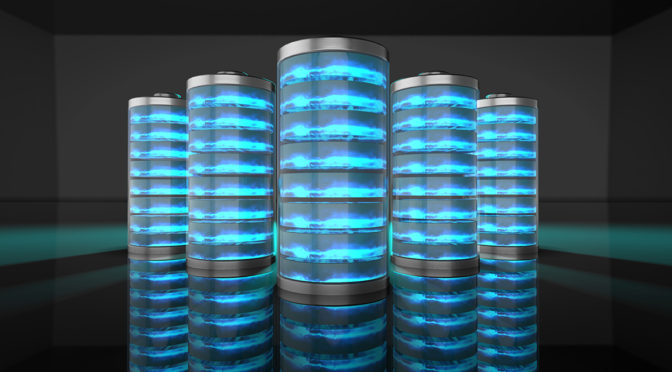
A breakthrough by Deakin University researchers could help address a major obstacle in the development of environmentally friendly, cost-effective, polymer-based batteries.
Researchers at Deakin’s Institute for Frontier Materials (IFM) used computer modelling and simulations to design a new type of solid-state polymer electrolyte, showing its potential use in various types of polymer-based solid-state batteries, particularly sodium and potassium batteries.
Polymer-based batteries can support high-energy density metals in an all-solid-state battery.
By using polymer as the ion conductor rather than the flammable organic liquid solvents in current lithium-ion batteries, the energy storage is greener, safer, and is also less expensive.
Lead researcher Dr Fangfang Chen said the team used a cost-effective, computer-to-lab material design strategy, applying modelling and simulations to find the the best compositions for polymer electrolytes.
“This work has been devoted to developing new polymer electrolyte chemistries that can be used with high-energy metals that are more abundant and less expensive than lithium, such as sodium and potassium.
The new materials can contribute to a more sustainable, greener future battery technology, as well as providing society with safer, high-performance energy storage devices,” Dr Chen said.
Alfred Deakin Professor Maria Forsyth said the work expands upon current knowledge of these new electrolyte systems.
“Lithium-based technology is expensive, in-demand and increasingly scarce, so breakthroughs that provide alternative, inexpensive, and safe energy storage options are of major significance.
We can now offer an alternative path to realising polymer-based solid-state batteries. This is a significant milestone, and this process will act as a design criterion for further development in this field of research,” said Professor Forsyth.
The research is the second significant finding published by IFM researchers in the prestigious journal Nature Materials.
In July, a team led by Dr Xiaoen Wang and Professor Forsyth developed a solid polymer electrolyte material that can replace the flammable liquid solvents currently used in sodium batteries.
The newest breakthrough demonstrates how computer-to-lab research is a cost-effective way to drive new discovery for advanced batteries, which are much needed for energy-hungry applications.
Professor Forsyth said the back-to-back discoveries have designed two effective, efficient polymer electrolytes from ‘different angles’.
“This reflects IFM’s leading position in the field of polymer electrolytes,” she said.
Deakin is currently establishing a $9.5 million facility at Melbourne’s Burwood campus, which will expand already extensive research into sodium and lithium batteries.
The Battery Technology Research and Innovation Hub (BatTRI-Hub) upgrade will include a testing lab and pilot production line to research and manufacture advanced lithium and sodium batteries.
The expansion project includes a $5.2 million contribution from the Victorian Government via the Victorian Higher Education State Investment Fund (VHESIF).
Increase in absenteeism and avoidance of schools and workplaces due to their highly populated environments have drawn much needed attention to the way these enterprises operate and the need for regulated hygienic systems in order for them to stay safe.
Australian indoor air quality and microbiology scientist, Dr. Claire Bird is an Australian indoor air quality and microbiology scientist and Executive Secretary of The Integrated Bioscience and Built Environment Consortium (IBEC). Here she shares her top four professional tips to help combat the four most common indoor air quality issues.
Infection Spread.
Consider the four D’s
Density – amount of people in an indoor space
Duration – potential time in a space with another person
Distance – from an infected person
Dilution – of the pathogen of concern
2. Mould
Inspect your air conditioning units regularly, dry water leaks within 48 hours and believe it or not, bleach is actually an effective disinfectant to help rid the presence of mould when usedsafely.
3. Prioritise protective gear
If you have endured a flood or are undertaking construction work to improve your space, be mindful of the environmental effects that surround repairing damaged building materials and be vigilant in implementing protective gear to avoid serious health damage.
4. Know your space and technology
Do not rely on carbon dioxide sensors to measure air quality, understand the population density of the space and that it is not overcrowded, check up on the state of furniture in the room and wear masks when congregating closely within a room, as density and distance always matters.
There are many pollutants that may negatively impact the air quality indoors, even in places we perceive as typically ‘clean’ like an office environment. As we can’t physically see poor air quality, its importance is often unknown or not regulated.
It can often become a difficult task to employ these safe practices for quality air control, with many environments offering minimal or even no natural ventilation options. However, technology has graced us with the innovation of air purifiers. Those which are correctly fitted with the appropriate high-efficiency particulate air (HEPA) filters can lower the concentration of airborne particles (including those containing viruses). Air purifiers can be useful additions in areas with poor ventilation when reducing transmission of airborne infections.
A University of South Australia PhD student can now add ‘world first’ to her CV after collaborating with Professor Javaan Chahl to accurately measure heart and breathing rates of African wildlife filmed with a drone.
Danyi Wang, working under the guidance of UniSA remote sensing engineer Professor Javaan Chahl, used sophisticated signal processing techniques to detect vital signs of zebra, sable antelopes, waterbucks and giraffe from drone footage.
It is believed to be the first time that this technique – pioneered by Prof Chahl and his team in 2019 – has been used to successfully extract heart and breathing rates of animals filmed from a drone at long distances.
The collaboration with Thron, one of the world’s most high-profile drone pilots, came about after the cinematographer read about Prof Chahl’s remote sensing study with Adelaide Zoo.
Thron films across the world using specialised drones with infrared cameras, zoom lenses and spotlights to rescue animals affected by natural disasters. He spent six months in Australia in 2020 after the World Wildlife Fund hired him to find vulnerable wildlife in the wake of the country’s devastating bushfires.
That experience – as well as the world-first experiment in Malawi, Africa – features in a documentary series, aptly named Doug to the Rescue, which airs in more than 30 countries worldwide on the Curiosity Stream channel.
In the Malawi documentary, which premiered in mid-June, Wang and Prof Chahl are interviewed via Zoom, discussing the challenges they faced to pick up tiny movements from the animals’ chest cavities filmed by Thron’s drone from ranges of more than 50 metres.
Cinematographer Douglas Thron and PhD Student Danyi Wang collaborating. Image: Curiosity Stream
“We had to select the right sequences in the video where it was stable enough for us to get heart rates, but we were able to do it,” Prof Chahl says.
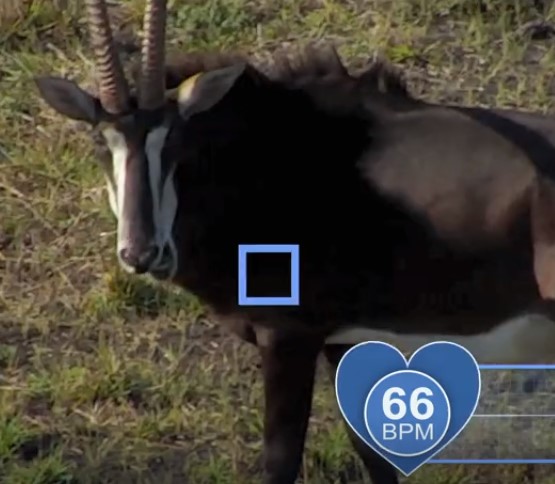
According to Wang, the sable antelope’s heart rate was right in the middle of the normal range and its breathing rate was at the lower end, which indicated it was very healthy and not stressed at all, even by the presence of the drone.
Sable antelopes heart rate was in the normal range. Image: Curiosity Stream
Likewise, the vital signs captured from a giraffe, zebra and waterbuck were all in the expected range.
“It was exciting to work with a US-based documentary team on location in Malawi, via video conferencing from Adelaide, while Australia’s borders were closed,” Wang says. “It just shows what is possible in a research context using modern technology, even in a pandemic.”
Prof Chahl says there is significant potential to use the same technology to monitor the health of wildlife globally, particularly endangered animals, and assist conservation efforts.
“We have demonstrated that a drone can be used to film wildlife at long distances without disturbing or stressing them, and then use AI techniques to successfully extract cardiopulmonary signals to remotely monitor for signs of poor health.
“This documentary was partly an experiment. Doug and his team wanted to verify that their work was not distressing the animals they try to help. Our results confirmed that.”
Edith Cowan University (ECU) will partner in a new whole-of-sector science collaboration aimed at reinvigorating Western Australia’s agricultural research and development capabilities.
The newly launched WA Agricultural Research Collaboration (the Collaboration) brings together leading researchers from ECU, the Department of Primary Industries and Regional Development (DPIRD), Australia’s national science agency CSIRO, Curtin University, Murdoch University and The University of Western Australia.
The collaboration will build on current research efforts to harness and apply cutting-edge science and expertise to WA’s unique challenges and opportunities to contribute to our national and international agricultural priorities.
It will also support WA primary producers to adopt new agricultural technologies across grains, livestock and irrigated agriculture.
Backed by Western Australian Government investment of $25 million over three years, the Collaboration will attract additional funding from participants and other funders, including industry-based research and development corporations.
Six programs have been identified, with the first three focused on boosting agricultural productivity and profitability in the face of a changing climate. The first aims to increase the gross value of production through intensification of agriculture by 2030 by focusing on sustainable growth of irrigated agriculture and the northern beef industry.
The second, to transform the WA grains industry to achieve an average 25 million tonne crop per annum by 2035. And the third, to address climate change through technologies that can deliver and maintain agricultural productivity while reducing agricultural carbon emissions by 50 per cent by 2035.
The final three programs will act as integrating initiatives to support growth and long-term sustainability of the industry, and will be focused on agricultural technologies, Aboriginal participation and capacity building for growers.
Professor Kerry Brown (ECU Research Theme Leader, Natural and Built Environment) said the Collaboration is an exciting initiative to foster and promote Western Australian research excellence in a wide range of agricultural research and development opportunities and respond to the unique issues facing the agriculture sector.
“ECU is well positioned with its world class research expertise in digital agriculture, climate resilience, agricultural research, logistics and supply chain management, and farm management to provide great benefit to farmers and communities in WA as a result of this bold venture,” Professor Brown said.
Senior Lecturer in ECU’s School of Science (Computer Science) Dr Leisa Armstrong said it is an exciting opportunity for the universities to work in a collegiate manner on a state-wide approach to pressing issues for industry.
“I am participating in at least three of the project missions, including one of the first to be initiated and one with significant funding that all the collaborating universities are involved in, the Grains Transformation project.
“The Northern Agricultural Region mission is another funded project, it will focus on improving productivity of pastoral lands and how to compliment beef production and alternative cropping,” Dr Armstrong said.
The Collaboration, which is expected to be fully operational in early 2023, complements the existing agricultural research undertaken by ECU industry practitioners through the innovative partnership with Rylington Park Institute for Training and Research in Boyup Brook.
News about the energy crisis engulfing Australia’s east coast seems inescapable. Terms such as “grid”, the “National Electricity Market” and “transmission” are being tossed around alongside the frightening prospect of soaring power bills – but what does it all mean?
Here, I break down a few of the terms and ideas underpinning this unprecedented event to help you make sense of it.
What is the electricity grid and how does it work?
An electricity grid doesn’t refer to any specific location, but is a network that delivers electricity from producers to consumers through a series of poles and wires spanning the continent.
The National Electricity Market is one such interconnected grid. Contrary to its name, it doesn’t cover the entire nation, only Australia’s east and south: New South Wales, the Australian Capital Territory, Queensland, South Australia, Victoria and Tasmania.
Each time you switch on the light, heater, or toaster, you’re using electricity that arrives to your home via this network.
Power is carried from electricity generators (coal-fired power stations, gas plants, wind and solar farms) to retailers (the company charging your power bills) to your home or business via “inter-connectors” (high voltage towers, undersea cable).
Inter-connectors are particularly important when the demand for electricity in a region is higher than what a local generator can supply, such as during cold snaps or heatwaves. Then, a supplier in a neighbouring region can step in to fill demand using the inter-connectors.
Neighbouring suppliers can also step in if their electricity prices are lower than local suppliers’.
Why do energy prices fluctuate throughout the day?
Energy prices rely heavily on demand. The more electricity is needed, the more expensive it is. And clearly, demand fluctuates throughout the day.
During cold winter months electricity demand is expected to increase as people switch on their heaters. During hot summer months, switching on air conditioners also leads to increased electricity demand.
The winter demand typically experiences two daily peaks: in the cold morning and evening hours, when most people use their heaters. The demand during the day, when the outside temperatures are relatively high, drops to a lower level.
Likewise, the summer demand usually peaks during hot afternoon hours, when most people use their coolers and air-conditioners.
Image: Shutterstock
How are energy supply and prices determined?
The National Electricity Market is not only a physical grid, but also plays the role of a wholesale market which facilities the exchange of energy between generators and retailers.
Because electricity can’t be stored easily, energy supply and demand is matched instantaneously, in real time.
Generators submit their offers to supply the market with a certain amount of energy for a certain period of time. The Australian Energy Market Operator then decides which generators to deploy, starting with the cheapest.
Retailers buy energy from generators at a wholesale price, which is extremely volatile because of sharp unpredictable increases in energy demand and, therefore, price.
Retailers then resell the electricity to businesses and households. Consumers pay a more-or-less fixed price for power. But since retailers need to mitigate their risks related to the extremely volatile wholesale prices, they incorporate this risk into consumers bills.
Indeed, wholesale prices have historically represented around 35% of the final bill for households.
But retailers can’t go overboard – energy prices in the National Electricity Market are regulated by state and federal laws. Though, retailers are allowed to make a reasonable margin.
I have rooftop solar. How am I affected by the current price spikes and shortages?
By installing a rooftop solar, households are expected to escape any sharp increases to their energy bills, and even save around 30% to 60%.
This results in return on investment into rooftop solar system in three to seven years, depending on the location, and usage time, shading, roof direction and inclination.
So it’s not surprising soaring power prices have led to increasing demand for solar panels.
Households can make the most of their solar panel system by adding battery storage – technology that allows you to store any extra electricity your rooftop solar generates – to maintain electricity supply during grid blackouts. Batteries, however, are expensive, which means this option might not be very cost-effective just yet.
Image: Shutterstock
Could price gouging be impacting energy prices?
The increase in energy prices is mainly driven by the increasing global cost of fossil fuels, inflation, and supply chain disruption. But it’s also likely electricity generators are taking further advantage of the situation by price gouging in the National Electricity Market.
This is a situation when generators try to withhold some supply to get higher payments later, making so-called “windfall” profits. It is the energy regulator’s responsibility to look closely into this issue.
Can electricity prices in Australia go down in the short term?
The outlook isn’t very optimistic and we probably won’t see electricity prices decline in the next few weeks or months.
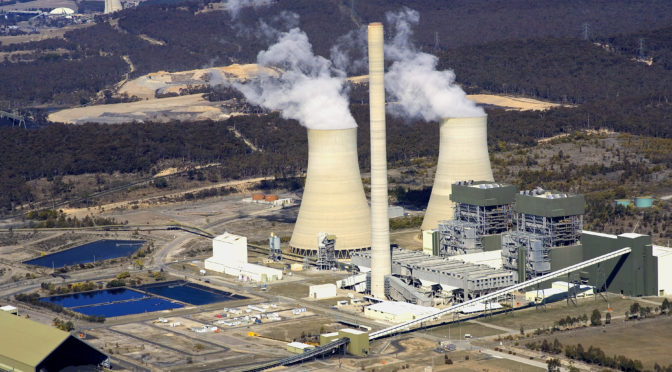
The challenging global environment (largely due to Russia’s invasion of Ukraine), the shutdown of coal-fired power plants in Australia, limited generating capacity, and the colder than usual start to winter, are creating extreme demand conditions.
These challenges aren’t going away any time soon, and will likely result in even larger price spikes in the future.
Fortunately, the Australian Energy Market Operator has taken the extraordinary measure to bring some stability to the energy sector by temporary suspending the normal market operations.
This will reduce the risks of blackouts or supply shortfalls. It will also provide transparency on how generators operate, preventing them from price gouging.
Once we reach some stability, ensuring uninterrupted power supply to Australians, ways to reduce energy cost should be explored. This will take a number of months.
Would having more renewable energy help?
The Labor government plans to significantly increase the share of renewables in the National Electricity Market, to 82% by 2030.
More renewable energy in the grid could certainly reduce energy prices in the medium to long term – it’s the most cost-effective way to generate electricity, and as Australia’s produces its own renewable energy, we’ll be better shielded from global market issues.
But transitioning from fossil-fuel generation to renewables will be difficult, as it requires building significant new infrastructure, which takes time.
So while Australia transitions to clean energy, it’s imperative to set up a short-term strategy to ensure the sector is sustainable. This could include government investment in dispatchable generation – energy that can be dispatched to consumers on demand.
Q&A with Grace Young, Chief of Innovation, Wattwatchers
Grace Young is presenting at the EnergyNEXT clean energy event in Sydney on 19 July, 2022. Her topic is Energy Management En Route to Net Zero: Data and the Internet of Things, the Post-Pandemic Reset & the Electrification of Nearly Everything.
In this presentation she’ll be diving into an energy management marketplace in rapid transition—as energy prices surge globally, Net Zero for electricity looms by as early as 2030, the legacy of COVID-19 is resetting work-life balance for millions of Australians, and the rise of electric vehicles (EVs) is accelerating.
Grace will highlight technology trends and data-driven solutions that are propelling energy management integration into new and emerging use cases in proptech, fintech, mobility and more, including emerging opportunities for ‘energy data as a service.’
In the following Q&A, Grace introduces some of the themes and ideas that fall under this wide-ranging umbrella.
Why do people need energy data?
So often when people get a big energy bill, they feel powerless. It’s all seen as a ‘tax’ that just needs to be paid, rather than something they have any agency in changing. Energy companies are not particularly incentivised to change this, which is probably a big reason as to why we still see static energy bills issued in arrears, often every three months. With such a lag between using energy and seeing the effect on our bills, it’s little wonder people are left scratching their heads when the bill arrives.
More and more folks are starting to look for alternatives—installing solar, and increasingly batteries, to take back some degree of control. However, getting solar panels installed is only half the battle. Using that solar effectively is critical in making the most of the many thousands of dollars invested.
In both cases—whether someone has solar installed or not—visibility of what’s happening is super helpful in being able to make informed choices. And that visibility can only happen with much richer energy data than is provided by the typical utility billing meter (even the ones they call ‘smart meters’).
But energy data doesn’t help with how you use energy. It also helps with ‘big ticket’ purchases that have an impact on energy in the household.
For example, a friend of mine was looking to install solar and was informed that his pool pump was the most likely cause of high energy bills. Because he had energy monitoring in place (a Wattwatchers device provided through the ARENA-backed My Energy Marketplace program) he knew that heating was the biggest culprit. This changed how the solar installer sized his system to optimise his cost savings.
This same friend also discovered a thermostat for underfloor heating had been adjusted incorrectly, ramping up energy usage. He found out on the day it happened, so was able to correct the problem immediately, avoiding a big bill shock. He has also determined that his hot water service is doing strange things, and is researching alternatives to optimise his solar usage for water heating. All made possible by energy data.
Now, to be clear. This friend of mine is not like me—not some big energy nerd who works in the industry. He’s a music teacher, father of two, who loves a good beer watching the footy, and is worried about climate change. But he has been empowered by the simple fact he has access to the data he needs to make sound decisions, and is saving a lot of money in the process.
How does a Wattwatchers device work?
Our devices are shaped like the small circuit-breakers that slot into typical household and business meter boxes or switch boards.
Attached to the device are accessories called current transformers (or CTs for short) that wrap around the individual cables for the electricity circuits coming into, or going out of your meter box, and measure the energy flowing through them.
In a typical home (which is wired in a single-phase configuration), one Wattwatchers device can monitor up to 6 circuits. This includes the main grid connection, tracking both energy coming in (that you purchase from your retailer) and going out (if you have solar or batteries) of your premises. But in addition, we can also track how much total energy your solar system is generating (if applicable), and what portion of that you are self-consuming on-site; and also key energy-consuming appliances and equipment, like electric hot water, air-conditioning units, pool pumps, EV chargers, and general power and lighting circuits.
In commercial and industrial use cases, one device can cover two 3-phase circuits up to 600 amps, which is quite large. We even have a 3000 amp version (the 3RM, which uses larger circumference Rogowski coils to handle such high currents).
The device reads this information and sends it back to our servers over the cellular internet network (the same one your mobile phone uses), or in some cases over a WiFi network—for example, piggy-backing on the home or business WiFi. This data is sent to our servers every 30 seconds (or as often as every 5 seconds) for real-time applications—that is, seeing what’s happening in your premises right now—and also tallied every 5 minutes for historical use.
How can I access my energy data? Are you nationwide?
The energy data from our devices is sent to our servers (hosted in Australia by Amazon Web Services). We store 5 minute data indefinitely, and the 30 second data is available for a month.
For those of you that are technically minded, we make this available via our well-documented API (short for Application Programming Interface).
This is how different apps and services access your data, to provide you the benefits that having this data available can provide. Some of these are our own apps, like the MyEnergy app for iPhone and Android phones. But many, many more are provided by third-parties—the Use Cases section of our website contains a range of third-party provider examples.
Often we’re invisible to the end user, powering someone else’s solution. All this can be done anywhere in Australia, and internationally too. One of the great things about electricity is that it’s broadly the same everywhere.
So, there’s a lot more to a Wattwatchers energy monitor than just the device itself!
What things can you track, apart from usage?
Total usage is a good ‘broad brush-stroke’ indicator for calculating cost, emissions and things like that. But if you have solar, for example, then you also want to know how much of your own generation you are consuming (i.e. on-site self-consumption), and how much that is saving you, whether that be in dollars or carbon emissions.
One of the issues with the so-called ‘smart meters’ used by energy companies (for billing) is that they only provide visibility on two things: the amount you use from the grid, and the amount of solar you send to the grid, if you have solar panels. And this information is usually not available to you at the time it’s being used—often at least 24 hours old, if not more. This is a very limited view that provides very little help to a householder or business owner trying to work out the best way to reduce energy usage.
As mentioned earlier, what is much more helpful is to be able to see usage across the individual circuits, getting real-time alerts for things that don’t ‘look’ right (like the elevated energy consumption my friend discovered in his home).
With real time data, you can make immediate decisions like turning high-energy use equipment on or off, or up and down, as well as being able to take longer-term approaches like energy efficiency and demand management. Wattwatchers devices also collect power quality data, including voltage, which can have a big impact on people’s expensive electronics and appliances if it’s fluctuating too high or low.
What sort of insights can you get from the data?
There are so many things you can learn, if you want to, from your energy data. Energy data geeks will tell you it can be quite the rabbit hole, once your curiosity is piqued and you start looking into it!
But most of us aren’t energy geeks, and so it’s important to get tools that can do a lot of the data analytics heavy lifting for you, so you’re not having to spend hours and hours poring over spreadsheets and the like to make sense of it all.
Patterns of usage are important. So are seasonal changes. Time-of-use can be vital, especially for businesses that face peak demand caps and penalty payments for exceeding limits.
But granular, real-time data can reveal a lot more, including the performance and operational well-being of assets like solar systems, and even supporting fault detection and predictive analytics in industry use cases.
And energy data can be used throughout the process, from finding what you might change through to verifying whether those changes had the impact you expected.
For example, one of our customers specialising in energy saving for data centres uses Wattwatchers data to:
Establish a consumption baseline for cooling units, the main electricity consumers at such sites,
Design their smart interventions,
Prove the savings outcomes they promised have been delivered, and
Provide ongoing monitoring of results over time, staying connected with their customers pending licence renewal negotiation.
In the Internet of Things (IoT) era for energy, lots of real-time data is a basic prerequisite.
How can energy data be used to manage and report on carbon impacts?
Our data is often used by householders and businesses to make important energy management decisions, including optimising time of use, or to identify and verify savings, and also for sustainability reporting and ratings.
When it comes to climate impacts from carbon emissions, electricity is one of the biggest ticket items for many homes and enterprises. So whether you’re just wanting your household to do their bit for a brighter future, or a business that is required to report on this for regulatory reasons, or by larger businesses you supply to, knowing what’s happening with energy in your premises is really important.
It’s not just how much energy you’re using, but also how much of it is coming from different sources, including the coal-heavy grid, or your own solar if you have it, for example. Wattwatchers provides the data for our customers to do exactly that.
It’s pretty easy to take the data provided by Wattwatchers devices to generate the reports you need. Firstly, by taking your baseline measurements to know where you really stand. Then by monitoring for the effects of changes you’ve made.
There are a number of carbon accounting platforms coming to life, but for the moment many are relying on averages to do their calculations. But devices like Wattwatchers, that provide more granular data, can make these calculations more accurate. See, for example, our recent blog post on hourly carbon accounting for the sort of difference this can make. The old adage “you can’t manage what you can’t measure” is as true as ever for carbon accounting, when it comes to electricity use.
But there’s so many more possibilities, not just the immediate benefits for a business or household, but for the system as a whole. For example, the Australian Energy Market Operator (AEMO) and leading university researchers have been using data from Wattwatchers devices, via one of our oldest customers Solar Analytics, to better understand how solar inverters behave during periods of high voltage variability. This sort of research has proven to be vital in ensuring the stability of the nation’s electricity supply in the age of distributed energy resources (DERs)—a transition led by householders with rooftop solar.
And this is super-important if we, as a community, want to see more and more renewables powering our electricity grid.
What are some of the more ‘left field’ applications of energy data you’ve seen?
I’ve already mentioned industrial use cases like fault detection and predictive maintenance, drawing on energy data-related ‘signatures’ and ‘patterns’ that can be revealed by granular monitoring. So, this uses our data for much more than just monitoring consumption.
Another example of thinking ‘outside the box’ can be found in using energy data to remotely monitor electricity in a home to provide a ‘protective watch’ over a loved one, across town or perhaps much further away. For example, getting an alert if Nanna doesn’t boil the electric kettle in the morning. Kind of an energy data-enabled chaperone from afar. I personally would have really valued this service when my Mum was ailing and had a fall at home and was unable to get up. Thankfully, in this instance, she had a care visitor later that morning to assist her. There have been startups that have incorporated energy into a broader suite of monitoring tools to provide this exact service.
By making energy data more accessible, especially via initiatives like the My Energy Marketplace project, we hope to spur innovation and creative, curious thinking to make these innovative services a reality.
Can you explain ‘Energy Data as a Service?’
I came to Wattwatchers from a startup that wanted to do this sort of innovation, creating a platform for local energy trading, where a householder with solar could sell their energy to their neighbours, or family and friends.
When starting out, I was coming to the energy space with a ‘digital innovation’ mindset, having been in the digital world for many years and seeing the rise of data-led startups in ecommerce, social media, entertainment, and many other fields.
I kind of assumed that energy data would be fairly easy to access—that if we got the customer’s permission we’d be able to tap into smart meter data, or the like, to power our service.
Howdoody was I wrong!!
Like myself, I think lots of people underestimate how hard it is to collect energy data, especially at a granular level inside people’s homes. I suspect most people have never really even thought about it.
Historically this has meant that many business and government initiatives have been designed without actual measurement and verification, and use estimations and deemed results in the absence of real data. Government energy savings schemes, such as those currently operating in NSW and Victoria, are great examples of this.
Australian and global concerns about consumer data rights, including privacy and security, are making it even harder to collect data, hold it, and make it available to third parties. (We are very supportive of this increased focus on privacy and security, to be clear. But it certainly doesn’t make our jobs, as innovators and creative thinkers, any easier!)
With some very welcome government support, Wattwatchers has invested in developing a model for data sharing—with pre-approval from customers, and built-in protections and rewards for them—which underpins our emerging business offering that we describe as energy data as a service.
Basically this means that we do the hard work of collecting the data, and making it shareable with third parties. This is often anonymised, but even in this form it’s still immensely useful and valuable because it’s so hard to get otherwise.
Our early data service customers include some of the nation’s leading research institutions working on our energy future. And we’re really excited to explore more and more opportunities.
The energy crisis and unprecedented take over of the market by AEMO has spun many customers into panic, getting a glimpse of the fragility and lack of control we have over our energy supply. And let’s not even talk about the anxiety that we all now feel when we receive our power bill in the mail!
Threats of black-outs and demands to not use dishwashers at certain times has led the customer to take a closer look at, what a lot of them thought, was just an ‘on tap’ resource.
But for many customers, there is a bewildering array of options on what to do to make a difference and many don’t understand that it is many small changes that will effect a big change.
To get some clear direction on things that could genuinely make a difference, the country’s top energy experts were asked what would be the one piece of advice that they would give to customers and businesses to help.
These professors and professionals will all be talking at Energy Next, a free-to-attend industry event focusing on the latest renewable energy and energy management technologies, that is being held in Sydney on the 19th-20th July 2022.
From solar tips to data management and heating the body rather than the room to fast-tracking EV purchases, this is what they said:
Consumer Tip:
Home owners that have solar and batteries, and are using them optimally, are somewhat shielded from the big price fluctuations we are seeing. So now is a great time to be looking at whether solar and a battery will work for you, if you don’t already have it. Especially so given new, low-interest ‘green loan’ options that are coming onto the market. But having solar is only half of the battle. Optimising your use of that solar by aligning your usage with when your panels are generating, is critical.
Many solar systems only give you a small part of the picture ‘out of the box’ (e.g. how much you’re generating). Knowing where your energy is being used, through energy monitoring across all your key circuits (like aircon, pool pumps, hot water, and EV charging), is critical to make the most of your investment.
Business Tip:
The adage “you can’t manage what you can’t measure” is more true than ever in the current circumstances. It can be a surprise to find that what you thought were your ‘big customers’ aren’t the worst (or only) culprits for high energy use. For some businesses, demand charges can also be a killer—so knowing exactly what you’re using, in near-real-time, can be the difference between a reasonable bill and a blow-out. And, of course, it’s not just about the direct costs of electricity—many businesses are now having to report on their carbon emissions, and often electricity consumption is a big contributor. In all of these cases, having solid energy monitoring in place is key. Grace Young, Chief of Innovation, Wattwatchers.
Consumer Tip
Bite the bullet and invest in an Electric Vehicle. That sales guy that wants to shift his inventory of petrol burners is not going to mention that EVs are incredibly cheap to run.
Business Tip
Measure, monitor and manage energy usage and the performance of your solar system. What gets measured gets improved! Matt Stubbs, Director, Profergy
Consumer and Business Tip
Data will be the primary determinant of energy investment returns and operational stability. Given the rapidly changing nature of energy models and interoperability requirements, one cannot pre- determine which data will be most important in the future. Data requirements for asset owners, grid operators, traders, regulators and analytics companies are vastly different and require different capture methods, granularity and delivery mechanisms.
The logical approach is that asset owners take full control of their OT data by independently collecting, normalising and consolidating all their OT data regardless of source. Cybersecurity and accessibility of this OT data needs to be tightly managed, both inside and outside the organisation, to share with experts, to integrate new business models and to drive innovation in machine learning, predictive models and artificial intelligence.
A data-centric strategy is the critical foundation to optimise performance in this highly competitive and rapidly changing sector.
Energy companies need to discard old operating models and embrace new OT data competencies. Those that do not will be rapidly “disrupted” out of the industry.
Tim Lane, Ardexa, Senior VP Sales & Marketing Asia Pacific.
Consumer Tip
If you have solar PV, run your power hungry appliances (like washing machines, dishwashers) during the middle of the day. This will help reduce strain on the energy grid and reduce your carbon footprint – and if you have a time-of-use tariff (where the rates are cheaper in the middle of the day) it will also save you money. Dr Scott Dwyer – Research Principal, UTS Institute for Sustainable Futures
Customer tip
Stop heating the space using an aircon. Instead, use an electric blanket to “heat the body.”
Business tip
Working from home? In the longer-term, co-host the renewable generation capacity and storage for hydrogen production/export within the national electricity market. Dr Chang Wang, Postdoctoral Research Fellow, Monash University
Business Tip
Enosi would recommend that businesses pay attention to both their bottom line and their ESG responsibilities as they contract for energy supply and manage their use.
Locking in a supply-linked PPA through your retail energy provider that is matched to renewable sources will both capture the lower cost of renewable power, and support further investment in renewables. This is known as a 24/7 PPA, and is becoming more popular among ESG leaders in the US and Europe.
Matching consumption to when your supply is actually generated will put businesses on the path to ‘true zero’ carbon, incentivising demand shift to when solar/wind are available, and the development of resources that fill the gaps in renewable supply. Steven Hoy, CEO, Enosi
Business and Consumer tip
My response for both is energy efficiency – replacing expensive-to-run items, which requires the support of government, landlords, industry etc. It’s not innovative or exciting but remains the first thing anyone should do. Dr Kathryn Lucas-Healey, Research Fellow, Australian National University
Customer Tip
Put as much solar on your roof as you can fit ASAP. Then use Solar Analytics to find an awesome electricity deal (hint it is likely to be a retailer who is well hedged or has generation). Stefan Jarnason, CEO, Solar Analytics
Consumer tip
Install a heat pump for your hot water – that’s >40PJ of saving for Australia right there (~60% of that would be gas). Just make sure you go for a quality name like Reclaim, Sanden or Steibel Eltron, otherwise you’ll get a noisy heat pump that doesn’t do enough heating in winter. If you have solar panels, make sure you can program the heat pump to come on during the day – that will double your return on investment. If you don’t have panels, make sure you can program the heat pump to only come on during off-peak electricity times.
Business tip
What can you do in one day? Good maintenance – fix steam leaks, compressed air leaks, insulation damage etc. What can you do in one week? Get sub-metering installed for electricity, steam, gas and water – that will reveal waste, often fixed by simple behaviour changes (e.g. closing cool room doors). Jarrod Leak, CEO, Australian Alliance for Energy Productivity (A2EP)
Consumer tip
Improve your self-sufficiency to rely less on the energy system to meet your demands by reducing your overall demand, switch to solar energy during the day and complement your solar with a battery system for peak demand times or night-time or when the grid is down. Adrian Knack, Director of Engineering, Redback Technologies
As networks come under increasing pressure due to the increase of renewable energy on the power network, and start to face operational challenges where the demand may fall below the minimum demand threshold, security challenges may occur. While standards have been updated to account for shedding PV capability other solutions exist to optimise the network loads. Utilising low-cost CAT M1 mobile network devices to control loads such as hot water, pool pumps, and even older inverters such that they can obey demand response signaling has become a viable alternative to the replacement of aging audio-frequency load control hardware.
The benefits of moving to a CAT M1 IoT have numerous advantages of AFLC. Two-way communications for greater insights into the load can be added or removed from the network at any given time. Data over time also allows for a more accurate prediction of the switchable load into the future. The speed of the data transfer means the loads can also react in real-time to un-forecast events. Adding additional capabilities to monitor grid conditions to these devices to protect homes from safety-related issues such as broken neutral, voltage sag and swell and other quality of service metrics means that CAT M1 IoT devices may be the future of ensuring the safe and stable operation of our power networks into the future.
We spoke to Adrian further about this proposed solution to manage possible demand thresholds:
Why will there be a problem if demand falls below the minimum demand threshold with our new renewable energy sources? You talk about security challenges – what sorts of impact would they have?
Primarily the issues which we’re seeking to help mitigate are around voltage management, unintended disconnection of distributed solar, frequency response. This would be done by using an IoT device (such as Luceo Link LV) which communicates on Telstra’s CAT-M1 network to monitor and control loads (e.g. hot water, pool pumps, etc.) to either increase or decrease the load on the electrical grid.
Can you explain how the CAT M1 technologies will control power loads?
CAT-M1 is a low power wide area network cellular technology (like 4G/5G but lower bandwidth). It was specifically developed for lightweight edge device processing and control. Utilising this communications medium in the context of load control for the electrical grid means that we are able to monitor power usage and quality of service (of the electrical grid) in real time. Furthermore, because the communications are two ways, just like your phone internet, you can send control signals to connected devices to have them operate in certain ways (which the home owner would have to agree to) in order to support the stability and security of the electrical grid (to help ensure there are no blackouts… or at least a reduced risk).
Can you give us an example of a CAT M1 technology and how many households already have these sorts of units?
I’d probably move away from CAT-M1 at this point, it is just an enabling technology. Other internet based technologies exist (like home wifi) but CAT-M1 is good because it is like your mobile phone subscription it doesn’t require user setup.
In Queensland, they have the AFLC system to control loads on different tariffs, but this is limited because you don’t get feedback from each house/load if it actually got the signal and responded. The IoT solution ensures compliance to the command being issued and it is easier to assess the impact. It is also easier to turn the control to specific houses, suburbs, device types. etc.
Some solar and battery inverters offer relay control of devices which could operate in a similar way but inverters are significantly more expensive than a small control device.
How do they integrate into the existing power network/grid integration?
This is installed in the home owners meter box typically (at least the Luceo Link LV which we offer). This makes most sense because the networks are only interested in large loads (e.g. hot water) which would make a significant difference to the power on the network. But in theory you could extend all the way to things like smart plugs.
How would the consumer integrate these CAT MI technologies into their local/ at home energy network?
An electrician would typically install the device in the home owners (or commercial facility) switchboard and connect the control relay to the load being controlled.
Has this solution been tried and, if so, what were the results of this trial?
We’ve had a trial of 50 homes in Queensland for the last 12 months. The trial controlled the home’s electric hot water systems and experimented with adjusting the operating times of these systems to perform tasks like solar soak (using excess solar on the grid during the day) and removing loads from the grid during peak usage times (i.e. morning and evening).
There is a lot of discussion about the instability of a grid powered by renewable energy, what are the key things that need to happen to mitigate against this instability?
Visibility of the low voltage network is the first step. Once we have clear visibility rather than projections and assumptions we can start to make better decisions on how to operate the grid and where to invest in infrastructure to ensure the stability of the network. This also allows for better decision making in future- proofing the network for 100% renewables, electrification of transportation (e.g. EVs) and net-zero emissions by 2050.
For more information or to register for free for Energy Next, go to: https://www.energynext.com.au/en-gb.html
Image: Jun Qu, Senior Investment Associate at Main Sequence
To solve this century’s global challenges — and the next — founders, policymakers, industry leaders and investors must collaborate in order to successfully commercialise research and bring these new technologies to the world. Senior Investment Associate at Main Sequence, Jun Qu, shares six lessons he’s learnt about building a deep tech innovation ecosystem.
The Silicon Valley Zeitgeist
After spending five years in the Bay Area— first at Stanford University and later with McKinsey’s internal tech incubator and investing group, Launch — there is something to be said about the way ideas are nurtured in and around Silicon Valley.
Although a vast majority of these lessons come from SaaS and consumer tech, the tried and true favourites for venture investors, the fundamentals behind what makes a venture investible or scalable are the same.
For the scientific and engineering solutions needed to fix the planet’s biggest challenges, these elements are arguably even more important, and the stakes have never been higher, so where better to unearth these solutions than Australia, a world leader in deep technology research.
For Aussie deep tech researchers and founders who are taking the leap, here are six lessons we can take from our American counterparts:
Tell the story The most compelling founders are the best storytellers. Irrespective of the complexity of the idea, the concise and confident communication of an idea is important. Break it down so everyone from everyday consumers to world-leading researchers can understand the impact, and don’t get stuck in the weeds.
Focus on the problem In VC, it is common to see numerous ‘solutions’ in search of a problem — aka ‘if you build it, people will buy it’. As a former engineer, it took a shift in my own mentality to understand how investors and customers think. Maintain focus on the big problem you are solving, and the impact will follow.
Perfect is a luxury A mentor once told me “to never let best get in the way of better”. Engineers like to get things perfect and bug-free, but the objective for new ventures is to achieve good enough. Up against limited capital and time, over-engineering something is a luxury. Start with the minimum viable product and consider what is truly necessary to prove your proposition.
Celebrate wins… and losses Tall Poppy Syndrome is common in Australia, threatening our entrepreneurial spirit and leaving our most ambitious ideas on the table. It hurts us whether we win or lose, and is a key cultural aspect that needs to change. We must be proud of the hard lessons, celebrate the wins and swing for the fences more often.
Make collaboration habitual Business is rarely a zero-sum game and we can unlock more opportunities through collaboration. From building new products by combining products to co-investing in shared infrastructure and educating across industries, collaboration is essential to growing the deep tech ecosystem. Be curious, explore the possibilities, and say yes more often.
Ask for help Engineers hate having to ask for help. But, unless we are on the bleeding edge, it’s highly likely someone else has done this before. It is more efficient to seek help than start from scratch and it means things get rapidly done. It’s okay to not know, but avoid spending precious time and energy reinventing the wheel on something that has been done before.
The global opportunity for Australia
From CSIRO’s invention of WiFi to pioneering the Cochlear implant, Australia is responsible for some of the world’s most significant scientific breakthroughs.
More recently, the runaway success of SaaS and fintech darlings including Atlassian, Canva and Afterpay has returned Australia to the stage as a global leader in innovation. However, the effective translation of research is where we have an opportunity to really shine.
We’re already seeing the emergence of purpose-driven founders tapping into Australia’s science capability to translate impactful research for planetary gain.
Take Dr Stefan Hrabar and Dr Farid Kendoul as one example. Formerly researchers within the Robotics and Autonomous Systems Group at CSIRO’s Data61, the duo saw the real-world potential of their research and decided to turn these ideas into a commercial enterprise. They have since founded Emesent which has grown to be recognised as a world leader in drone autonomy, LiDAR mapping, and data analytics.
Space startup Quasar Satellite Technologies and industrial AI innovator Presien share similar founding stories and are leveraging research to deliver technologies that are drastically transforming their respective industries.
Australia’s world-class research capability means the opportunity to be a leader across industries like hydrogen, space and quantum technologies is well within reach.
Main Sequence Managing Partner, Bill Bartee, often says, “We’ll do anything it takes — we’ll mop the floors if we need to,” and it’s this dedication to building future technologies which sets us in good stead.
While many countries are trying to create the next Silicon Valley, let’s instead lean into our history of bringing domestic ingenuity to the global stage. Australia’s deep tech ecosystem is thriving, and we’re confident investors and global leaders will increasingly look toward the southern hemisphere as a place that nurtures the scientific-backed industries that future generations will depend on.
Charles Darwin University (CDU) will house an advanced manufacturing and test flight facility for the development of drones, as well as broader aerospace and defence industry parts.
The CDU-RMIT TestLab is a joint investment from the Federal Government, the Northern Territory Government and CDU, each contributing $1 million to the project, which will drive workforce transformation in Northern Australia.
CDU will partner with RMIT University, who will offer its knowledge in aerospace and defence industry, and Siemens who will provide high-tech software used by leading aerospace, defence and other industries world-wide.
The facility will be located at CDU’s Casuarina campus and will adopt and showcase Industry 4.0 practices and technologies. Industry 4.0 is the digitisation of the manufacturing process and is significantly transforming the way we innovate high-tech products.
CDU Vice-Chancellor Professor Scott Bowman AO said the TestLab project would showcase CDU’s strengths to support the advanced manufacturing and strategic priorities for Northern Australia.
“The establishment of the TestLab with RMIT is a tremendous opportunity for us to combine our expertise and facilities to strengthen the Australian aerospace and defence industry,” Professor Bowman said.
“Hosting a TestLab means we have first-hand access to sophisticated facilities that allow the advanced manufacturing of aerospace and other uncrewed autonomous technologies.”
Minister for Education Jason Clare said the Testlab will encourage university and industry collaboration and help keep Australia at the forefront of technological advancements in Industry 4.0, or the fourth industrial revolution.
“The project will strengthen the links between defence and aerospace industries and CDU and contribute to work by the NT Government to strengthen digital infrastructure in Darwin,” Minister Clare said.
“Once established, the Testlab will support advancements in the manufacture of remotely piloted aircraft as well as incorporate AI-assisted virtual planning, production, manufacture and maintenance to accelerate product quality and efficiency.”
Chief Minister of the Northern Territory Natasha Fyles, said the CDU Testlab would be a significant boost to Darwin and the Northern Territory, while also creating new educational pathways and skills relevant to defence and aerospace industries.
“The establishment of an Industry 4.0 Testlab at CDU will be an exciting and welcome addition to the Northern Territory, and gives new and exciting opportunities for our students,” Ms Fyles said.
“We are launching rockets from Arnhem Land, and building the world’s biggest solar farm in the Barkly. The addition of this new technology is the first of its kind for the NT and will build upon our advanced manufacturing capacity and strengthen Australia’s defence and aerospace research capability in the region.”
Australian Industry 4.0 TestLabs network Chair and former Deputy Vice-Chancellor STEM College and Vice-President Digital Innovation RMIT University, Professor Aleks Subic, said that both universities brought strong capabilities in technology innovation for the aerospace, defence and space sectors.
“RMIT has been a partner of Australia’s defence and aerospace sectors for around 100 years and this announcement marks an important milestone in the transformation of Australia’s aerospace and aviation industry,” Professor Subic said.
“RMIT and Charles Darwin University will bring the right expertise and collaborative approach to developing relevant technological solutions and workforce transformations that grow local industry.”
Director of the North Australia Centre for Autonomous Systems at CDU, Professor Hamish Campbell said the project would attract innovative new businesses to the Territory.
“We are seeking local businesses or interstate businesses wishing to relocate operations Darwin to partner with the TestLab,” Professor Campbell said.
“This is an exciting opportunity for Territorians wishing to pursue a career within the rapidly growing drone industry.”
“The pathway to Industry 4.0 centres on the optimisation of opportunities presented by digitalisation and the defence industry is a leader when it comes to product ideation and creation,” Ms Murray said.
“We’re proud to partner with CDU and RMIT to bring students closer to the same high-tech software being used by leading aerospace, defence and other industries worldwide, giving them the opportunity to stretch the boundaries of product innovation.”
A range of training programs will be introduced to support Australia’s Uncrewed Autonomous Systems as well as a new Higher Diploma in Advanced Manufacturing, which is being fully funded by the Federal Government, and open to enrolment later this year.
Construction of the TestLab will begin in July in anticipation for a late 2022 opening.
Lithium demand is being driven by the ever-expanding lithium-ion battery market – the leading technology for portable electronics and electric vehicles, which has revolutionised our lives over the last 30 years.
Australia supplies about 60 per cent of the world’s lithium in the form of a mineral concentrate called spodumene. With an abundance of ‘hard rock’ lithium, we are amongst the countries with the largest lithium deposits globally.
The conventional way of extracting lithium from spodumene is in a rotary kiln, which requires very high temperatures (>1000 °C) and can only be applied to spodumene of a certain type and size.
This process is highly energy intensive, and the constraints placed on the feed applicable to this process, results in a large proportion of the lithium in these hard rock deposits to be wasted.
The issue scientists at ANSTO together with LIT have been working to address, is that these current techniques only recover between about 50 to 70 per cent lithium from the original ore.
The two organisations developed a process called LieNA®, which removes the need for high temperature processing and is ideally suited to processing of the waste, and realising the majority of the (lithium) value from Australia’s hard rock deposits.
Patented by Lithium Australia, the LieNA® technology involves an initial treatment of the waste spodumene with caustic under autoclave conditions to form a synthetic lithium sodalite which can be easily recovered.
Lithium is then easily extracted and purified in relatively straightforward, hydrometallurgical processing steps and finally isolated as lithium phosphate, which can be directly used in manufacture of lithium ferro-phosphate batteries.’
The new technology enables the majority (>95%) of the lithium value to be realised, with vastly reduced energy inputs as compared to conventional processing.
Drive costs down, and get more from your rocks
Dr Chris Griffith, Senior Process Chemist at ANSTO, explained that not only would the new technology improve the overall extraction, it avoids the energy intensive, high temperature step of conventional spodumene processing, and increases the sustainability of lithium operations world-wide.
“Until now, it has been quite accepted by industry that a large amount of lithium is ‘lost’ during processing. We’re the first in the world to achieve such an efficient level of extraction,” Dr Griffith said.
“This technology really has huge potential for an industry which is integral to our transition to the electrification of transport, and ultimately to a cleaner and greener future.”
In early 2020, Lithium Australia Limited was awarded $1.3 million from the Federal Government’s Department of Industry, Science and Technology CRC-P Round 8 program.
The overall objective of the CRC-P program is to progress the development of LieNA® to a Feasibility Study level and eventual commercialisation of the LieNA® technology.
“ANSTO has been pleased to work with Lithium Australia Limited on processing technology development since 2015, and it is sensational to see the LieNA technology reach this stage,” Dr Griffith said.
An industry partnership with huge potential for the Australian economy
Stuart Tarrant, Chief Financial Officer at Lithium Australia, said “Partnering with ANSTO to develop the LieNA® technology has been highly beneficial to Lithium Australia.
“Upcoming ESG regulations are forcing the industry to consider ways to improve recoveries and shorten supply chains.
“If commercialised, LieNA® has the potential to achieve both and as an outcome we have experienced higher interest from lithium concentrate producers.”
Demand for lithium has reached record level highs and the amount of metal used has almost quadrupled in the last decade.
“The possibilities here are tremendous – some estimates are that the global lithium-ion battery market size will grow from USD 41.1 billion in 2021 to USD 116.6 billion by 2030,” Dr Griffith said.
“Innovation like this puts Australia in a good position to move away from simply supplying a mineral concentrate to overseas converters as quickly as possible.
“It provides another avenue for Australia to maximise the value from our valuable critical and energy mineral resources and allows us to conduct more value-adding downstream processing here in Australia.”
Compared to lead-acid batteries, lithium-ion batteries lose less charge when not in use, and almost all lithium-ion battery components can be recovered and re-used.
ANSTO has more than a 40-year track record of partnership with the mining and minerals industries, and a team of more than 60 dedicated professionals and technicians working in the Minerals business unit.
With Australia in the grip of its worst-ever engineering skills shortage, first-of-its-kind research by Engineers Australia reveals the reasons women aren’t entering the profession – and what needs to happen to change that.
Shock findings from the Women in Engineering Report show that the biggest reason girls don’t choose to study engineering is that they simply don’t know what engineering is, and what engineers do.
With the new Labor Government committing to both a strong women’s agenda and addressing our skills crisis, Engineers Australia Chief Engineer Jane MacMaster says these findings are a clarion call for swift political action to stem the gender imbalance and, drive a new generation of women engineers
“Women make up 48% per cent of Australia’s workforce, yet account for just 13% per cent of the nation’s working engineers. Women are missing in action from the profession and this research tells us what we can do to change that.”
Of the 1,400 respondents, a whopping 90% of women in non-engineering fields did not consider it as a valid career option. Other barriers include the perception of engineering as too ‘male-dominated’, challenging or boring; and girls not feeling supported to do well in STEM subjects from as early as primary school.
With the research also revealing more than 90 per cent of girls at least partially committed to a field of study before year 11, MacMaster says we now have proof that early intervention and education are the key.
“We need to target four main groups: schoolchildren, their parents, their teachers and careers advisors. If parents aren’t aware of the breadth of opportunities in engineering, they’re less likely to make their kids aware of it.”
Australian Government Women in STEM Ambassador Lisa Harvey-Smith says attracting women to engineering is critical to meeting the engineering needs of our booming economy.
“It makes no sense to ignore 51% of our population in the design and construction of our infrastructure and technologies. Australia needs to seize this opportunity, with efforts needed in explaining the positive outcomes of engineering better so that more women want to train as engineers, but most crucially in improving the culture and work practices of the industry so that they want to stay.”
Key Research findings
Lack of familiarity is the single top stated reason for never considering engineering
90% of women in non-engineering fields either briefly or never considered engineering
Concerns around not enjoying or being good enough at maths and physics are also prominent
Most common female perceptions of engineering are ‘male dominated’ and ‘challenging’
Women are less likely to associate engineering with positive attributes such as ‘respected’, ‘impactful’, ‘creative’, ‘fulfilling’ and ‘exciting’.
There is a strong correlation between familiarity with engineering and consideration of study 65% who were familiar considered studying it compared to only 11% that were not at all familiar.
Solutions:
To get more young girls into engineering, we need to address their key drivers – around fulfilling work that matches their personality and interests
There is a perception that girls must excel in STEM subjects, not merely do well in them, to get into engineering
Early intervention and education are key – starting with primary school and into junior high school
Engineers (women and men) see value in more exposure and promotion of the profession early
Dr Scott Dwyer, Research Principal, UTS Institute for Sustainable Futures explores how Heyfield, Victoria could dictate the path for all edge of grid towns in Australia
More and more communities are looking to make energy work better for them, spurred by a desire to use their local resources more sustainably for the greater benefit of those who live there.
While there is already substantial momentum building with local energy projects, determining a viable path is challenging. What resources can be developed? Which technologies and partners should they choose? What business models will be financially viable? How can the benefits be equally shared among the community?
MyTown aims to answer these questions for the Victorian town of Heyfield, while also seeking to develop a replicable model that can also bring benefits to the surrounding region, as well as other edge-of-grid towns around Australia.
Over the next three years, MyTown will test the viability of microgrids as a local energy solution for the town of Heyfield in Victoria.
A ‘microgrid’ can be defined as a group of homes or businesses that generate, use and share electricity. With the ability to be controlled as a single entity, microgrids are able to connect and disconnect from the main electricity grid as required.
Microgrids have the potential to enhance the integration of renewable energy, draw on local resources, drive deep carbon reductions, and overcome local grid constraints. They can also support the decarbonisation of the wider energy system while also improving overall system resilience.
However, there are many options for communities looking to understand whether a microgrid makes sense for them and determining a viable path can be difficult to navigate.
[l-r]: Moragh McKay, Julie Bryer, Caroline Trevorrow, Tim MCoy, Emma Birchall, Scott Dwyer, Kristy Walters
The Heyfield community
Heyfield is a town of around 2,000 people located in Wellington Shire, Victoria. With a long track record in sustainability initiatives and considerable potential for low-cost and local energy, Heyfield is an ideal location to pilot a new approach with a community at the helm.
Using Heyfield as the model community, the project will bring together progressive industry, community and research partners to pilot an innovative approach to a microgrid feasibility
As well as understanding the feasibility of a microgrid for Heyfield, the project will also develop the knowledge and tools to make it faster, easier and cheaper for other fringe-of-grid towns in regional Australia to do the same for their communities.
Want to know more?
Energy Next is a free-to-attend B2B exhibition showcasing the latest clean energy innovation and technologies, which will be held alongside Clean Energy Council’s Australian Clean Energy Summit. The event will be held at the International Convention Centre (ICC) in Sydney on the 19th-20th July. Interested parties should go here to register for the event.
The University of Queensland will lead Australia’s effort to supercharge commercialisation in the food and beverage industry, with a share of $362 million in federal government funding.
The UQ-led Food and Beverage Accelerator (FaBA) project will receive $50 million Trailblazer funding over four years to boost growth and innovation in the sector, potentially creating thousands of new jobs.
The Director of UQ’s Queensland Alliance for Agriculture and Food Innovation, Professor Matthew Morell said the project is backed by industry and innovation partners, along with Queensland University of Technology (QUT), the University of Southern Queensland (USQ), CSIRO and the Queensland Department of Agriculture and Fisheries.
“This is about working together to create new technologies, products and businesses in the food and beverage sector which will ultimately create jobs and boost the Australian economy,” Professor Morell said.
“By 2030, this project aims to contribute to doubling the value of Australia’s food and beverage manufacturing sector through a focus on smart production and new ingredients, creating innovative foods and beverages.
“FaBA is expected to help attract $1 billion in investment into food and beverage manufacturing and create 1700 skilled positions, along with a further 15000 jobs across the sector.”
UQ, industry partners and UQ’s university collaborators will also invest a further $110 million funding in the project.
“This will be a catalyst for commercialisation and a game-changer for this sector,” Professor Morell said.
“This investment will allow innovative smaller businesses to accelerate their capacity for developing and manufacturing products that meet changing consumer needs, such as the desire for premium products.”
Food and beverage manufacturers will have access to affordable pilot facilities and state of the art equipment to test new products and FaBA will also work with CSIRO to use existing national facilities in food research.
Congratulating the bid team, UQ Vice-Chancellor Professor Deborah Terry said the project will allow UQ, with the support and funding from government and industry, to build successful, enduring and innovative partnerships for the benefit of the economy.
“This is an exciting opportunity to be at the forefront of research that has a critical role in creating new products, companies, technology and jobs, not just for Queensland, but the entire country,” Professor Terry said.
“I’m particularly pleased that this project will also result in direct investment in regional Queensland, with infrastructure and enterprises to be developed in Toowoomba, Mackay and Cairns.
“I’d also like to acknowledge the expertise of UQ’s commercialisation company UniQuest in supporting the development of this project from an exciting idea to reality.”
The project is supported by Industry partners: Kalfresh, Simplot Australia, Gelita, v2food, GrainCorp, Meat and Livestock Australia (MLA), Nourish Ingredients, All G Foods, Eden Brew, Change Foods, Phyllome, and BioSouth. Research partners: Queensland University of Technology (QUT) and University of Southern Queensland. Commercialisation partner: UniQuest. Innovations partners: AgriFood Connect, and FKG Group.
For more information about the Federal Government’s Trailblazer Universities Program, visit here.
The examination of meteorites recovered from the Nullarbor Plain in western South Australia by a joint team that included Dr Andrew Langendam from the Australian Synchrotron contained organic residues in the form of microfossils preserved in mineral veins within the dense rock.
“It has been an established site for finding meteorites since the 1980s. The dark iron-rich meteorites stand out against the white limestone and red soil of the plain, “ said Dr Langendam. Link to video
The research revealed that a variety of fossil microorganisms, diatoms, bacteria and fungi, were entombed and preserved within veins of calcite and gypsum.
X-ray fluorescence microscopy at the Australian Synchrotron supervised by instrument scientists Dr Jessica Hamilton (then a PhD student at Monash) and Dr David Paterson, both co-authors, confirmed that redox-active metals, such as manganese and iron, were mobilised in vein-filled cracks within the meteorite by environmental or microbial activity.
“The location and quantity of calcium, iron and manganese can be delineated in the sample by the ultra-sensitive technique. It revealed that the manganese enrichment occurred at the rim of calcite-gypsum veins,” said Dr Hamilton.
The research team noted that meteorites could preserve a suite of microfossils, organic biosignatures and records of nutrient cycling under the arid conditions on the Nullarbor.
Co-lead author on the paper published in Geochemica et Cosmochemica ActaandFrontiers in Microbiology, Dr Alastair Tait from Monash University’s School of Earth, Atmosphere and Environment, said in a news report on the Monash website, “This is an original finding and it is important because it shows us that microorganisms can interact with astro-materials in a way that is vital to their metabolism.” Read more
Co-lead author Prof Gordon Southam of the University of Queensland’s School of Earth and Environmental Sciences said in a news report on the UQ website, “This adds a new dimension to the search for life on Mars, targeting comparable meteorites on the red planet.”
“Essentially, they provide a time capsule of past biological activity, or, in the case of samples from the Nullarbor Plain, meteorites can serve as a refuge for life,” said Prof Southam. Read more
“They act as lifeboats for life on a hostile surface, where there are not many bioavailable minerals,“ said Dr Langendam.
Mars has an extreme environment compared with Earth. The temperature on the desert-like surface of the Red Planet is approximately -62 degrees Celsius. Its atmosphere is very thin and made up of 96 per cent carbon dioxide. The atmosphere of Mars is far less dense than the atmosphere of Earth, with inhospitable low atmospheric pressure.
“By studying how meteorites on Earth are altered by weathering and microbial activity, it may help to know what chemical signatures to look for when we study the same meteorite material that fell on Mars, which could have been weathered and potentially altered by any life there. Looking at meteorite chemistry as an environmental record, and as a potential way to compare processes on Earth and other planets, is a new idea and really exciting,” said Dr Hamilton.
Although the Martian landscape has been studied by a series of exploratory vehicles, including the most recent Perseverance Rover, no actual samples from the planet’s surface have been returned to Earth as yet. The samples are analysed by instruments on the surface.
The research team suggested that samples returned from Mars will be used to build an overall picture of the volcanic and sedimentary history of Mars, in which past life might be preserved.
A more recent report on the project was reported in Astrobiology, where it was featured on the cover.
ANSTO supports a number of research activities relating to planetary science. Learn more