

Tag Archives: education

30 years of revolution in university science education

Image: Shutterstock

Photo of Merlin Crossley
Professor Merlin Crossley. Credit: Supplied.

It’s called the “sage on a stage”: an expert dispenses information to a hall full of students, who, in theory, listen attentively and take notes. It’s a style of university education that hadn’t changed in centuries. That is until the past 30 years, during which a “revolution” has occurred in Australian university science education, according to Merlin Crossley, deputy vice chancellor of academic quality at UNSW.

COVID had a lot to do with it. The “temporary” shift to online learning never quite went away. The growing diversity of students also nudged university science departments to look at their practices. Where once Australian university students tended to be middle- and upper-class school-leavers, the past 30 years has seen them diversify. There are more mature-aged students, students from different economic, educational, linguistic and cultural backgrounds, and overseas students.

Setting the standard

Professor Elizabeth Johnson, Deakin University. Credit: Supplied.

The changing nature of university science education is not new. In the late 2000s, the Australian Council of Deans of Science established its Teaching and Learning Centre (T&L Centre) to support and drive innovation in university teaching and learning and recognise excellence in education. Amongst its successes was the development of Science Threshold Learning Outcomes (TLOs), first released in 2011.

Brian Yates, emeritus professor, University of Tasmania. Credit: Supplied.

Professor Elizabeth Johnson (Deakin University) was the inaugural director of the ACDS T&L Centre and says the TLOs are the result of one of the largest consultations across Australia on the university science curriculum, developed with teachers, researchers, university leaders, industry and students. “They set the standard for what a science graduate ‘should know and be able to do’,” she says.

Brian Yates, an emeritus professor at the University of Tasmania and ACDS Immediate Past President, was also involved in the development of the Science TLOs. He says that they have been widely adopted across Australia, if not to the letter, certainly to the spirit of the guidelines. They emphasise skills such as understanding the scientific method, critical thinking, science communication and learning how to be self-directed learners.

Student-centered approaches

Photo of Susan Rowland
Susan Roland, vice provost, University of Sydney. Credit: Supplied.

But even before the TLOs, university science education was changing. Where once, students were expected to steer themselves through their university days, students began to demand an approach based on pedagogical evidence, says Susan Rowland, vice provost at the University of Sydney. While the sage on a stage will never be abolished entirely, “there is a more significant expectation of professionalism”.

Many universities now encourage selected academics to be the pace-setters for their more research-centric peers, investigating new learning practices and sharing them with their colleagues. “These are people who are valuable as leaders of the culture around teaching,” she says.

UNSW Dean of Science, Professor Sven Rogge agrees. “The backbone of a great university education is an academic who is both pushing the boundaries of research on the international stage and deeply committed to engaging, high-quality teaching. But what’s often overlooked is the transformative role of education-focused staff – experts in student-centered, modern learning who inspire innovation and lift the entire teaching culture. Through peer leadership and collaboration, they help bring the latest thinking in pedagogy into the lecture theatre, ensuring our students get the very best of both worlds.”
Photo of Sven Rogge
Professor Sven Rogge, UNSW. Credit: Supplied.

New teaching methods are essential in the post-COVID world, where students have voted with their feet and in-person attendance at universities has dramatically declined. But the change has given rise to new, more interactive ways of learning. Short bite-sized videos are a favourite new format for students, perhaps because it reflects their social media worlds. And Rowland says that online lectures can be extremely interactive via the chat channels, allowing students to support each other, debate each other and test ideas with each other in real time – something they could never do in a packed lecture theatre.

Another significant shift in the past 30 years is not just about teaching style, but content. Where more vocational degrees, such as law and engineering, have long encouraged industry to provide practical experience to students, it’s a concept that science has also begun to embrace more enthusiastically in recent years. “It’s a recognition that most graduates from a science degree don’t go into research,” says Yates. Instead, programs are being developed to bring industry into the lecture theatre, and to send students into the labs of industry.

Looking to the future, Yates predicts the introduction of more Indigenous learning systems in science degrees. In December 2024, the ACDS released a guide to including Indigenous knowledge and knowledge systems into tertiary science education.

AI as a trusted learning companion

Rowland sees AI becoming a trusted learning companion for future students. An AI chatbot might be able to ask a student about their understanding of a topic, and then ask them to reflect on where they got the information or how they made a decision. Such conversations with a bot are low stakes for the student – there’s no embarrassment of getting something wrong in front of the entire class – but Rowland says that being asked to think about their methods of learning builds a useful long-term “habit of reflecting and habit of self-assessment”.

Into the future

The release of the Australian Universities Accord in February 2024 will continue to push universities further down the path of professionalised and work-integrated tertiary science education, says Yates. For universities that offer science degrees, the Accord will provide a framework for a more coordinated response to the needs of the nation. It will ensure Australia’s science graduates are equipped with the vital skills needed to shape the future.

Written by Sara Phillips
First published in Australian University Science, Issue 13

Education report urges greater connections between schools and industry

The latest education report released by the Mitchell Institute at Victoria University has found that a lack of industry and community engagement in schools means that students are not being adequately prepared for the world of work.

The education report found that effective school-industry partnerships could smooth the transition from school to workplace in light of changing demands due to technology advances. Declining numbers of school-industry partnerships mean that school students may be missing out on these opportunities.

School-industry partnerships offer a range of activities to students, including real world learning projects, mentoring programs and career-taster days. Mitchell Institute Director, Megan O’Connell explains that the importance of these activities is increasing as workplaces change and evolve.

“Schools alone can’t foster the many skills and capabilities students need to thrive in the digital age,” Ms O’Connell explained. “Partnerships between schools and industry is one of the best ways to make sure students understand and develop the skills they need for their future careers, so this needs to be a priority for all Australian schools.”

The changing future of work

The report was commissioned to address the changing face of employment across all Australian industries due to emerging smart technologies such as AI, robotics, Internet of Things and big data analytics. To drive future growth and innovation, the report highlighted the need for young people to develop three areas of critical knowledge, skills and capabilities. These include:

  •         STEM skills, which have been estimated to add $57.4 billion to GDP over the next 20 years
  •         Digital skills, including data analysis, building digital platforms and developing software
  •         Transferable skills and capabilities, such as using critical thinking, problem solving, analytic and judgement capabilities to perform non-routine tasks

The report found that the real world learning opportunities providing by school-industry partnerships improved learning outcomes in all three of these key areas.

It examined several studies on the impact of school-employer engagement programs on student outcomes. Programs such as giving students careers-related tasks in mathematics classes were found to increase student opinion of the task’s relevance and boost their test scores. Greater employer exposure during schooling was also linked to greater earning potential after graduation.

Ms O’Connell says that many students lack the opportunities to experience the world of work first-hand.  “We need to make sure every student can access meaningful experiences that provide connections with people outside of usual school and family networks. All students should be able to think about how the world of work aligns with their passions and interests at school.”

Increasing engagement

The report recommended that schools prioritise school-industry partnerships by investing more time and resources into these activities. To address the barriers preventing these partnerships, it was recommended that schools work with the government to alleviate regulatory issues and equity barriers.  

“Currently there are complex administrative requirements getting in the way of partnerships working – we need to do more to simplify these across the country,” Ms O’Connell said.                                                     

“To achieve the benefits, we need a system that supports industry partnerships alongside the curriculum in all Australian schools.”

One school-industry partnership already enjoying success is the Schools Plus program, which is running in three Perth schools. Students participate in weekly STEM-themed robotics classes, supported by Google. The partnership was facilitated by Australian Schools Plus, a not-for-profit organisation. Google provides funding, expertise and time for its staff, including engineers.

Extra resources for teachers

The report highlighted that teachers often lack resources which showcase the applicability of the curriculum to real-world careers. To help them bring classroom material to life, teachers can use resources such as Careers with STEM, a print and digital careers platform for students, teachers and parents.

Both the magazine and online platform feature study tips, quizzes, articles about the STEM careers of the future, a comprehensive tertiary study directory and inspiring profiles. Careers with STEM showcases relatable people from diverse backgrounds, who are often using their STEM skills in unexpected ways. Students are also alerted to upcoming STEM-related competitions and extra-curricular programs, such as the FIRST robotics competition and the Questacon invention convention.

Careers with STEM, published by Refraction Media,  includes a quarterly magazine, which is distributed free of charge to every Australian secondary school, and a digital hub at CareerswithSTEM.com.au.

The Mitchell Institute report, Connecting the worlds of learning and work, is available at www.mitchellinstitute.org.au.

Parents and schools connect

Developed by MGM Wireless Limited in Adelaide, South Australia, School Star is a secure mobile phone app that keeps parents in the loop about attendance, functions and other school news.

MGM Wireless invented the world’s first SMS based automated communication solution for schools in 2002.

Almost 1300 schools from around Australia use MGM’s communications system and half of them will be active users of the new School Star app within the next six months.

MGM Wireless CEO Mark Fortunatow said the company plans to take the app internationally after its success in Australia.

“We are formulating plans and strategies and hope to move in to the United States and Canada by the end of the calendar year,” he says.

“We also have partners and people in Shenzhen and Singapore that we have been working with for some time and have a network in place there already.”

School Star has a Facebook-styled news feed that can be regularly updated and is the only school app that allows direct two-way messaging between parents and schools with an SMS failover.

“Parents need a feedback loop. School Star does that and a number of other things that no other school app does,” Fortunatow says.

“Communication through other school apps gets to about 40% of the intended recipients at best.

“School Star will automatically send messages and content by SMS instead if parents run out of mobile data or don’t have access to Wi-Fi – so schools will reach almost 100% of parents.

“It is also unique because it promises a secure environment where only approved users can access school information.”

Schools install MGM’s content management system and enter in relevant news and information for parents.

Parents and students then register themselves using a secure two-factor verification process and once complete will allow users access to school information.

Only registered users from the current school database can use the school specific School Star app. It also allows the schools to ‘lock out’ unwanted users.

MGM ensures that sensitive information like names, photographs, dates, and places are kept secure at all times.

“Schools are loving School Star – they can publish news and send messages with a smooth interface and easy integration path,” Fortunatow says.

“News articles are easy to create, and parents love keeping in touch with what’s going on at the school.”

“School Star includes an engagement dashboard with state-of-the-art analytics so schools know which content is working best.”

School Star is available to download for free in the App Store and Google Play in Australia and will be available in the United States and Canada later this year.

– Caleb Radford

This article was first published by The Lead South Australia on 27th April 2016. Read the original article here.

Science in the spotlight

There has never been a better time to work in science communication, but as the Executive Director and CEO of the Australian Museum – Australia’s first museum and second oldest science institution – I may be a little biased.

The popularity of science is growing thanks to the rise of social media. Translating this increased street credibility into tangible, sustainable benefits for both the Australian Museum and the scientists we employ is high on my agenda – because we can’t ask others to innovate if we aren’t innovating ourselves.

Most people only see the public facing side of the Australian Museum, for example the exhibitions and collections that are open for public viewing, and don’t know about the tremendous scientific research undertaken by the Australian Museum Research Institute (AMRI). The AMRI conducts research into pests and invasive species, which provides vital information and solutions to common problems that impact on our agricultural industries. It is also home to one of the most advanced wildlife genomic laboratories in Australia, and its experts work with customs and quarantine departments on cases involving illegally imported and exported species.

Despite the manifold practical applications of the research we conduct, many people still don’t realise that museums are deeply engaged in science and science education. Naturally, some scientists are reluctant to champion and promote the vital work that they do.

As the first person from a marketing and communications background to take the reins at the museum, I am firmly focused on communicating the work of the AMRI and the public programs at the Australian Museum. It’s my job to help identify the stories that put science in the spotlight, to educate the public on the value of science.

Forming strong relationships with the media and collaborating with the corporate world – to not only generate revenue but also to put STEM on the agenda beyond the usual circles – is a smart strategy.

The AMRI works with the airline industry on tackling problematic bird strikes by analysing tissue samples of bird remains to identify the species and determine whether the flock can be safely relocated. Recently, the Australian Museum Lizard Island Research Station, located 270 km north of Cairns, assisted climate scientists to identify the worst coral bleaching event ever reported on the Great Barrier Reef.

In the past, scientific institutions may have been reticent to form mutually-beneficial partnerships with industry, but I believe that sponsorship deals and philanthropy are key to the long-term relevance and viability of scientific organisations.

In many ways, the collection at the Australian Museum reflects the work and research we undertake. We have more than 18 million specimens and a cultural collection of more than one million objects from Australian Indigenous cultures, the Pacific Islands and South-East Asia. We also have the largest Egyptian collection in Australia.

But today, it isn’t enough to let your work do the talking. To ensure innovative STEM solutions spark ideas in the wider community and create a snowball effect, it takes the active communication of scientific research and the benefits it can provide – both from a sustainability and economic perspective. The STEM community must continue to share news of its work, to inspire and foster innovation in future generations.

Kim McKay AO

Executive Director & CEO, Australian Museum

Read next: Robert Hillard, Managing Partner of Deloitte Consulting, on Disruptive STEM.

Spread the word: Help to grow Australia’s innovation knowhow! Share this piece using the social media buttons below.

Be part of the conversation: Share your ideas on innovating Australia in the comments section below. We’d love to hear from you!

iSee: Education’s future

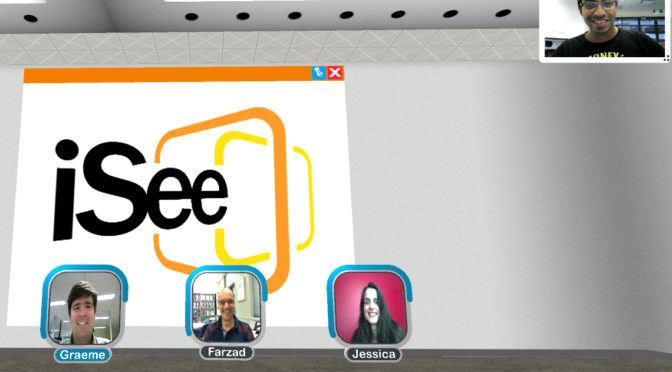
Known as iSee, the technology merges videoconferencing with interactive, virtual environments. It’s been built by University of Wollongong (UOW) researchers in partnership with the Smart Services CRC and now through the spin-off company, iSee VC. iSee operates by immersing dozens of users in a game-like setting where they appear as ‘mevatars’.

Like avatars in online gaming, ‘mevatars’ represent the user in a virtual space. However, while avatars are typically an alter ego or fantasy character, mevatars are created by streaming the user’s webcam into an immersive setting in real time, enabling authentic face-to-face interactions.
The technology can stream more than 50 webcams in a virtual space where users can move around, form groups, converse and share content. It employs point sensitive hearing, where multiple users occupying the space and engaging in multiple conversations will only hear what is within earshot – just as they would in the real world.

Farzad Safaei, Jessica Sullivan and Graeme Booker are all playing a role in making iSee software a reality for schools and beyond.

Farzad Safaei, Jessica Sullivan and Graeme Booker are all playing a role in making iSee software a reality for schools and beyond.

iSee is designed to mimic natural conversations and the real life act of mingling, explained Chief Technical Officer Professor Farzad Safaei, from UOW’s ICT Research Institute.

“You can have multiple, simultaneous conversations going on in the setting between different groups,” Safaei said. “Importantly, the user – not the system – chooses who to focus on. From an education and training perspective, this makes it easier for students to interact with their peers, which is one of the key elements missing from online education tools.”

The NSW Department of Education and Communities is already trialling the iSee program to connect secondary students and teachers from a large metropolitan high school with staff and students from a small regional high school.

Colin Wood, who leads the department’s Virtual Learning Environment team, said the technology is helping students overcome regional isolation.
“It eliminates the need to travel long distances to experience natural social interaction and access specialist education, training and professional development,” he said. Wood agreed that a major benefit is that users can interact as they would in a physical space, such as a classroom.

Teachers have the ability, for example, to post slides and content on virtual whiteboards, break students into groups and then circulate, listen to the chat and provide feedback. Meanwhile, students can meet, interact, share ideas and collaborate with each other.

Safaei said iSee requires at least 70% less bandwidth to operate than other videoconferencing systems. This is because to any given user, it only transmits the audio and video from people who are visible or within earshot inside the virtual setting.

“You could have 20–25 users in the environment, but one user on average is only downloading three to four videos,” he said.
Although commercialisation has been initially focused on education and training, iSee’s Client Business Innovation Leader Jessica Sullivan said the technology is set to have wide-ranging applications for organisations interested in humanising the web.
Myles Gough

www.isee-meetings.com