Tag Archives: manufacturing in Australia

Farmers wired up

Professor Ian Atkinson, the Director of JCU’s eResearch program, leads the Digital Homestead research project that set out in 2012 to evaluate how information and communications technology, particularly NBN and sensor technologies, could improve northern cattle grazing.

The program was started with $700,000 from the Queensland Smart State grant and brought together researchers from JCU, CSIRO, QUT and the Queensland Department of Agriculture and Fisheries.

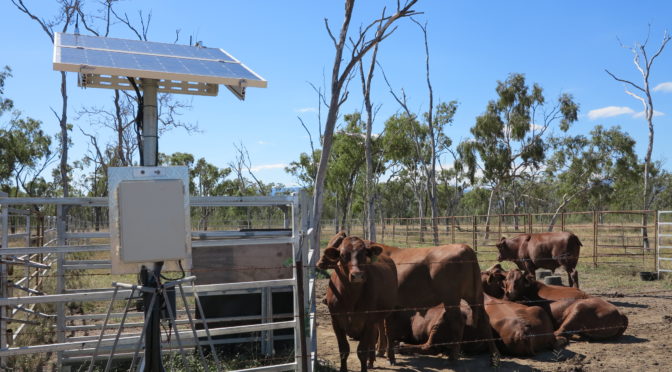
The team fitted solar powered behaviour and tracking collars to cows and installed walk-over weigh stations to monitor their condition. They used satellite technology to keep an eye on pasture performance and grazing capacity and sensors to collect data on weather and water levels in dams.

They then tied all the inputs together into a ‘digital dashboard’ farmers could access from their PCs, providing real-time statistics on cattle and the property at a glance.

Atkinson said the parts of the system were relatively simple, but once they were integrated and connected they made a great difference. “Farmers don’t want shiny gadgets. It’s simple, on-farm analytics that can make a significant difference to profits,” he said.

“We’re currently focused on integration, and translation of research. There is some great stuff coming, and the industry needs to get ready to take best advantage of it,” he said. “Extras such as bore monitoring, farm security and even open gate alarms are, or soon will be available, and the priority now is to get the system into the hands of farmers and business as the true NBN roll-out reaches more rural areas within the next year.”

The research team carried out trials at CSIRO’s Landsdown Research Station near Townsville and in September last year began a commercial stage trial at the Queensland Department of Agriculture, Fisheries and Forestry’s SpyGlass Research Station near Charters Towers.

The next stage will involve working with industry to develop strategies and process to translate the research outcomes into the hands of producers.

 The Northern Australian beef industry returns about $5.7 billion a year to the Australian economy and accounts for about 5 per cent of all jobs in the north.

3D body scanning helps build fighting force of the future

The $1 million project run the University’s School of Health Science uses ‘digital anthropometry’ to customise the internal specifications of Navy submarines and ships, and to improve the design of uniforms and specialist clothing.

The population is generally taller and wider than they were 30 years ago and lead researcher and senior lecturer Dr Grant Tomkinson says the data will inform decisions around working environments such as the height and width of doorways and the length and width of bunks in submarines.

“Submarines are built to last across many generations, 20 to 30 years or more,” Dr Tomkinson says.

“So while we have a piece of machinery that can last for many decades, the average sailor – just like the average person – is changing over time. People are now on average about an inch or so taller, and a bit wider, than they were 30 years ago.

“It is a way of surveying body size and shape for the Navy which will give them some good predictions on how they might change in the future, and then how their equipment and machines should look.”

Dr Tomkinson and colleague Dr Nathan Daniell are working with a team of postgraduate and undergraduate students to measure 1500 Navy personnel based in New South Wales and Western Australia.

“Our survey of body size and shape uses both traditional methods and a digital approach,” Dr Tomkinson says.

“We use a 3D whole-body scanner, which is like stepping into a large changing room and 15 seconds later we get a 3D image of your body that we can extract measurements from at a later stage.

“It captures about half a million data points on the surface of the body and then we can measure dimensions like waist circumference without needing the person again in the future.”

Dr Tomkinson says the team is contracted to take about 90 measurements of the body, including standard measurements like circumferences, heights, lengths and breadths of the arms, legs and torso.

“We’re also doing some customised measurements such as eye spacing to help viewing through periscopes, head measurements for helmet fit, hand length to navigate controls, and the length from the knees to the buttocks to help with seating size,” Dr Tomkinson says.

“If you’re not fitting in your environment well, you’re not going to be as efficient and it will create more stress and strain. You’re more likely to have more niggles, and those niggles can lead to injuries. The main driver behind this research is ergonomics – to optimise the fit of the person to the environment, help them work better and ultimately build a stronger defence force.”

Captain (Dr) Simon Reay Atkinson said the Royal Australian Navy and the Australian Defence Test & Evaluation Organisation (ADTEO) are collaborating with UniSA and DSTO in the research to solve real-world Defence problems.

“We live in a world in which we can no longer isolate the information from the technological from the human. In this world we need to better fit our people to the work spaces and organisations they occupy, such as operations rooms, so they can solve pressing problems, healthily and over prolonged periods away from Base Ports,” Captain Atkinson says.

This article was first published in The Lead South Australia on 16 April.

Cooking with gas

Wholesale natural gas prices – driven largely by demand in Asia – are more than double the prices modelled by many economists back in 2011. And while the Australian government has applauded the booming Liquefied Natural Gas (LNG) industry in Queensland in its energy green paper for becoming the “first in the world to bring onshore coal seam gas [CSG] to export markets”, this development will see domestic gas prices increase significantly.

“There was this view that we would have a gas boom like the US did,” says Professor Chris Greig, Director of the University of Queensland’s Energy Initiative. “That’s not a reality… It’s too expensive in Australia and the value opportunities are too significant in Asia. The nature of most gas developments in Australia is going to be such that we’re never going to have an abundance of super cheap gas that can realistically compete with coal.”

Yet investment in the sector is booming. According to the energy green paper, almost $200 billion in capital investment has been committed for new LNG projects across Australia.

Petroleum engineer Brian Evans from Curtin University in Western Australia expects that CSG will be produced and used for electricity for the next 30–50 years – and possibly longer given the number of untested basins.

From an emission-reduction standpoint, shale gas is the preferred option. It’s much deeper underground than CSG, which means extraction is less likely to affect shallow groundwater tables. And the process by which shale is deposited doesn’t create carbon dioxide, meaning when the gas is burned, there is next to no CO2 emitted. “The production of shale gas in the US has single-handedly reduced the country’s greenhouse gas outputs,” says Evans.

Australia boasts enough discovered shale gas reserves to easily power the country at its current population for the next 100 years – possibly up to 300 years as the potential to recover more gas improves. Evans expects it will be at least 10–15 years before shale gas is making any real impact to Australia’s electricity generating capacity because of the costs associated with extraction and set-up, as the gas is located in remote regions where there’s no infrastructure, such as pipelines and roadways. The mission of the Energy Pipelines CRC, set up in 2010 and with an additional five years of funding to date, is to facilitate such an expansion by supporting the energy pipelines industry within Australia.

In order to deploy any of these technologies, develop a new gas market, or assist the transition toward renewables, Greig says the government needs to incentivise the corporate sector to invest on projects with 40–50 year outlooks.

“What we’re seeing from government is very short-term decision making,” he says. “Somewhere in government, someone needs to develop a long-term vision for the energy sector, and the electricity sector, which has bi-partisan support. And only then can we build policies that enable us to move toward that long-term vision.”

Roll of the DICE

A report by the Climate Council, an organisation reconstructed through crowd funding from the abolished Climate Commission, suggests that by 2030 more than 65% of the country’s coal-fired power stations will be more than 40 years old. These will need to be either retired or replaced.

In an opinion piece for Business Spectator, Climate Council executives Tim Flannery and Andrew Stock suggested this is “the ideal time to begin phasing out inefficient power stations and fundamentally rethinking our energy system” by ramping up our renewable energy generation and storage capacity.

“A well-conceived energy policy for the electricity generation sector would see ageing, low-efficient plants replaced with high-efficiency ultra-supercritical [coal] plants,” says Professor Chris Greig, Director of the University of Queensland’s Energy Initiative.

These plants have lower emissions simply by virtue of their efficiency, and could achieve emissions reductions of 25% compared to existing plants, says Greig.

Another option in reducing emissions and continuing to rely on coal is to replace ageing power plants with smaller, modular facilities that use a technology called the Direct Injection Carbon Engine (DICE). First demonstrated by US engineers more than 20 years ago, the DICE is a modified diesel engine that can generate electricity by burning coal that has been finely ground-up and mixed with water.

With the DICE, air is compressed inside a cylinder by a rotating piston. As the air is being compressed, the slurry is directly injected into the chamber at a precise moment.

The heat of the pressurised air causes the slurry to combust and the intense heat and pressure inside the engine creates mechanical energy, which can drive a turbine and generate electricity.

This is similar to the way heavy fuel oils are injected into conventional diesel engines on transport trucks, and ensures good control over the heat release rate, as well as high-efficiency combustion of slurries made from varying qualities of coal. Carbon capture systems can also be integrated onto the engines to minimise emissions.

The CSIRO has developed methods to produce more cost-effective fuels that work inside much larger engines. Their work has sparked renewed interest in DICE systems for a range of electricity generation applications.

Louis Wibberley, the principal investigator, says DICE systems are more efficient than conventional coal-fired power stations and can achieve up to 40% emissions reductions with black coal, and up 50% reductions with brown coal.

– Myles Gough

Uncovering healthcare cons

Supported by new funding available from 1 July 2014, the program will operate three streams to explore and compare huge datasets available in the healthcare sector. The goal is to make improvements to the detection and management of fraud, consumer choice and data management.

The CMCRC is adapting one of its existing analytical solutions, I+Plus, to analyse and cross-reference the many disparate sources of information available in healthcare. It’s hoped this tool could prove useful for healthcare providers to compare their performance with competitors by using industry benchmarks once they are developed.

The CMCRC hopes to have the first results of its new research initiative into healthcare by the end of this year, said Chief Operating and Commercial Officer, David Jonas.

Jonas, who is also CEO of the organisation’s health insurance spin-off company, CMC Insurance Solutions, said the new research program is a natural extension of the group’s work into health insurance.

“It’s broadened out in the past two years to the whole of health,” he explained.

Although it’s a foray out of capital markets for the CRC, success in identifying fraud in the health insurance market, along with a raft of other achievements, led the centre to investigate the detection of similar inefficiencies in the provision of health in general.

The CMCRC will receive $32 million in funding through round 16 of the Australian Government’s CRC Program. About 40% of that will be going into the new health market quality program.

Industry partners already signed up by the CRC include 29 private health insurers, the National Health Performance Authority, NSW Health, and the Victorian Government’s WorkSafe and TAC (Transport Accident Commission) compensation schemes.

“We don’t yet have a public health insurer as an industry partner, but we are gradually engaging with Medicare and the Department of Veterans’ Affairs,” Jonas said.

The new program’s first initiatives will identify the metrics required for assessing market integrity and efficiency. The research will then look at what data needs to be gathered to generate those metrics and how such benchmarks can be used to find solutions.

The centre is already engaging in a range of small start-up projects with all of its industry partners. Jonas pointed out that one of the main difficulties with the healthcare industry is the fragmentation of data, with diagnosis and treatment records for patients being distributed across multiple healthcare providers and funders.

But if healthcare is looked at as a market, rather than a system, it could be easier to identify inefficiencies and then achieve efficiencies.

“Part of our program is to assure market quality in healthcare for providers and users,” Jonas said.

Penny Pryor

www.cmcrc.com

Virtual dentistry for remote Australia

The trials, which explored the application of ‘teledentistry’, were developed by the Oral Health CRC, the University of Melbourne’s Institute for a Broadband-Enabled Society and dental specialists at Melbourne’s Royal Children’s Hospital. They are supported by Google.

The project’s research leader, Associate Professor Rodrigo Marino, said the system could help improve dental health for Aboriginal children in remote communities. A pilot program is also exploring the use of teledentistry to provide dental services and oral healthcare treatment plans for elderly patients in nursing homes.

Pneumonia linked to oral infections is a major cause of hospitalisation among older people, and can be fatal. “Residents in nursing homes often don’t have access to dental services,” Marino said. “But with teledentistry, a consultation could be done by the nurses, with minimal disruption or discomfort for elderly patients.”

The CRC’s teledentistry trials involved consultations with 43 children in Geelong, Shepparton and Rosebud in Victoria. Three dentists in these regional towns were trained to use intraoral dental cameras to enable Royal Children’s Hospital orthodontists and palate specialists to conduct virtual examinations via real-time video.

No special software or equipment needed to be developed for the trials. CRC researchers used a computer equipped with sufficient memory to handle real-time video processing, a web camera for video conferencing and an intraoral camera about the size and shape of an electric toothbrush. They found that video streaming at a minimum of 3 Mb/s and internet bandwidth of 5 Mb/s provided good quality images for the dental specialists to analyse.

“We could see images in real time on the screen during the consultations, and the remote area dentists and the specialists in Melbourne could collaborate to work out a treatment plan for each patient,” said Marino.

Of the trial consultations, 57% resulted in treatment advice that meant patients could avoid a time-consuming trip to Melbourne. Marino said teledentistry will eliminate the time and expense incurred by rural patients, who often face a long, exhausting drive with no guarantee of an immediate and direct benefit.

He said the promising results show teledentistry could play a vital role in providing affordable and timely dental healthcare for urban Australia as well as rural and remote populations.

“It can increase access to specialist care and it can screen patients to make sure that only those who need to see a specialist will be put on waiting lists,” Marino explained. “So, it also has the potential to reduce the waiting time for treatment.”

Rosslyn Beeby

www.oralhealthcrc.org.au

Alzheimer’s Disease drug discovery gives hope

Scientists from the University of South Australia, along with colleagues from Third Military Medical University in Chongqing, China, have discovered the drug Edaravone can alleviate the progressive cognitive deficits of Alzheimer’s Disease.

Edaravone is used to aid neurological recovery following acute brain ischemia and subsequent cerebral infarction, but is currently available only in some Asian countries.

Lead researcher Professor Xin-Fu Zhou, who is Research Chair in Neurosciences at the University of South Australia, said Edaravone alleviated Alzheimer’s Disease pathologies at multiple levels and improved learning and memory functions in mice.

“Edaravone can bind the toxic amyloid peptide which is a major factor leading to degeneration of nerve cells,” Prof Zhou said.

Prof Zhou said lessons learned from failures of current clinical trials suggest that targeting multiple key pathways of the Alzheimer’s Disease pathogenesis is necessary to halt and delay the disease progression.

“Edaravone can suppress the toxic functions of amyloid beta to nerve cells – it is a free radical scavenger which suppresses oxidative stress that is a main cause of brain degeneration,” he said.

“The drug can suppress the production of amyloid beta by inhibiting the amyloid beta production enzyme. It also inhibits the Tau hyperphosphorylation which can generate tangles accumulated in the brain cells and disrupt brain functions.”

Prof Zhou said that although he didn’t believe Alzheimer’s Disease could ever be cured, the drug was the best hope of attacking the debilitating disease through multiple signal pathways.

The research is a collaboration between Prof Zhou’s lab within the University of South Australia’s Sansom Institute for Health Research and School of Pharmacy and Medical Sciences, and labs led by Prof Yanjiang Wang in Chongqing, China.

The next phase is to seek funding and investment to develop an oral formulae before undertaking clinical trials.

The discovery was published yesterday (7 April) in the Proceedings of the National Academy of Sciences of the United States of America.

First tech-commercialisation skills study funded

The year-long study will be run by Knowledge Commercialisation Australasia (KCA) – the peak body for Australian organisations and individuals in knowledge commercialisation and exchange between public sector research organisations, business and government – and gemaker – a company specialising in commercialising technology.

The key objective of this study is to provide a clear understanding of what it really takes to get new ideas generated by Australian publicly funded research organisations into society and the marketplace.

To kick start the project and help consolidate the study’s framework, a series of workshops will be hosted across five states between April and June. Technology transfer practitioners and industry stakeholders will be invited to participate in these workshops, offering both individuals and institutions an exclusive opportunity to help shape the future direction of professional development within the sector in this country, and provide foresight as to the true nature of the skill set required to effectively undertake this role going forwards.

 “There is an increasing expectation from government entities within Australia for publicly funded research organisations to improve on the conversion of research into commercial outcomes. Much like the theme of our forthcoming conference – Raising the Bar – this study will enable us as a community of practitioners to look strategically at what it means to be a commercialisation professional at a research organisation in Australia, and how we might look to improve upon how we go about our practice. We are thrilled to be awarded the Professional Standards Research Grant,” KCA Executive Officer Melissa Geue said.

KCA applied for the research grant in partnership with technology commercialisation consultancy gemaker (associate member of KCA) in late November 2014. The project team is being led by gemaker’s Commercialisation Director Athena Prib, RTTP and will be comprised of gemaker’s team of specialists in capability development and workplace competencies, as well as KCA’s Executive Officer, Melissa Geue and Vice Chair and Professional Development Leader, Dr Alastair Hick (also Director of Commercialisation at Monash University).

“We are excited to be leading the first project of its kind that will open the door for the research and commercialisation sector to connect and self reflect, and we hope this study offers a baseline for our association, KCA, to build on for years to come,” said Natalie Chapman, gemaker’s Managing Director.

Overall the study will provide insight into the different technology transfer models used across Australia and the mechanism used to equip people with knowledge of skills required by industry and research. The primary goal is to look at the skills and competencies required on both the research and business side, to undertake a skills gap analysis, and to begin to assemble a framework for professional development across the Australian research commercialisation sector.

“Knowledge exchange and commercialisation is an important area of innovation for Australia and building standards and professionalisation options for the industry is an opportunity to cement Australia’s leadership,” said Dr Deen Sanders, PSC Chief Executive Officer.

“Our role is to encourage professional standards and consumer protection and so we are pleased to support the research and commercialisation sector in taking a serious and strategic approach to building a profession in this area.”

IP fund boosts commercialisation

The unique Intellectual Property Management Initiative offers grants to initiate patent protection of inventions stemming from biological research at South Australia’s three main universities – The University of Adelaide, Flinders University and University of South Australia.

Dr Stefan Enderling, the business development manager at Bio Innovation SA, said the initiative is funded by the Government of South Australia and managed by Bio Innovation SA to help pay for the first stages of the patenting process.

“This provides the institution with a dated ‘peg in the ground’ relating to their intellectual property, and gives them an asset with which to undertake economic development,” he said.

A patent is a right granted for a device, substance, method or process that is new, inventive and useful when compared with what is already known. It gives researchers an exclusive right to commercially exploit an invention.

In Australia, patents are administered through IP Australia and the first step in the process is applying for a Provisional Patent.

The 2011 commencement of the Intellectual Property Management Initiative is linked to a 90% increase in the filing of provisional patents from South Australia’s universities.

“It’s been a very successful program,” said Dr Enderling. “The filing of provisional patents increased from 57 during the 2008–2011 period, to 109 in the years 2012–2014.”

The rapid impact of the initiative illustrates the highly targeted nature of budgets within research environments.

Costs of provisional patents are usually in the range of AUD$4000 to $7000, but can be as high as AUD$10,000 for more complex technologies. Further patenting and searching across international databases attracts additional costs. Typically, institutions do not have funds set aside to cover these expenses.

“Universities have scarce resources that have to be diverted towards specific purposes,” said Dr Enderling. “In the past, this meant that patenting was often pushed to the side.”

Biological sciences patent attorney Mark O’Donnell said the Intellectual Property Management Initiative has nudged more South Australian researchers towards protecting their ideas.

“In the scheme of the cost of the research, four to seven thousand dollars doesn’t sound like that much,” he said. “But it’s a big expense for a university to take on, so having this fund is a fantastic thing for them.”

“Previously – because of the lack of funding – provisional patents just weren’t being filed, so research never had that chance of being commercialised.”

“I have not heard of any other comparable programs across Australia,” said O’Donnell, a partner at patent and trade mark attorney firm Madderns in Adelaide, South Australia.

The Intellectual Property Management Initiative has provided support for 78 projects since 2011 at the University of South Australia. The university’s technology commercialisation company ITEK Ventures Pty Ltd has filed 67 new patent applications in that period.

One of ITEK’s projects to benefit from the initiative is the Hand Held Cancer Probe, an ultrasensitive magnetic probe which detects small amounts of clinically introduced magnetic material in lymph nodes. The probe offers a non-radioactive approach for mapping the spread of cancers.

“The Intellectual Property Management Initiative covered the costs of filing the provisional patent, the International Type Search Report and the PCT application associated with this technology,” said Dr JC Tan, Commercial Manager at ITEK Ventures Pty Ltd.

The PCT application provides the university with patent protection in 148 countries, and expands the time frame for investigating market potential.

“Although the Hand Held Cancer Probe project has not yet been licensed, we are currently talking with Australian and international industry about this technology,” said Tan.

This story first appeared in The Lead, South Australia: bit.ly/1INzUFy

JCU develops new standard for life jackets

surf2Researchers led by Wade Sinclair from JCU’s department of Sport and Exercise Science were given a clear brief – the vests must return an unconscious swimmer to the surface and not inhibit lifesaver tasks such as diving and swimming.

The testing found that full-sized lifejackets compliant with Standards Australia’s rigorous Level 50 standard were unusable in heavy surf. Their buoyancy and impact levels from waves were too high, making their use by lifesavers exhausting.

The JCU team tested low buoyancy devices and found they could be used more comfortably in the surf, but still reliably return a swimmer to the surface.

With no Australian Standard in place for low buoyancy devices, the JCU team conducted research, trials and analysis around Australia and then wrote a report for the SLSA and Standards Australia.

The low-buoyancy, high performance vests are designated as Standards Australia Level 25 – suitable for users such as wakeboarders and surfers who need to remain agile but also face the risk of becoming disabled in the water.

Manufacturers have used the new standard to produce ten prototype life vests. JCU is now testing them in different conditions around the country.

Anthony Bradstreet from SLSA said the organisation’s board will receive the final report on the JCU trials in May. “We need to be sensible and take a risk-based approach,” he said. “I don’t think it is going to be necessary for competitors to wear these vests in flat conditions, but their potential use in rougher conditions will still be a fairly large cultural shift.”

Mr Bradstreet said SLSA wanted JCU to produce a specification, rather than choose a specific product, as that approach would ensure multiple suppliers and encourage ongoing innovation.

He said JCU won the contract to do the testing over bigger organisations for a number of reasons. “We were aware of Wade Sinclair’s work in surf sports and he had gathered a group of very keen and eager research assistants around him. There is a lot of respect for JCU’s Sport and Exercise Science department,” he said.

*SLSA has more than 160,000 members

*About 60,000 are ‘nippers’ – children aged 5 to 13-years-old.

*The vests are expected to cost between $150 – $200

Science’s $145 billion value

A report released today has found that advanced physical and mathematical sciences make a direct contribution to the Australian economy of around $145 billion a year, or about 11% of GDP.

When the flow-on impacts of these sciences are included, the economic benefit expands to about $292 billion a year, or 22% of the nation’s economic activity.

Prof.Ian_ChubbThe report was commissioned by the Office of the Chief Scientist and the Australian Academy of Science and produced by the Centre for International Economics (CIE).

“For the first time we now have the numbers on the table showing the importance of these sciences to the Australian economy,” Australia’s Chief Scientist Professor Chubb said.

“It is too easy to take the benefits of science and innovation for granted, and this report shows that the knowledge from these disciplines supports and enhances economic activity which benefits all Australians.”

Australian Academy of Science President Professor Andrew Holmes said the report was a significant step in improving public awareness of the economic contributions of Australian science.

“The detailed report carefully maps out the pathways by which advanced physical and mathematical sciences yield economic results,” Professor Holmes said.

The figures in the report are conservative and only include the economic benefits of discoveries and innovations implemented in the past 20 years in physics, chemistry, earth sciences and the mathematical sciences.

The report includes examples of how these sciences benefit the economy, such as advanced mathematics supporting the effectiveness of mobile phones and wireless internet, and sets out a selection of breakthroughs that have had an economic impact.

The report, titled The importance of advanced physical and mathematical sciences to the Australian economy, did not examine the economic benefits of biology and life sciences. The economic impact of these sciences could be assessed in further studies.

A copy of the report can be found at chiefscientist.gov.au and science.org.au/science‑impacts‑economy.