Tag Archives: innovation

Armour forged through collaboration

Forged from plough parts, heated in a makeshift iron forge and moulded into shape over a Stringybark log, the homemade armour worn by Ned Kelly and his gang is almost as famous as the man himself. Although the suit of armour deflected many bullets, it weighed in at just over 44kg, and left his hands and legs unprotected.

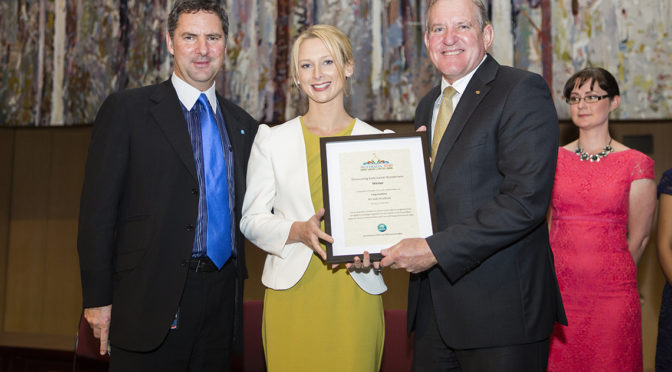
Now, the winner of the Cooperative Research Centres Association (CRC) Award for Excellence in Innovation 2015, the Defence Materials Technology Centre (DMTC), have developed a unique manufacturing process that produces armour with the same level of protection as traditional combat body armour, but is far lighter.

The DMTC developed a cutting edge manufacturing process for shaping ceramic boron carbide armour. Very difficult to manufacture, one of the key issues for the team was maintaining quality control as the material expanded and compressed in response to the heat of the production process.

“Up until recently, body armour design has been relatively simple, durable but so heavy you can’t move quickly…Think: the Ned Kelly suit,” says DMTC CEO Dr Mark Hodge. “Having optimal equipment enhances survivability. Mobility is a significant contributor to personnel protection and with less weight and more mobility, soldiers are able to get out of trouble more quickly,” he says.

Body armour designs trade off protection against weight and bulk reduction with highly protective systems often proving heavy and restrictive. Successive models have been designed to offer more comprehensive levels of protection, with vests made from industrial strength fibres to deform bullets upon impact, and plated metal inserts to provide extra protection to vital areas. Although significantly lighter than Kelly’s original armour, today’s combat body armour remains heavy and unwieldy, a troubling fact as soldiers carry up to 58kg of gear in certain situations.

Untitled-4

As one of the hardest substances known to man, boron carbide is frequently used in the manufacturing of body armour. However up until now it was very difficult to bend boron carbide into a variety of different forms to be used for specific body shapes. As a result, heavier materials had to be used.

With this new near-net shaping technology developed by the DMTC, body armour made purely from boron carbide will allow for manufacturing of lighter armour panels such as helmet inserts and customised ballistic panels for combat vehicles.

The development of the specialised process will yield many benefits for the Australian defence industry, says Hodge. Rather than having to outsource research and development from another country, it is being done right at home. Allowing the defence industry to make adjustments and improvements at any time to accommodate the needs of defence personnel.

Contributions included academic support from The University of Melbourne and Swinburne University of Technology, advice from the DSTO, the Army’s Diggerworks Program, Australian Defence Apparel, and research and manufacturing expertise from BMT, CSIRO, and VCAMM. The collaboration allowed for strides in industrial design capability as well as guidance from the defence department as to what threats the armour should be designed to withstand.

“It would have been impossible to find all the expertise needed for the project under one roof,” Hodge says. “In order to source the appropriate equipment and variety of expertise, we needed a collaborative team that shared a common sense of purpose,” he says.

In the next 25 years Hodge says the integration of the unique net shaping process will be applied broadly to the defence industry due to the extensive use of boron carbide in combat body armour. However, this does not mean that work stops for Hodge.

“Bullets are made to defeat body armour, so we must learn the limits of the material so that we can continue to improve and offer the next level of protection.”

Kara Norton

Defence Materials Technology Centre (DMTC)

Cooperative Research Centres Association (CRC)

Award-winning app boosts mental health help for youth

You are 16 years old and have a secret, which you’ve been carrying around for what feels like your whole life. You feel trapped so you turn to marijuana and alcohol to numb the pain. Your grades begin to slip and your parents are worried so they send you to a psychologist. During your first visit, the clinician in the waiting room starts asking questions, and all you can hear is your heartbeat ringing in your ears.

When it comes to receiving effective mental health treatment, early diagnosis and non-judgmental support are essential. In order to assess what types of treatment options are available, many clinicians start with a verbal assessment. However this verbal assessment is a barrier for many young people, preventing treatment. Psychologist and PhD candidate Sally Bradford recognised that young people between the ages of 12­­–25 could benefit from a different kind of assessment.

“They’re going into an environment where they’re expected to verbally relay everything that is going on in their lives – to tell their deepest, darkest secrets that they may have never said out loud before,” Bradford says. “It can take a long time for them to find the words – especially if the clinician doesn’t ask the right questions,” she says.

As part of her PhD focusing on the use of technology in face-to-face mental health care with young people, Bradford created the electronic psychosocial assessment app called “myAssessment” that helps clinicians evaluate young people quickly and easily. Speaking to the National Mental Health Commission’s review of Australia’s mental health system, this new screening process underscored the need to improve health services and support through innovative technologies.

“The app could be beneficial in any field where you’re needing groups of people to be truthful, and give answers in a way that they do not feel judged,” Bradford says.

Based on the strides Bradford made in youth mental health with the invention of myAssessment, she was awarded the $5000 top prize at the CRC Association Early Career Research Showcase at the CRCA’s Excellence in Innovation Awards Dinner in Canberra.
240615_mentalhealth7

The app was developed in close conjunction with the Young & Well CRC, youth focus groups and clinicians, and subsequently trialled at a headspace Centre in Canberra over nine months in 2014.

“The app was designed with significant input from young people and clinicians, and puts their needs and requirements first. For clinicians, it follows an evidence-based format and doesn’t require changes to the way they currently provide services. For young people, it’s interactive, engaging, and easy to use,” Bradford says.

240615_mentalhealth3

The way it works is a patient arrives for their appointment. Prior to seeing a clinician, patients complete myAssessment on an iPad in the waiting room. The app is a simple survey, but with a range of different response options. Topics include alcohol and drug habits, sexual preference, eating habits and anxiety and depression. Questions include screening and probing questions. Screening questions can be a yes or a no answer that prompts further questioning: Do you drink? Smoke? Have you tried or used drugs? What have you tried?

A probing question allows for a more comprehensive understanding of the issue, such as, how do you (and your friends) take them? (drugs). After answering and submitting these questions, a personalised ‘Clinician Summary’ details the patient’s risks and strengths, providing the clinician with a foundation for the first interview.

240615_mentalhealth5

Bradford’s trials proved to be particularly enlightening, with an 87% response rate, and ¾ of patients reporting that myAssessment provided them with an “accurate” representation of themselves. The results also showed that young people were up to 10 times more likely to open up about drug and alcohol use, sexuality, and self-harm when the application was used, in comparison to a verbal assessment with the same questions.

“There was a wealth of data generated over the course of the trial, which could be particularly useful for policy reform in the future,” Bradford says.

Kara Norton

Young & Well CRC 

Australia’s leaders in research and innovation are honoured

The IP & Science business of Thomson Reuters, the world’s leading provider of intelligent information for businesses and professionals, today is honouring 43 Australians and eight institutions leading scientific research and innovation in Australia at the 2015 Thomson Reuters Australian Citation & Innovation Awards, held today at the University House at the Woodward in Melbourne. Eleven Australian Research Groups have been selected to receive Citation Awards in recognition of their outstanding contribution to research. In addition, Eight Australian organisations have been recognised for their excellence in innovation.

The Australian Nuclear Science and Technology Organisation (ANSTO) has won an Innovation Award in the category: Government (Government or Government funded) for delivering specialised advice, scientific services and products to government, industry, academia and other research organisations through the development of new knowledge, delivery of quality services and support for business opportunities.

Research recipients span myriad areas including astronomy, the environment, oncology, technology and others. Institutional honourees fall within seven categories, separated into large and small-to-medium sized organisations, government institutions, universities and most collaborative organisations. The awards are based on a proprietary methodology and analysis of Thomson Reuters data that recognises domestic innovation and significant research contributions originating in Australia.

“We are very pleased to have the opportunity to honour the individuals and institutions making significant contributions in Research & Innovation,” said Jeroen Prinsen, senior director for Australia and New Zealand, Thomson Reuters.

“Australia plays an important role in the global scholarly and commercial ecosystem and it is through the use of Thomson Reuters data that we are able to qualify and quantify this contribution, and give credit where credit is due. Congratulations to all of today’s honourees.”

The scientific research awards are part of Thomson Reuters Citation Awards and are determined by analysing the volume and impact of a researcher’s contribution to his/her subject area. The recipients were selected using a quantitative process identifying the average number of citations their research generated over a period of time, as indexed in the Thomson Reuters Web of Science®. This covers all articles, reviews and proceedings papers with at least one Australia-based author. The average citation, in turn, reflects its impact and influence on the given subject and the importance attached to it by subsequent research.
The fields from which the Citation Awardees were drawn represent national strengths, either because of the size of the Australian contribution to the global body of knowledge or because of its impact. The wide range of subject areas covered – from astronomy & astrophysics, ecology, and environmental studies to economics, neurosciences and psychology – is an illustration of the strength and diversity of academic research in Australia and a reflection of the innovation inherent among the country’s scientists.

This information was first published on 23 June 2015 by Thomson Reuters.

Understanding athletes’ immune function to optimise performance

With the Gold Coast Commonwealth Games looming in 2018, a key concern for athletes will be how to prevent illness from interfering with their training and performance.

This is the focus of new research at Griffith University. Partnering with the Australian Institute of Sport to examine the effects of exercise on the immune system in order to help athletes compete at their best, the research team say that illness during competition can destroy years of effort and dedication.

“On average, highly trained athletes spend 8 to 12 years training to compete at their best,” says Professor David Pyne from Griffith’s Menzies Health Institute Queensland (MHIQ).

“Given the time, effort and financial considerations made by athletes, their coaches and support staff, there is a need to find ways to keep athletes healthy during heavy training, travel and competition.”

Dr Nic West

Dr Nic West

Susceptibility to illness

Professor Allan Cripps, a leading immunology researcher at MHIQ has worked with Pyne and Dr Nic West in a bid to understand why athletes seem prone to illness during heavy training and competition.

“There is evidence that endurance exercise compromises immune function and increases illness in some athletes,” says West. “Intensive exercise, particularly endurance exercise, such as triathlon, long distance swimming and ironman events, can be associated with exercise-induced immune suppression where the number and function of immune cells is decreased and their ability to respond to challenge is lowered.”

For the current study the research team is seeking highly trained male triathletes and iron men between the ages of 18-35 years who undertake 12 hours or more exercise per week.

Athletes will have their immune, gut microbiota and metabolic systems profiled and compared with non-athletes.

A significant benefit of the study is that participants will receive information regarding the status of their own immune function that can be used to tailor individual training programs.

The study is taking place at Griffith University’s Gold Coast campus.

“We hope that participation and knowledge gained from this study will help elite and non-elite athletes to attain their performance goals,” says Pyne.

This article was first published by Griffith University on 16 June, 2015.

Help to combat pest animals is only a click away

The toolkit is a one-stop shop of practical knowledge to arm farmers and land managers with the information and connections they need to combat pest animals.

IA CRC digital communications manager Keryn Lapidge said, “We are pleased to have the Minister for Agriculture, Barnaby Joyce, officially launch PestSmart Connect today, recognising this as an important knowledge hub for tackling pest animal problems such as wild dogs, which have become a really big economic and social issue for Australian farmers.”

The website also links to the FeralScan website and app which provides people with the capability to map pest animal sightings and damage and then to use this information to track and control the problem.

“This website is really strong on connecting people and communities. A feature is the ‘connect’ portal which aims to provide contact details of agencies, organisations and groups that are active in pest animal management and can provide people with services, useful advice or assistance – at a practical on-ground level, but also at a policy level,” she said.

The PestSmart Connect website features pest animal species that are a having a major impact on biodiversity and agriculture in Australia including wild dogs, foxes, feral cats, rabbits and carp. There are handy glovebox guides, videos about trapping and baiting, case studies and links to assistance.

“We hope this will be a useful knowledge hub for farmers and land managers and we plan to continue to improve the resource over time,” Lapidge said.

The PestSmart Connect website www.pestsmart.org.au is the culmination of ten years of information gathering and research by the IA CRC – Australia’s largest integrated pest animal management research organisation.

Minister for Agriculture, Barnaby Joyce, launches the PestSmart Connect website - a handy toolkit of pest animal management information for farmers and land managers.

Minister for Agriculture, Barnaby Joyce, launches the PestSmart Connect website – a handy toolkit of pest animal management information for farmers and land managers.


This article was first published by the Invasive Animals CRC on 16 June, 2015.

Science Australia’s business heart

The outcome is loud and clear, the government wants to use CRCs to put science at the heart of Australian business.

CRCs will remain a feature of the Australian innovation landscape. The government only wants to support CRCs that are highly industry focused and only for a single term of up to 10 years. The application process is going to simplified to make it easier and more attractive for business to bid for a CRC.

In a bold and exciting move, they’ll be a new stream in the CRC Program called CRC-Projects (CRC-P). These will again address highly focussed industry issues but at a smaller, more nimble level than a full CRC (which are generally 7 year enterprises of maybe $100 million of activity). CRC-Ps will be up to three years, up to $3.0 million of government support and will be open for application three times a year. This is a huge development to open the CRC Program up more readily to smaller businesses and more specific projects.

Reviewer David Miles recommendations are aimed to discourage CRCs going on for very long terms. While this is a big concern for those addressing long-term innovation issues, the intent is to make the CRC concentrate on solving the problem at hand and exiting, leaving the industry players better off. This is a particularly interesting approach from Mr Miles because, prior to the commencement of his review, there was one train of thought that success in a CRC meant an ongoing body. The previous Parliamentary Secretary, Bob Baldwin, had publicly asked why more CRCs don’t continue as self-sufficient organisations beyond their government funding period?

Miles downplays the importance of an ongoing organisation in his review, making it clear that the real benefits from a CRC come when the industry players involved implement the research.

Miles also sees the industry training role of CRCs as very effective and important, encouraging more of them to do more in training postgraduates for industry roles.

CRCs that are not specifically aimed at solving industry issues are the potential losers in this Review. Time and again, the review says industry should be “front and centre” of the CRC program, arguing that when the Program tries to do everything, it achieves less. But Miles holds out a possible future for “non-industry” CRCs, encouraging other Government departments to directly fund CRCs through the Department of Industry and Science, Miles points out that this happens already (the Department of Defence funds the Defence Materials Technology Centre through the CRC Program). He points out that the CRC model works and is effective, but the Industry Department shouldn’t have to front for the cost of CRCs outside its portfolio area.

So while it is disappointing that some important areas of research may not qualify for CRCs anymore, the government is leaving the door open for other government departments to participate in the CRC Program.

For Australian business, the CRC Program should become more flexible and simpler for them to get involved in.

Dr. Tony Peacock

Chief Executive

Cooperative Research Centres Association


Cell manufacturing links research and industry

CEO of the Cell Therapy Manufacturing Cooperative Research Centre (CTM CRC) Dr Sherry Kothari said it puts promise in what she believes is the future of medicine.

“One of the biggest advantages that cell therapy holds is that it has the potential to cure. So with drugs and pharmaceuticals you tend to manage and treat conditions but you can’t generally cure them,” Kothari said.

“So the stem cell will go into the wound and it will dampen down any immune response and any inflammatory response to try and get the wound into a state where the normal skin cells can take over the healing process.”

CRC Partner the University of South Australia has a team currently working on a patch that will help cure chronic wounds.

Cell TherapyProject Leader Dr Louise Smith said chronic wounds affect sufferers for years, and sometimes decades.

“One of the ways we’re looking at healing it is by delivering stem cells to the wound to try and help it heal,” Smith said.

“So the stem cell will go into the wound and it will dampen down any immune response and any inflammatory response to try and get the wound into a state where the normal skin cells can take over the healing process.”

img - industries_health_150305_Cell Therapy_banner-2
The CTM CRC.

Chronic wounds are a burden to patients and healthcare systems as they are expensive and persistent, and without treatment can lead to extreme procedures such as amputation.

Around 450 000 Australians are affected by chronic wounds, while the US government spends an estimated $25 billion per year on treatments.

Smith said the project would not have worked without the CRC pulling everything together.

“We wouldn’t have access to the specific cells, we wouldn’t have access to the companies that we’re working with, and we wouldn’t have access to the clinicians and the cleanroom facilities,” she said.

The CTM CRC takes a promising cell therapy, finds an appropriate industry partner and facilitates the therapy through the manufacturing process until it’s ready for use in patients.

Kothari said academic researchers often struggle to source funding for their projects without industry partner collaboration.

“It’s what I and many others describe as the valley of death,” Dr Kothari said.

“You’ve got your academic research which stops at a certain point and then you’ve got the big companies, but often that research is still too early for them to invest in.

Chair of the CRC’s board Dr Leanna Read said bringing down costs is crucial to the future of medicine.

“There’s always a pressure on medicine because the health system is getting more and more expensive,” Dr Read said.

“If you can bring down the costs of producing the cells you’ll be able to expand opportunities for use in clinical practice because they’ll be affordable in mainstream medicine.”

The Cell Therapy Manufacturing CRC is the only one of its kind in Australia and one in a small handful of facilities around the world.

In an effort to build up a global presence in the growing industry the centre has recently formed collaborations with two cell therapy and regenerative medicine institutions in Canada and the UK.

“We have a lot of intellectual capital and know-how here in Australia and South Australia,” Kothari said.

“What we have here is this critical mass, the expertise, the know-how and the infrastructure, so we’ve got a real chance to make it work, to put South Australia on the world stage when it comes to the development of cell therapies.”

This article was first published in The Lead.

Designing the future

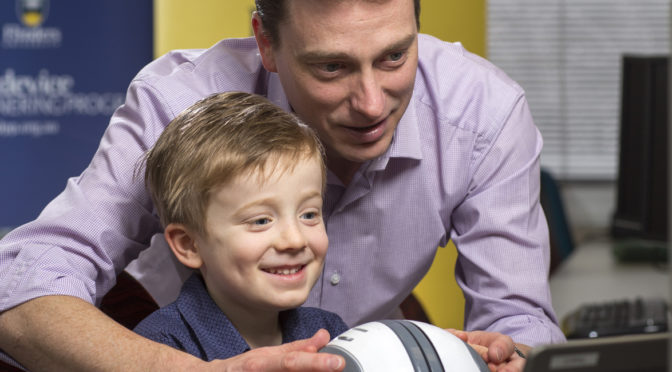
Mr David Hobbs demonstrates the OrbIT Gaming System and Orby Controller to a young child. Photo courtesy of the South Australian Department of State Development.

Laura Diment and David Hobbs are both former students and now staff at the new Flinders University campus at Tonsley, a world-class facility that brings multiple disciplines of STEM research together with industry. Diment and Hobbs began their Biomedical Engineering studies within the School of Computer Science, Engineering and Mathematics (CSEM), and have each received international acclaim for developing assistive technologies that enable children with disabilities to make the most out of the creative potential of modern software.

Hobbs, currently completing a PhD in rehabilitative engineering, has received significant attention for his work creating an accessible computer gaming system that incorporates a unique orb-shaped controller nicknamed ‘Orby’. The novel trackball controller can be operated without the need for fine motor skills. This makes it accessible for children with cerebral palsy, who are often unable to use mainstream controllers.

The novel trackball controller nicknamed 'Orby'.

The novel trackball controller nicknamed ‘Orby’.

The gaming system and 15 interactive games developed for Orby have been a huge success with the 18 families that trialled the technology, with most reporting increased social closeness for the period Orby was in their homes.

For Hobbs, whose main motivation for studying engineering is the potential to ‘give back’ to society, this is an ideal result. He is now in the processes of commercialising Orby and hopes it will eventually be available to families, though is quick to note the difficulties in finding a balance between the inevitable costs of research and development and creating an affordable end product.

It is clear, however, that Hobbs relishes the challenge; a past recipient of both Fulbright and Churchill scholarships, he is determined to keep building upon assistive capacity of the technology. Trials will soon begin investigating the potential of Orby to help in the recovery of stroke patients.

Making a splash

laura_thumb

First-class Honours student, Laura Diment, is also keen to use her STEM skills to help people who need it most. Diment chose to spend her compulsory five-month industry placement during her third year of study at a leading rehabilitation centre in Toronto, Canada – following the footsteps of Hobbs, who mentored her exchange from back in Australia. Here, she began creating Splashboard, an art program that uses Microsoft Kinect’s infrared technology to enable children with cerebral palsy to create musical art on screen. The technology can track movement in three dimensions, allowing children to interact with buttons on screen that trigger colour tools and sound by waving their arms.

Diment, who has since won a number of awards nationally and internationally for her creation, acknowledges the benefits of the opportunity to build industry partnerships early on in her Biomedical Engineering degree. “The future really is about connecting the industry and research earlier on, because they know what’s going to be beneficial in the long run.”

From these solid foundations in research and industry, Diment looks to be building a formidable career. She starts her PhD in Oxford as a John Monash scholar later this year, where her research will focus on creating a future in which developing countries have access to the skills and expertise necessary to design their own assistive technologies, rather than having to rely on Western-developed finished products that are ‘posted across’.

Much the same as Hobbs, Diment is confident in the capacity of STEM careers to create a better world. “We are designing the future,” she says.

With such bold ambitions, it seems only fitting that these two are working in Flinders’ new campus in the Tonsley business hub. The centre is quite literally amplifying the work that STEM disciplines at Flinders are capable of; the Biomedical Engineering discipline now takes up more than double its original size in order to make the most of the opportunities in this new environment. “People can come to us or work alongside us; it’s much more flexible and approachable.” Hobbs is grateful to have had the opportunity to help shape the new campus; “It’s a once in a generational opportunity… now it’s really up to us to maximise what we’ve been given and to do the best job we can.”

Breana Macpherson-Rice

The spirit within

WE OFTEN HEAR CALLS for a more entrepreneurial culture. But what does that mean in practical terms? Yes, it is affected by our national psyche, outlook and attitude to risk. We hear that Australians don’t ‘embrace failure’, and that our finance sector is too conservative in its attitude to science and innovation. These opinions might be true, but regardless we also have to get the building blocks right.

The ‘next big thing’ might come from a series of small steps in developing the environment for more innovators and entrepreneurs to thrive. The government has just released an Industry Innovation and Competitiveness Agenda, which features a few of the steps that will improve the situation for entrepreneurs in Australia.

Issuing share options to employees is an important way of attracting talent. New companies have an idea, a prayer and not much cash. But brilliant young people are often willing to take shares or options in lieu of salaries for a year or two to join the startup entrepreneurial adventure. They might take a very low salary, or spend a year couch surfing or forgoing the benefits of deodorant.

The incredible stories of the likes of Twitter, Instagram, Facebook and the rest mean that by taking shares in lieu of salary they may strike it rich. In Australia, rules introduced in 2009 killed off this pathway by demanding that tax be paid on those shares immediately. The government has now fixed that issue.

Removing barriers is another important avenue to increase business competitiveness in Australia. Simple things like vaccine companies undergoing identical audits from different regulatory agencies draws cash – and focus – out of the business. The government has decided to have a serious go at lowering those barriers.

For the Treasurer’s coming tax review, the Minister for Industry has flagged two more innovations: crowd sourcing of equity finance, and patent boxes. Australia is slow on the equity issue, with the USA, the UK, Canada and New Zealand all ahead of us. But the government has received a very comprehensive report detailing the necessary changes, and action is expected soon. The patent box concept, which started in the UK, allows companies to isolate earnings from patents and have them favourably taxed.

Apart from government, financing of innovation is slowly improving. Westpac has provided $50 million to Reinventure, a venture capital company. CSIRO’s new CEO, Larry Marshall, is an Aussie with 25 years of venture capital experience. If the equity-financing model allows self-managed super funds to invest, then who knows the limits?

Firing up the entrepreneurial spirit in Australia is the next big thing. The foundations are quickly being laid – next we need the builders to come in. The gap year has become common after senior secondary school. Wouldn’t it be something to see a ‘growth year’, when graduates or postgraduates gave themselves a year to pursue an idea?

TonyPeacockKnowHow founder Tony Peacock is the CEO of the CRC Association and 2014 Monash University Churchill Fellow at The Winston Churchill Memorial Trust.

The new class

THERE ARE INCREASING signs that Australian R&D investment in smart sectors such as finance and agriculture is reaping benefits overseas. Federal Trade and Investment Minister Andrew Robb points to a 10.4% rise in annual gross R&D expenditure to $31 billion (by 2012). This is twice the 4.9% per annum average among countries of the Organisation for Economic Co-operation and Development (OECD).

“Australia is a world-class innovation destination,” Robb says. “This is built on solid foundations of modern infrastructure, strong levels of investment, generous research and development incentives, and strong intellectual property protection.” In the Global Innovation Index 2014, Australia achieved its highest rank for innovation inputs, coming in 10th out of 143 countries and placing 22nd for outputs.

“We have seen a near doubling of patents filed abroad by Australian entities over a 10-year period,” says Ben Mitra-Kahn, Chief Economist at IP Australia, the Federal Government’s intellectual property office. He believes this is an encouraging indication that organisations are taking their innovations to foreign markets.

“Our national scientific research organisation, CSIRO, ranks in the top 1% of the world’s scientific institutions [in 15 of 22 research fields],” adds Robb. He cites Australia’s development of the bionic ear and CSIRO’s pioneering wi-fi work as high-profile examples of Australian innovation.

To that list, IP Australia adds ResMed’s patented sleep apnoea devices as well as Sportwool – a composite superfine Merino wool for endurance clothing, developed by CSIRO and WoolMark and adopted by foreign firms.

There’s also: the 3D-absorbent fabric developed by CSIRO and Textor Technologies, which is being used in the next generation nappy by global brand Huggies; Vision CRC’s ongoing work in contact lens technology worn by millions worldwide; and the Total Channel Control System to rejuvenate outdated irrigation systems. Total Channel Control is now used around the world, and was jointly developed by the former CRC for Sensor Signal and Information Processing, and Rubicon Water.

Relatively speaking, Australia’s weakness is innovation outputs. But efforts by many of the CRCs are building global relationships that will continue to boost the nation’s growth. In 2012, a report by Allen Consulting Group (now ACIL Allen Consulting) predicted that $5.9 billion in direct economic impacts would accrue during the five years to 2017 from CRC-produced technologies, products and processes – on top of the $8.6 billion in direct impacts already accrued since the CRC Program began in 1991.

“No one is more interested in or committed to maximising research impact than CRCs,” says Tony Peacock, CEO of the CRC Association.

190115_OS_2Taking finance further 

An example of successful Australian innovation on a global stage is the European Capital Markets CRC (ECMCRC). Established in early 2013 by the Australian-based Capital Markets CRC (CMCRC) in collaboration with European universities, more than seven universities were involved at the time of writing, with plans for at least another seven by early 2015.

The CMCRC was born out of the Securities Industry Research Centre of Asia-Pacific (SIRCA), set up in the 1990s by current CMCRC CEO Professor Michael Aitken as a model under which universities could collaborate and share knowledge and infrastructure and then jointly apply for research funding.

Like its Asia-Pacific predecessor, the CMCRC enables the finance and business departments of Australian universities to build and share valuable infrastructure.

A large amount of time in financial market research is spent collecting and collating data and the CMCRC has developed programs that expedite this process. These innovations also enable the data to be shared, with the result being a drastic reduction in research time.

One of the CMCRC’s earliest and most successful innovations was the SMARTS market surveillance system, which was sold to the US stock exchange NASDAQ in 2010. The proceeds of that sale allowed further developments, such as the Market Quality Dashboard.

“The Market Quality Dashboard takes all that data and produces basic metrics that everyone needs to use to analyse things like transactions costs and market volatility,” Aitken explains. It means researchers and academics no longer need to develop these metrics from scratch, thereby improving productivity.

In Europe, the ECMCRC will attract new members by providing academics and universities with access to these tools.

“What we’re doing is encouraging the universities to get together – by giving them something they couldn’t hope to achieve in a million years – and once they’re together, we collectively apply for funding from the EU to be matched by industry funding, thus sharing the very successful CRC model with other countries,” Aitken says.

The university PhD students who use the data, and are in industry placements, have the joint role of linking the research to commercial applications because they best understand what companies need.

Aitken says the CMCRC has already built three major pieces of technology and created at least 200 new jobs in Australian spin-offs as a result.

“We hope that we will do the same in Europe but we need to get the universities together first,” he says. “By focusing on industry engagement first and foremost, we will build interesting technology for businesses. This will build up ‘brownie points’ with industry partners who will provide access to their unique data, which will in turn foster scholarship.”

CMCRC’s predecessor, SIRCA, has 39 member universities from across the region, and Aitken says there are already plans in place for a capital markets research centre in North America in the next five years.


190115_OSboxA global effort

The area of agriculture and agribusiness is one of Australia’s five key strengths, points out Robb, and agricultural CRCs have also been very proactive when it comes to international cooperation. Two years ago, the Dairy Futures CRC launched a global research project to create the world’s biggest collection of DNA sequence data for dairy herd bulls.

The aim of the 1000 Bulls Genome Project was to build a database of DNA sequences to be used for breeding Australia’s dairy herds. From that data, mutations that affect animal health, welfare and productivity could also be identified.

A scientific paper analysing the genomes of 234 bulls from three dairy cattle breeds – Jersey, Holstein-Friesian and Fleckvieh – was published in the international journal Nature Genetics in July 2014. It explains that the research team identified 28.3 million genetic variants and was able to use the database to identify a recessive mutation linked to embryonic death in dairy cattle. The researchers also identified a dominant mutation linked to chondrodysplasia, a type of bone disease.

“There’s a real opportunity here if we can find the genes affecting traits that are important to dairy farmers, like fertility, milk production and disease resistance,” the project’s leader, Dr Ben Hayes, recently told the ABC’s Country Hour. “We’re combining the DNA information with the herd records that farmers have kept over a large number of years… to sort through those 28 million variants and come down to a few thousand that really do predict milk production, fertility and disease resistance.”

The project involves 20 international research partners from Australia, France, Germany, Canada, Denmark and the USA. Hayes is based at the Victorian Department of Environment and Primary Industries and leads the Dairy Futures CRC’s animal improvement research program – a partnership between dairy farmers, pasture and cattle breeding companies, government and researchers.

Hayes explains that identifying a gene mutation that causes embryonic loss in cows can help farmers build a healthy, more productive dairy herd. “We know that this particular mutation is already present at low frequency in Australian dairy herds. Locating the mutation means we can test for it and avoid matings between animals that both carry the mutation, to keep it from becoming a problem in the future.”

The CRC is also using the project’s genetic sequence data to design improvements in the routine use of DNA to predict the genetic merits of dairy cows.

“The ultimate challenge in making genomic selection more robust is to find the variants that are considered to be causative – the small fraction of all known variants that are responsible for major changes to the function of important genes,” Hayes says.

“We now have data for the entire DNA sequences, including mutations affecting the traits dairy farmers are most interested in. We are tracking down the causative genes for fertility, longevity and meat production, to equip farmers to make more informed breeding decisions and boost the quality of their herds.”


Small pigTHE PORK CRC is another good example of global collaboration. The CRC has strong links with the French National Institute for Agricultural Research (INRA) on genetic research around disease resistance and environmental resilience in pigs. Pork CRC Chief Executive Officer, Dr Roger Campbell, credits the collaboration to the reputation and efforts of their geneticist Dr Susanne Hermesch, an Associate Professor at the Animal Genetics and Breeding Unit, based at the University of New England in NSW. Hermesch says international collaboration is particularly important in her field of pig genetics.

“It’s a small, very specialised field, and you really need to look for collaboration to get the people you want,” she says. Hermesch also has collaborative arrangements with researchers at organisations in New Zealand, Scotland and the Netherlands.

Pork CRC’s attitude towards commercialisation of research at a national level also means that any collaborative international research is quickly adopted in the field.

“Research is part of the adoption process,” says Hermesch. “We are recording information and data on farms in the commercial setting.”

Australian breeding companies collaborate in research, which means they must have faith that the research outcomes will result in commercial benefits for their business.

“This international collaboration is valuable,” adds Hermesch. “I’m pulling people from all over the world into my extended research team with links to the Australian pig industry.”

Campbell expects there to be global advantages from the current genetic research because of these ties.

“The pig industry globally is not all that different,” he says. “I would expect that all geneticists, and therefore all breeding companies, are likely to benefit.”

www.cmcrc.com

www.dairyfuturescrc.com.au

www.visioncrc.org

www.porkcrc.com.au