
Tag Archives: climatic events

Science entrepreneur to speak at deep tech acceleration event

The push towards deep tech commercialisation is in the news following the announcement of the $2 billion Research Commercialisation Action Plan from the Federal Government pre-May 2022 budget and election push.

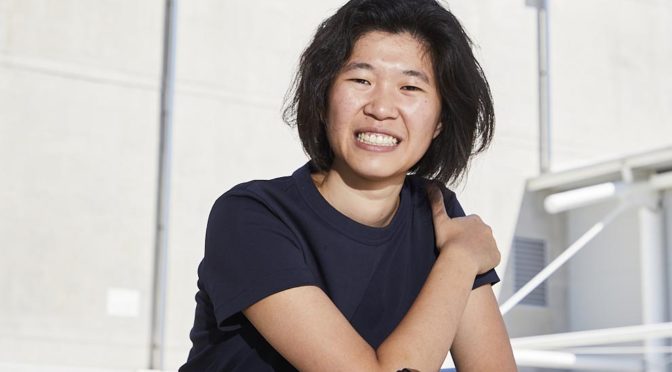
But for an Australia’s science entrepreneur, the business of science and innovation can start at the very beginning of a career – at least that’s the case for ShanShan Wang, an industrial designer who took her university project into a stellar science and innovation career.

ShanShan Wang is the Founder and Chief Executive Officer (CEO) at Roam Technologies, an Australian medical device company focused on portable oxygen, and making oxygen accessible and measurable to everyone.

She has since has won over five international design and innovation awards with her the most recent win of COVID19 NASA International Space Apps Challenge. She has also been named as one of Australia’s youngest innovators and the next generation of disruptive business leaders including Business Insider, AMP Amplify, Sydney Morning Herald and Australia’s Women’s Weekly– AWW Women of the Future. 

Catch ShanShan in conversation at ANSTO’s Accelerating Deep Tech Businesses, the fourth installment in the ANSTO x Science Meets Business Innovation Series. Register here.

From study to business

So many innovations start with a problem. For then UNSW industrial design student Wang, that problem was “what on earth am I going to write my thesis on?”

The answer came in surprising form – she spotted a mother and young child, tugging around a large cylinder, which she later learned was for the supply of pure oxygen. After some research, she realised there hadn’t been much improvement to this method of delivery for a long time, despite many people needing to use oxygen tanks daily. 

“I saw a problem, and I wanted to solve it,” she says.

Wang launched Roam Technologies – and a plan to convert air to oxygen on demand, in a small, easy-to-transport device – in 2014, the year after she graduated from university. Backed by clinical expertise in the field, engineering competancy, regulatory and quality supoort, their product, nicknamed Juno, is a small portable device that can produce oxygen out of ambient air and can regulate oxygen to user activity levels.
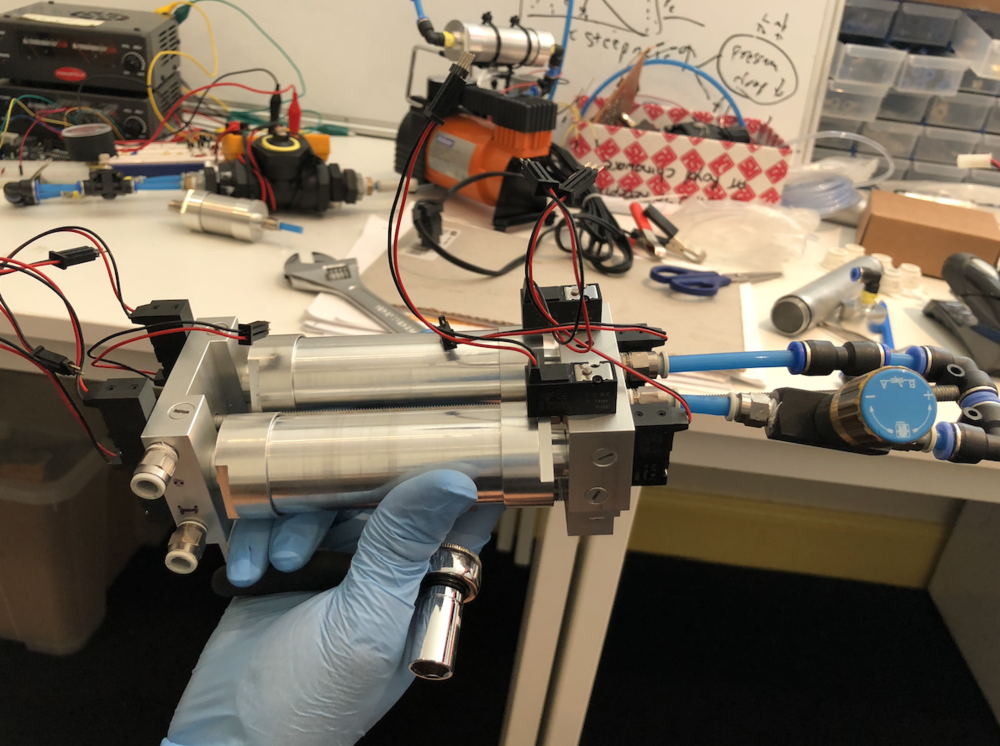
Juno leverages gas separation techniques with artificial intelligence to improve health. 

“It’s impactful health,” says Wang. “As COVID-19 has exacerbated a lot of problems that we’re trying to solve, it’s more important than ever.” 

The technology has since been featured in Popular Science, BBC News, Fox News, Business Insider, Huffington Post and more. 

She and her team are accelerating development of the device for regulation approval, before it is released to the wider market.

Accelerating Deep Tech Businesses is the fourth instalment in the ANSTO x Science Meets Business Innovation Series. Bringing together science leaders, deep tech entrepreneurs, academic partners and national organisations, this in-person and online event will be an opportunity to hear from, and connect with, those who embrace challenge-based innovation and collaboration. 
More information means better predictions

In the era of ‘big data’, researchers are reaping the rewards and making better predictions from working with increasingly vast amounts of information about our planet. And datasets don’t get much larger than those used for modelling climatic events and simulating the impacts of global warming on the Earth’s surface.

The primary tools for modelling the climate are Atmosphere–Ocean General Circulation Models (AOGCMs). To improve the credibility of AOGCMs, the World Climate Research Programme established the Coupled Model Intercomparison Project (CMIP). This facilitates comparison of different models to identify common deficiencies and stimulate investigation into their possible causes.

Better predictions: CMIP5

CMIP5 is the fifth phase of CMIP and a multi-model framework of unprecedented scale. It incorporates many more simulations than earlier versions, including those based on historical concentrations, experiments for investigating climate sensitivity, and four emission scenarios reflecting differing potential pathways to 2100.

Use of datasets produced by CMIP5 is widespread: several thousand researchers access the CMIP5 datasets via the Earth System Grid website, and 28 modelling groups worldwide work on models that input to CMIP5 activity. Over 1000 peer-reviewed papers using the datasets have been published in a range of respected climate journals, for example: Journal of Climate (184 papers), Geophysical Research Letters (129 papers), and Climate Dynamics (122 papers).

“Being the latest generation, the CMIP5 models are the most valuable resource we have in the field.”

In Australia, researchers at The Centre for Australian Weather and Climate Research, a partnership between the Bureau of Meteorology and CSIRO, have employed output from CMIP5 models to further our understanding of the current climate in the Pacific region and make better predictions about future climate.

The research, undertaken as part of the Pacific-Australia Climate Change Science Adaptation Planning (PACCSAP) program, provides insights into the current and future impacts of climate change on the Pacific and the implications for communities in the region.

The work further reinforces the strong credentials of climate research in Australia, which also boasts centres such as the ARC Centre of Excellence for Climate System Science at the University of New South Wales (see Share issue 21).

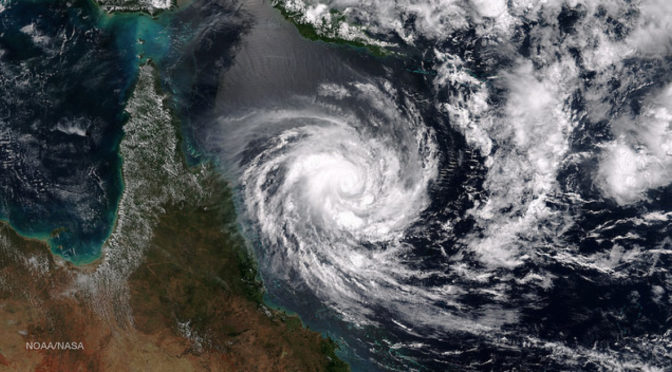
One of the research streams of PACCSAP has projected the impact of extreme weather events, such as tropical cyclones, onto the region’s future climate. The output from CMIP5 models was key to simulating the conditions for the genesis and behaviour of tropical cyclones.

“Being the latest generation, the CMIP5 models are the most valuable resource we have in the field,” says Dr Sally Lavender, Research Scientist at CSIRO’s Oceans and Atmosphere division. “The real advantage with CMIP5 is there are more models than the previous generation with a broader set of experiments, and all the models are much better in terms of sophistication. They also tend to be higher resolution and more have sub-daily time fields which, for modelling tropical cyclones, is very important.”

Dr Lavender is currently working to extend previous research using CMIP5 models to observe why and where cyclones form, and what determines their tracks. “We’re analysing the CMIP5 models to see how well they represent those processes in the real world to produce a selection of models that are good at representing tropical cyclones over the Australian region. We can then use these models to generate more informed projections of tropical cyclones under future climate scenarios.”

Research to date shows there is likely to be a reduction in the overall frequency of tropical cyclones in the Australian region; however, the proportion of high intensity cyclones is likely to increase. That needs to be taken into account in future building standards and disaster readiness planning.

Story provided by Refraction Media.

Originally published in Share, the newsletter magazine of the Australian National Data Service (ANDS).