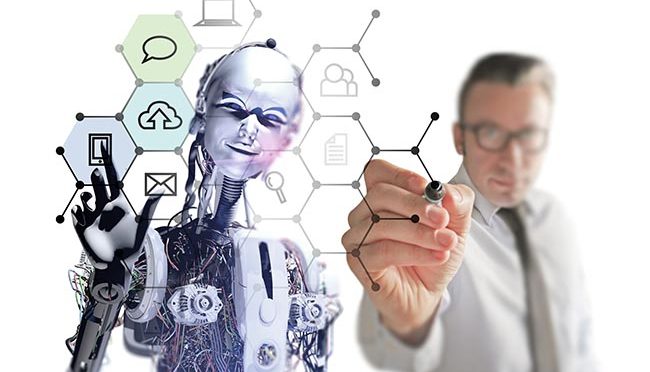
Like many of you I am waiting for digital disruption to make my job redundant so I can lean out, reclaim my work-life balance and let the robots do the rest.
As a journalist, my first thought was to see how digital disruption could work for me, so I looked for an artificial intelligence that could write this article for me (it couldn’t). But it came scarily close.
While so-called artificially intelligent chatbots are at best frustrating, programs such as Wordsmith can take sets of data and generate various articles based on simple coding of parameters, while stuffing a few synonyms in to sound like a genuine journalist.
Last week, an inaccurate post titled ‘The Trump Effect: It’s Happening Already!!’ went viral, and Facebook announced it would instigate third party fact checking to crack down on fake news. Imagine a world where AI could both check the accuracy of posts, but also one in which AI could generate endless streams of viral click bait.
Need a meeting? Download an artificial assistant like Amy from x.ai to contact your clients directly and discuss suitable times. All you do is turn up.
Fancy a bite to eat? Before long autonomous vehicles will be at your beck and call to escort you to your favourite restaurant or deliver a much-loved takeaway.
Work in a construction trade or manufacturing? Robotics and 3D printing can download, print and stack your bricks, scaffolds and planking, twist your toothpaste caps on and sort quality from flawed product.
What about a highly-paid, precision career such as surgery? Google is already working with Johnson and Johnson’s medical device company Ethicon on the next generation of surgical robots – research that is based on Google’s work in autonomous cars.
Chances are if you teach and/or work in academic research, you’ll already be aware of the possibilities of massive open online courses (MOOCs) and their potential for disrupting the way we learn, and allow access to our institutions. In four years, MOOCs have gone from zero to over 4,000 courses reaching around 35 million students.
Worried? You’re not alone, a PwC survey of CEO’s globally found 62% of 1300 surveyed were concerned about the impact of digital disruption in their industry. I recently heard a leader from the giant resources company BHP talking at the AFR Innovation Summit about being a recycler rather than a producer of steel after their disastrous 2015 downturn.
But if you think digital disruption means the robots are coming for your job, you’re wrong. While just under half of our jobs are expected to be at risk of automation in the next 10–15 years, for every disrupted career area, new opportunities arise. Like writing the programming software to create news stories or humanising the language used by AIs. By researching the signals that can make autonomous cars safer for pedestrians or by understanding the psychology behind creating incentives for innovation in your staff.
Where are we most at risk from missing the opportunities from digital disruption? Our team of thought leaders have the answers.
Managing Director and Head of Content, Refraction Media
Read next: Head of KPMG Innovate, James Mabbott, uncovers the point of difference between those who remain resilient to change and those who get left behind.
Spread the word: Help Australia become digital savvy nation! Share this piece on digital disruptors using the social media buttons below.
More Thought Leaders: Click here to go back to the Thought Leadership Series homepage, or start reading the Women in STEM Thought Leadership Series here.