All posts by Karen Taylor-Brown

Driving innovation by creating beta-testing sites for researchers

NSW could significantly increase technological innovation and new product development by creating beta-testing sites within NSW for university researchers.

Stoic Venture Capital Partner Dr Geoff Waring said technology innovation lifts employment while improving competitiveness of local companies at a global level.

“Creating a policy for beta-testing sites in NSW for university researchers would attract researchers, entrepreneurs, start-up companies, venture capital and multinationals to NSW,” Dr Waring said.

“It could also help to develop links between university research and industry as well as lead to the creation of new technology start-ups from the intellectual property developed at local universities.”

Dr Waring said NSW’s current procurement innovation stream for small and medium sized companies whereby contracts of up to $1 million may be awarded following successful proof of concept trial, does not currently meet the needs of university researchers who are at a very early level of development.

Many of NSW’s most difficult problems are beyond the technology capability of existing suppliers, so need unproven technology development, he said.

“These difficult problems include ecological conservation, the effects of climate change and pandemics. University researchers have a parallel problem proving their technology that works in the lab also works and is safe in use. Venture capital investors want to see a proof of concept before they invest. All these parties gain from a small-scale beta test.”

If the NSW Government shared more information with university researchers about the priority problems they faced and had a process to evaluate emerging technologies, the universities could bring to the government potential technologies that could be trialled on a small scale in NSW locations, he said.

Small pilot trials could be undertaken in a managed environment to minimise risk.

“There would need to be requirements around safety, data privacy and a minimum level of technology readiness according to the standardised benchmarks,” Dr Waring said. “Coming from a university would also give the science a high degree of legitimacy.”

This has similarities to the Federal Business Research and Innovation Initiative and Melbourne 5G IoT testbed and prototype street programs, Dr Waring said.
“This is an innovative approach that could assist researchers and investors to overcome information gaps that act as a barrier to financing while exploring solutions to city problems that are too difficult for existing providers.”

Distributed by Medianet

Australian hospitals are under constant cyber attack.

Recently, the Australian Cyber Security Centre (ACSC) issued warnings to Australian health-care providers that it had observed an increase in cyber incidents targeting the sector.

These attacks seem to be aimed at infiltrating networks and burrowing deep into their infrastructure before deploying further attacks.

The ACSC is tasked with improving Australia’s cyber security posture, and provides advice and support to help ensure Australia is a secure place to live and work. As part of its warning, the ACSC flagged the possibility of “ransomware” being deployed, which could disable critical systems unless a ransom is paid. In a hospital or other health-care facility, this could be a life-threatening situation.

Attacks against the health-care sector are dangerous at any time. But when services are under pressure from COVID-19, and information-sharing (including tools such as contact tracing) is increasingly important, an all-out cyber attack against the health sector could be very damaging.

The current threat

The ACSC guidance identifies two significant threats.

The first is the SDBBot Remote Access Tool (often referred to as a RAT), whereas the second is a ransomware tool named Cl0p. While neither is desirable, the combination of the two is particular concerning in a health-care setting.

SDBBot Remote Access Tool (RAT)

A RAT is a piece of malicious software designed to allow criminals to remotely access and control one or more systems in an organisation. Once run, the SDBBot RAT installs itself, downloads additional components and deploys the remote-access capability.

Once fully installed, criminals will often use a compromised computer to explore other systems – a technique often referred to as “pivoting”. As the criminals move through the network, they often take the opportunity to make copies of sensitive data. This can be a valuable asset to use for coercion, blackmail or even sell through the underground economy.

Cl0p ransomware

Having the SDBBot RAT successfully deployed enables other attacks – one of the most concerning is that of ransomware. While not an inherent feature of SDBBot, a frequent consequence of infection is the subsequent deployment of the Cl0p ransomware.

Ransomware generally encrypts an organisation’s files or data so they are no longer accessible. Recovering the files typically involves paying a ransom, often in Bitcoin or another cryptocurrency.

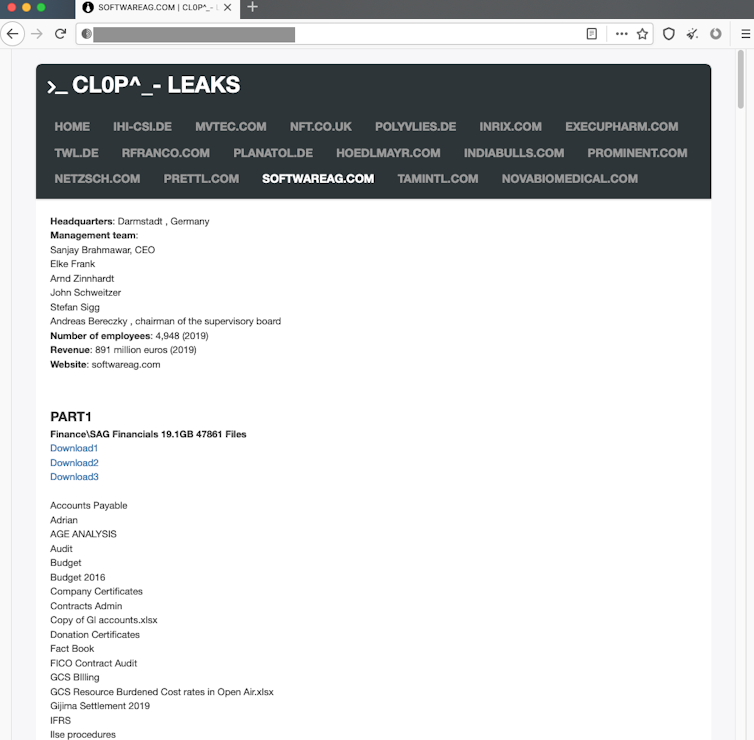
In October, German company Software AG faced a US$20 million ransom demand after a Cl0p ransomware attack. In this incident, the criminals claimed to have more than a terabyte of stolen data, including emails, financial records and even scanned copies of passports. This data trove was published online when the company failed to pay the ransom.

Screenshot of Cl0p Leaks website showing Software AG financial data available for public download (taken from dark web site).

This is an example of an increasingly common tactic referred to as “double extortion”, in which not only is data stolen and held to ransom, but there is the added threat the data will be posted in public or auctioned to interested parties. The threat of public exposure of the breach, coupled with the potential release of confidential data, can often encourage organisations to pay the ransom.

Potential consequences

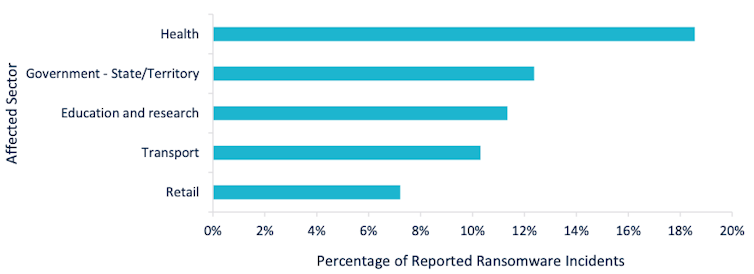
A recent ACSC report on ransomware in Australia identified the health-care sector as the most targeted, by a significant margin. This is perhaps not surprising, given the sector’s lack of training, lax security practices and chronic underinvestment in technology and digital infrastructure.

ACSC report on impacted sectors for reported ransomware incidents – October 2020. ACSC

Health-care providers face two significant consequences of cyber compromise. First, personal or sensitive data are valuable to criminals. Having such data leaked online is embarrassing and has significant legal implications for the organisation and the government.

A second, more serious, consequence can be seen when a ransomware attack impacts critical systems. The most notable example in recent years was the Wannacry attack in 2017 that targeted the UK National Health Service, among others. https://www.youtube.com/embed/5v5gtycGTps?wmode=transparent&start=16 Ransomware attack on UK hospitals.

The NHS suffered a major outage over several days following the Wannacry ransomware attack, resulting in thousands of operations and appointments being cancelled. Wannacry was estimated to have cost billions of dollars globally, with the UK NHS spending close to US$100 million to recover and strengthen its cyber defences.

Screenshot of Wannacry ransom demand. Wikimedia

A ransomware incident earlier this year in Germany had deadly results. When ransomware crippled a hospital in Dusseldorf, an emergency patient was sent to another facility instead. She died, and her death has been attributed to the delay in treatment.

Australia has had similar incidents in the past. Last year saw seven hospitals affected by a ransomware attack.

Should we be worried?

Cyber attacks are a constant threat, and most organisations are well aware of the risks to their business operations, intellectual property, sensitive data and reputation.

But in the health-care sector the stakes are higher. Losing data can cost lives, and patient records being stolen is a breach of privacy that can have long-lasting effects for the patient.

With systems intertwined and dependent on each other, just one compromised target can have major implications.

Interestingly, the Cl0p Leaks website (only available on the dark web through the TOR web browser) features the following reassuring statement in relation to hospitals – perhaps showing an ethical streak to the criminal group.

Cl0p Leaks screenshot (taken from Dark Web site)

Cyber criminals are usually motivated by profit. Ransomware attacks work because individuals within organisations make mistakes. When combined, there is a strong motivation for criminals to continue these actions and for organisations (and us) to continue to pay to clean up the mess that’s left behind.

Paul Haskell-Dowland, Associate Dean (Computing and Security), Edith Cowan University

This article is republished from The Conversation under a Creative Commons license. Read the original article.

Reducing risk in mega wildfires

Fighting wildfires is one of the most dangerous professions in the world but new ECU research may reduce firefighter injuries and fatalities whilst responding to large wildfires.

Dr Greg Penney, who is also a Senior Firefighter has recently completed his PhD in wildfire engineering at ECU. His research has examined how we can reduce the risk of injuries and death among firefighters responding to wildfires.

“Despite 242 formal inquiries and reviews into Australian natural disasters since 1927, and more than 62 international post-incident investigations following firefighter fatalities or injuries during wildfire entrapment and burnover, volunteer and career firefighters continue to be injured or killed in the line of duty in alarming numbers,” he said.

“Over the past 20 years nearly half of Australian first responder fatalities were firefighters and bushfire fighting has resulted in the highest number of injuries of all.

“Firefighting will always remain an incredibly dangerous occupation, but we need to re-examine how we prepare and respond to bushfires in order to keep our communities and our firefighters safe.”

Practical guide to save lives

Dr Penney has attempted to address the issues by developing a handbook to provide practical guidance to firefighters, incident management teams and urban planners.

“As a 14-year career firefighter who has worked in both metropolitan and country operations in Western Australia, I have not only lived in communities devastated by bushfires but have also been part of significant campaign bushfire operations as a firefighter,” he said.

“There are a number of ways to improve fire suppression operations, firefighter safety and resilient community design where development meets the bush.”

Dr Penney’s practical guide explores occupational safety in dynamic and high-risk environments, not only contributing models to improve wildfire suppression, but to provide guidance regarding the safety of high consequence operations at the rural urban interface.

His contribution to knowledge in occupational safety also extends to prevention, addressing improvements in urban design to not only improve the safety of responding firefighters, but to improve the resilience of communities from the impacts of wildfire internationally.

“The exposure to catastrophic bushfires will only increase as the effects of climate change continue to worsen.

“Bushfires continue to cause devastation around the world each year, with hundreds of houses and multiple of lives lost,” Dr Penney said.

“Climate change is ultimately resulting in longer and more severe bushfire seasons, while fire behaviour is also more difficult to suppress. Mega wildfires are a global problem that is unfortunately here to stay.”

A Handbook of Wildfire Engineering is available for download at the Bushfire and Natural Hazards CRC website.

Article first published by Edith Cowan University

Determining shark ‘Deterrent’ devices from snake oil

Shutterstock

As summer descends, sharks may be at the forefront of the minds of many beach goers and reef adventurers.

Globally, the number of shark bites is on the rise, with a threefold increase since 1982. White sharks, bull sharks and tiger sharks are most commonly responsible.

In Australia this year, there have been 20 unprovoked shark bites (when humans don’t initiate contact) — a similar number to recent years. However, we’ve had eight fatalities, the highest on record since 1929. The latest fatality was at Cable Beach in Western Australia, a location not recognised as a shark bite hotspot.

Still, the risk of an unprovoked shark bite is still exceptionally low. You’re more likely to drown at a beach than be killed by a shark. But there are things people can do to reduce the already low risk even further.

What’s behind the shark bite trends?

There is no single reason for the observed trends in unprovoked shark bite.

A 2016 study found more people in the water contributes to rising incidents, as populations around coastal cities and towns increase. But this doesn’t tell the whole story.

Another reason may be due to changes in the distribution and an increasing abundance of key prey such as humpback whales (Megaptera novaeangliae) and New Zealand fur seal (Arctocephalus forsteri) along parts of the coast.

For some sharks, weather conditions can also play a role. This is the case for bull sharks, which are commonly found in warm, shallow waters along coasts and rivers, such as in Sydney Harbour during summer and autumn when water temperatures are higher.

After flooding, there is a heightened risk of an unprovoked bite, as bull sharks prefer turbid water in the coastal zone. In other words, more rain generally means more bull shark activity.

Research in 2018 confirmed this. The authors found when total rainfall in a catchment near a beach was greater than or equal to 100 millimetres, the bull shark catch increased between one and eight days later.

And as we’re entering a summer with La Niña weather conditions — which means we’ll see increased rainfall — the risk of encountering a bull shark will be higher, particularly near river mouths.

Shark deterrent technology

If you want to learn about safety and sharks, it’s a good idea to start at the Shark Smart websites for Queensland and NSW, which provide simple ways to reduce your personal risk.

This includes identifying times, locations and conditions to avoid, such as not swimming at dawn and dusk, and avoiding swimming with schools of baitfish or diving birds.

For those wanting greater peace of mind, personal electric shark deterrents are commercially available, with products suitable for divers, surfers and swimmers.

Sharks have a set of sense organs called ampullae of Lorenzini that can detect very weak electric currents in the water. Deterrent devices produce a electric current strong enough to elicit an avoidance response by the sharks without hurting them.

No shark deterrent is 100% effective, but independent testing has demonstrated several can significantly reduce the risk of a bite. Still, results are variable.

For white sharks, one electric deterrent reduced the percentage of bait taken from 96% to 40%. And for bull sharks, researchers tested several different electric deterrents and found the best-performing device resulted in a 42.3% reduction in baits being consumed.

Electric devices aren’t the only type of deterrent. Chemical deterrents based on a necromone (dead shark smell!) have been effectively tested on Caribbean reef and blacknose sharks. They may not be effective against large species, such as tiger or white sharks though.

And research from earlier this year on reinforced neoprene wetsuits — fortified with composite fibres — shows promise for reducing the physical trauma of a shark bite, potentially reducing the chance of a fatality or serious injury. https://www.youtube.com/embed/NRyK6bA0-0U?wmode=transparent&start=0 The Freedom+ Surf is an electric shark deterrent that has been independently tested.

Know your deterrent from snake oil

If you’re thinking of buying a deterrent, a challenge for consumers is that many on the market have little to no biological or ecological basis, and have not been independently tested, as CHOICE, Australia’s leading consumer advocacy group, pointed out in 2016.

A shark deterrent is a safety device and as such should be the subject of an Australian Standard – similar to the way a life jacket must follow a standard – to ensure claims are valid. Currently no specific Australian Standard exists for shark deterrents.

No one can legally make a seat belt in their garage and sell it as an effective safety device. The same should apply to shark deterrents.

There is a risk a person may place themselves in a more dangerous situation than they otherwise would have on the false belief the deterrent they have purchased has some level of effectiveness.

If you are looking to purchase a shark deterrent, look for those that have been independently tested in the field and found to have an actual deterrent effect. Don’t just rely on anecdotes and “the vibe”. In any case, the most effective deterrent is to make informed choices when entering the water this summer.

And we should never lose sight that an unprovoked shark attack is traumatic for surviving victims, first responders, and friends and families who lose a loved one.

Daryl McPhee, Associate Professor of Environmental Science, Bond University

This article is republished from The Conversation under a Creative Commons license. Read the original article.

First-of-its-kind chatbot developed to support genetic counselling

Dubbed ‘Edna’ (which stands for electronic DNA), the chatbot is the first of its kind globally developed specifically to support genetic counselling for adults being tested to ascertain future risk of preventable or treatable conditions (known as ‘additional findings’).

These conditions include treatable genetic disorders such as hereditary breast cancer or cardiomyopathy.

Derived from real-world patient interactions, Edna is designed to answer the most generic and simple questions asked by patients, which then creates more time for genetic counsellors to focus their highly specialised skills on deeper and more specific issues relevant to patients.

Professor Clara Gaff is Executive Director of Melbourne Genomics, a ten-member alliance that includes CSIRO.

“If the healthcare system were to provide this kind of testing – which is beyond immediate medical need – one of the challenges is the genetic counselling time required to support patients’ informed consent,” Professor Gaff said.

“This prototype chatbot shows how we might employ technology to meet this need.”

CSIRO researcher Dr Dana Bradford, who led the development of Edna, said chatbots simulates human conversation through artificial intelligence.

“For chatbots to accurately recognise content in human speech – and provide a meaningful response – they need a large body of data to draw on, called a chatbot ‘brain’,” Dr Bradford said.

“Many chatbot brains are developed from open source data but this is inadequate for highly specialised fields like patient decision-making.”

“We developed Edna’s brain by systematically analysing transcripts of actual genetic counselling sessions for additional findings.

“This expert basis for Edna makes all the difference in applying this new technology.”

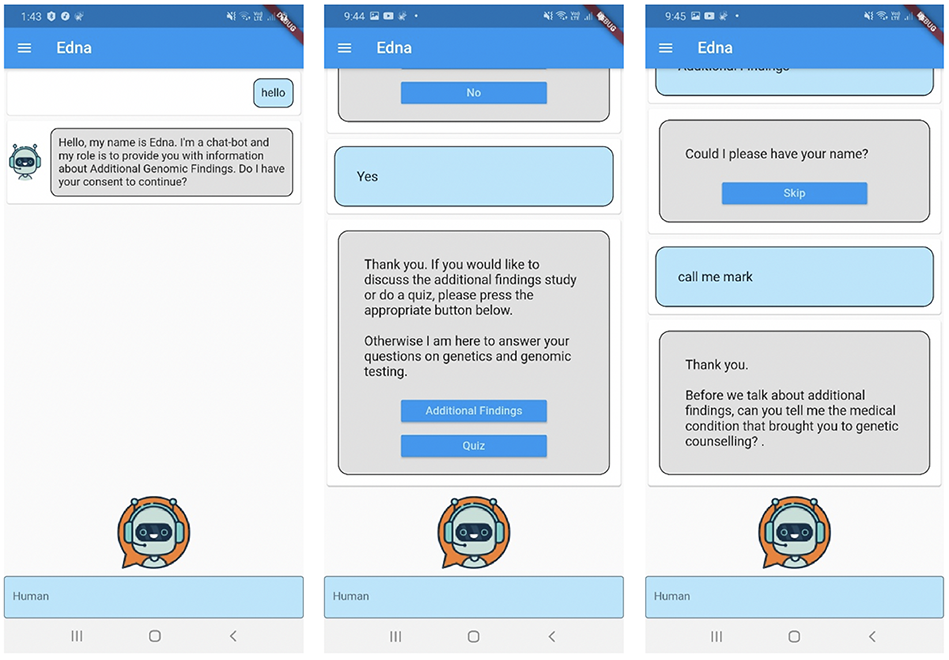
An example of EDNA in action. Credit: CSIRO

Edna is a downloadable smartphone app which can collect a patient’s family history and analyse human responses for signals that interaction with a genetic counsellor may be needed.

Edna’s development was part of a larger proof-of-concept study led by Melbourne Genomics to better understand the implications of offering additional findings testing to patients in Victoria.

“The Edna chatbot represents a significant movement toward feasible, real-world-informed digital health processes that can support patients’ informed decision-making about testing for future disease risk,” Professor Gaff said.

Edna is currently undergoing a feasibility trial with patients, genetic counsellors and genetics students, and is slated to undergo a larger-scale patient trial in the near future.

“When built in partnership with healthcare experts and patients, chatbot technology has enormous potential to provide and collect basic information in complex fields like genetics,” Dr Bradford said.

“Not only is the service on-demand, so people can access it whenever they wish, but it could free up highly-skilled expert time to build more effective care.”

The Edna chatbot was recently published in the peer-reviewed journal Patient Education and Counselling  .

For more on the Additional Findings proof-of-concept study, read the protocol paper A novel approach to offering

Jane O’Dwyer to lead CRC Association

Jane O’Dwyer, currently Vice-President (Engagement and Global Relations) at The Australian National University will become the Chief Executive Officer of the Cooperative Research Centres Association (CRC Association) in January 2021. She will succeed Tony Peacock, who has led the CRC Association for the past decade with great distinction.

“We are delighted to have Jane join us after what was a highly competitive process,” said CRC Association Chair, Belinda Robinson. “Her leadership skills, energy and unique experience across peak bodies, industry, academia, media and politics, make her an ideal fit to lead the organisation in its next chapter.”

“Along with my colleagues on the Board, I’m looking forward to working with Jane to support and represent our members and advance the benefits of cooperative research in Australia.”

“I would also again like to thank Tony and recognise the tremendous work he has done for the CRC Association and the Australian innovation community. He has been very well respected by our members and stakeholders and I would like to wish him and his wife Ros the absolute best for his next chapter.”

Jane joins the CRC Association after a more than 25-year career that has spanned Australia, Japan and the United States. Commencing her career as a political advisor, Jane held key roles in the Australian Local Government Association and Sports Medicine Australia. She joined ANU more than 15 years ago after 4 years in Japan, and has been a close and trusted advisor to three consecutive ANU Vice-Chancellors across media and public affairs, policy, international relations and global engagement. She spent three years in the United States, where she established the ANU North America Liaison Office attached to the Australian Embassy in Washington DC.

Ms O’Dwyer holds a Bachelor of Arts (Curtin), Masters degrees in Management (ANU) and Journalism (Wollongong) and is a Graduate of the Australian Institute of Company Directors. She is Deputy Chair of the Canberra Writer’s Festival and a Director of the Canberra Convention Bureau.  

“I’m delighted to join the CRC Association and know I follow in the footsteps of a highly respected and active CEO in Tony Peacock. Cooperative Research Centres are a great Australian success story, and a testament to the profound national value of industry-university research cooperation.   

“I relish the opportunity to work with the Board to write the next chapter for the CRC Association at a time when research and the development, and retention, of a highly skilled research workforce that can transition between universities and industry, will be essential to emerge from the impacts of COVID-19.

“Cooperative research is critical to Australia’s future.”

Making biodiesel from dirty old cooking oil and ag waste just got way easier

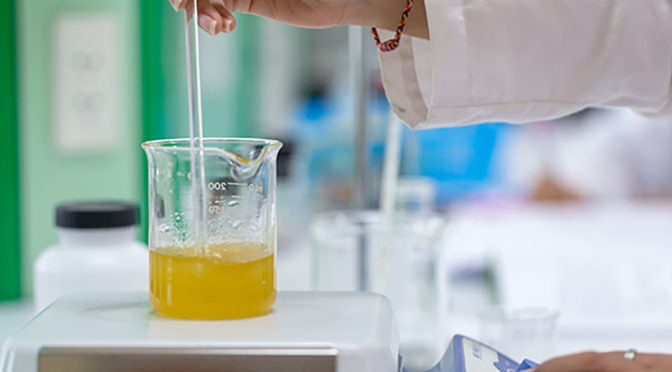
Researchers have developed a powerful, low-cost method for recycling used cooking oil and agricultural waste into biodiesel, and turning food scraps and plastic rubbish into high-value products.

The method harnesses a new type of ultra-efficient catalyst that can make low-carbon biodiesel and other valuable complex molecules out of diverse, impure raw materials. 

Waste cooking oil currently has to go through an energy-intensive cleaning process to be used in biodiesel, because commercial production methods can only handle pure feedstocks with 1-2% contaminants. The new catalyst is so tough it can make biodiesel from low-grade ingredients, known as feedstock, containing up to 50% contaminants.

It is so efficient it could double the productivity of manufacturing processes for transforming rubbish like food scraps, microplastics and old tyres into high-value chemical precursors used to make anything from medicines and fertilisers to biodegradable packaging.

The catalyst design is reported in a new study from an international collaboration led by RMIT University, published in Nature Catalysis.

Co-lead investigator Professor Adam Lee, RMIT, said that conventional catalyst technologies depended on high purity feedstocks and required expensive engineering solutions to compensate for their poor efficiency.
“The quality of modern life is critically dependent on complex molecules to maintain our health and provide nutritious food, clean water and cheap energy,” Lee said. 

“These molecules are currently produced through unsustainable chemical processes that pollute the atmosphere, soil and waterways. 

“Our new catalysts can help us get the full value of resources that would ordinarily go to waste – from rancid used cooking oil to rice husks and vegetable peelings – to advance the circular economy.

“And by radically boosting efficiency, they could help us significantly reduce environmental pollution from chemical manufacturing and bring us closer to the green chemistry revolution.”

Catalyst sponge: advancing green chemistry

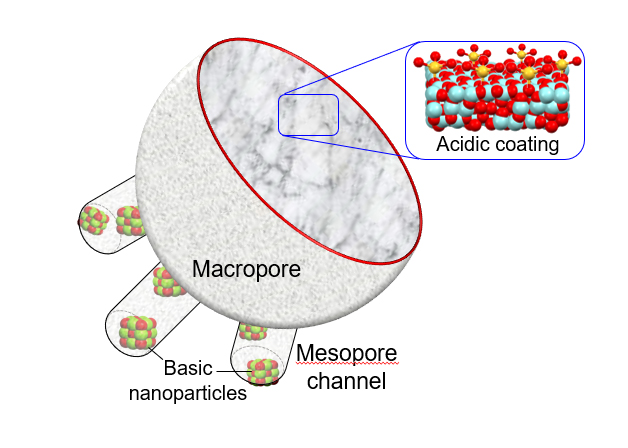
To make the new ultra-efficient catalyst, the team fabricated a micron-sized ceramic sponge (100 times thinner than a human hair) that is highly porous and contains different specialised active components. 

Molecules initially enter the sponge through large pores, where they undergo a first chemical reaction, and then pass into smaller pores where they undergo a second reaction.

It’s the first time a multi-functional catalyst has been developed that can perform several chemical reactions in sequence within a single catalyst particle, and it could be a game changer for the $US34 billion global catalyst market.

Co-lead investigator Professor Karen Wilson, also from RMIT, said the new catalyst design mimicked the way that enzymes in human cells coordinated complex chemical reactions.

“Catalysts have previously been developed that can perform multiple simultaneous reactions, but these approaches offer little control over the chemistry and tend to be inefficient and unpredictable,” Wilson said.

“Our bio-inspired approach looks to nature’s catalysts – enzymes – to develop a powerful and precise way of performing multiple reactions in a set sequence.

“It’s like having a nanoscale production line for chemical reactions – all housed in one, tiny and super-efficient catalyst particle.”

DIY diesel: supporting distributed biofuel production

The sponge-like catalysts are cheap to manufacture, using no precious metals.

Making low-carbon biodiesel from agricultural waste with these catalysts requires little more than a large container, some gentle heating and stirring.

It’s a low-technology, low-cost approach that could advance distributed biofuel production and reduce reliance on fossil fuel-derived diesel.

“This is particularly important in developing countries where diesel is the primary fuel for powering household electricity generators,” Wilson said.

“If we could empower farmers to produce biodiesel directly from agricultural waste like rice bran, cashew nut and castor seed shells, on their own land, this would help address the critical issues of energy poverty and carbon emissions.”

While the new catalysts can be used immediately for biodiesel production, with further development they could be easily tailored to produce jet fuel from agricultural and forestry waste, old rubber tyres, and even algae.

The next steps for the RMIT School of Science research team are scaling up the catalyst fabrication from grams to kilograms and adopting 3D printing technologies to accelerate commercialisation.

“We’re also hoping to expand the range of chemical reactions to include light and electrical activation for cutting-edge technologies like artificial photosynthesis and fuel cells,” Lee said

“And we’re looking to work with potential business partners to create a range of commercially available catalysts for different applications.”

The research was supported through funding from the Australian Research Council (Discovery, Linkage, Industrial Transformation Training Centres).

‘A spatially orthogonal hierarchically porous acid-base catalyst for cascade and antagonistic reactions’, with collaborators from University College London, University of Manchester, University of Western Australia, University of Plymouth, Aston University, Durham University and University of Leeds, is published in Nature Catalysis (DOI: 10.1038/s41929-020-00526-5).


Distributed by Medianet

Smart collar to track your pet in real-time


The prototype builds on work between CSIRO and Ceres Tag to develop smart ear tags for tracking livestock across expanses of open grazing and monitoring their activity and health.

Unlike similar products for pets, the prototype collar uses both Bluetooth and satellite communications rather than one or the other to track an animal’s movements in real-time. Updates are sent to the owner’s phone via an app whenever their pet wanders outside of a boundary they’ve established.

Dr Phil Valencia, Senior Research Engineer at CSIRO’s Data61, said the solution developed for the agriculture industry could also have flow-on benefits for conscientious pet owners.

“The Companion Collar uses Data61’s EIP (Embedded Intelligence Platform) and BLE (Bluetooth Low Energy) technology to determine if the pet is nearby, automatically switching to satellite communications when the collar is outside of the home network,” Dr Valencia said.

“Many devices only employ Bluetooth or WiFi-based tracking, which often involve a community of people listening’ on their phones and sharing their location data with a service in order to report the tracking device. This method is also only suitable for short distance monitoring.”

Navigating the neighbourhood

The other smart collar to track your pet approach available on the market is a GPS-based tracker that requires a mobile plan. These devices are often expensive, rely on cellular coverage and use a large amount of power, requiring weekly, if not even more frequent, charging. The Companion Collar requires monthly charging on average, depending on the amount of activity the animal performs.

Pets who remain within the virtual boundry set up by their owner will trigger the device’s automatic power saving mode, but those who wander outside will cause it to switch to GPS location and direct satellite reporting.

Other crucial information such as specific behaviours, out of the ordinary activity and data for health metrics will also be monitored by the Collar, with information being uploaded to the cloud and displayed on a smart phone app.

“Owners will get valuable insights into how their pet has behaved throughout the day, with the system identifying if the animal’s activity is above or below its typical levels, and whether it was significantly different at a certain time of day,” Dr Valencia said.

Personalised pet health through a smart collar to track your pet

Lewis Frost, Ceres Tag Chief Operating Officer, said insights will lay the foundation for personalised pet treatment and medication, suggesting the collar will vastly improve the health and welfare of domestic pets.

“Ceres is leveraging all its learnings from the livestock smart tag development to create a superior product in the companion animal market utilising the skills of our very capable development team,” Mr Frost said.

The Companion Collar is the latest project in a longstanding partnership between Ceres Tag and Data61, with CSIRO’s Kick–Start program making this project possible.

CSIRO Kick-Start is an initiative for innovative Australian start-ups and small SMEs, providing funding and support for innovative Australian start-ups and small businesses to access CSIRO’s research and development (R&D) expertise and capabilities.

The Kick-Start program provides dollar-matched funding vouchers of between AUD$10,000-$50,000 and access to CSIRO expertise and capabilities to help grow and develop their business.

First published on CSIRO.au

Read next: Navigating the future of GPS

How Australia can reap the benefits and dodge the dangers of the Internet of Things

Shutterstock

The Internet of Things (IoT) is already all around us. Online devices have become essential in industries from manufacturing and healthcare to agriculture and environmental management, not to mention our own homes. Digital consulting firm Ovum estimates that by 2022 Australian homes will host more than 47 million IoT devices, and the value of the global market will exceed US$1 trillion.

The IoT presents great opportunities, but it brings many risks too. Problems include excessive surveillance, loss of privacy, transparency and control, and reliance on unsafe or unsuitable services or devices.

In some places, such as the European Union, Germany, South Korea and the United Kingdom, governments have been quick to develop policies and some limited regulation to take advantage of the technology and mitigate its harmful impacts.

Australia has been late to react. Even recent moves by the federal government to make IoT devices more secure have been far behind international developments.

A report launched today by the Australian Council of Learned Academies (ACOLA) may help get Australia up to speed. It supplies a wide-ranging, peer-reviewed base of evidence about opportunities, benefits and challenges the IoT presents Australia over the next decade.

Benefits of the Internet of Things

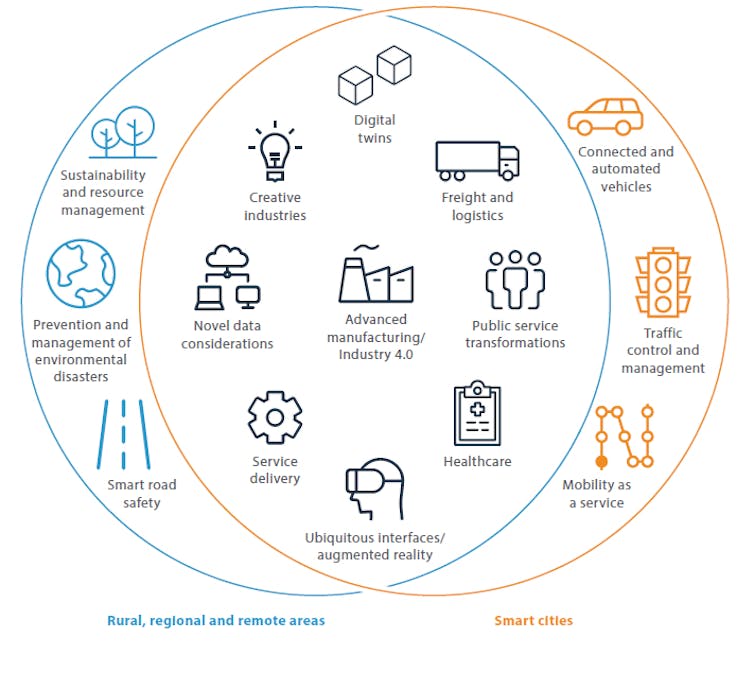
The report examines how we can improve our lives with IoT-related technologies. It explores a range of applications across Australian cities and rural, regional and remote areas.

Some IoT services are already available, such as the Smart Cities and Suburbs program run by local and federal governments. This program funds projects in areas such as traffic congestion, waste management and urban safety.

Health applications are also on the rise. The University of New England has piloted the remote monitoring of COVID-19 patients with mild symptoms using IoT-enabled pulse oximeters.

Augmented and virtual reality applications too are becoming more common. IoT devices can track carbon emissions in supply chains and energy use in homes. IoT services can also help governments make public transport infrastructure more efficient.

The benefits of the IoT won’t only be felt in cities. There may be even more to be gained in rural, regional and remote areas. IoT can aid agriculture in many ways, as well as working to prevent and manage bushfires and other environmental disasters. Sophisticated remote learning and health care will also benefit people outside urban areas.

While some benefits of the IoT will be felt everywhere, some will have more impact in cities and others in rural, remote and regional areas. ACOLA, CC BY-NC

Opportunities for the Australian economy

The IoT presents critical opportunities for economic growth. In 2016-17, IoT activity was already worth A$74.3 billion to the Australian economy.

The IoT can facilitate more data-informed processes and automation (also known as Industry 4.0). This has immediate potential for substantial benefits.

One opportunity for Australia is niche manufacturing. Making bespoke products would be more efficient with IoT capability, which would let Australian businesses reach a consumer market with wide product ranges but low domestic volumes due to our small population.

Agricultural innovation enabled by the IoT, using Australia’s existing capabilities and expertise, is another promising area for investment.

Risks of the Internet of Things

IoT devices can collect huge amounts of sensitive data, and controlling that data and keeping it secure presents significant risks. However, the Australian community is not well informed about these issues and some IoT providers are slow to explain appropriate and safe use of IoT devices and services.

These issues make it difficult for consumers to tell good practice from bad, and do not inspire trust in IoT. Lack of consistent international IoT standards can also make it difficult for different devices to work together, and creates a risk that users will be “locked in” to products from a single supplier.

In IoT systems it can also be very complex to determine who is responsible for any particular fault or issue, because of the many possible combinations of product, hardware, software and services. There will also be many contracts and user agreements, creating contractual complexity that adds to already difficult legal questions.

The increased surveillance made possible by the IoT can lead to breaches of human rights. Partially or fully automated decision-making can also to discrimination and other socially unacceptable outcomes.

And while the IoT can assist environmental sustainability, it can also increase environmental costs and impacts. The ACOLA report estimates that by 2050 the IoT could consume between 1 and 5% of the world’s electricity.

Other risks of harmful social consequences include an increased potential for domestic violence, the targeting of children by malicious actors and corporate interests, increased social withdrawal and the exacerbation of existing inequalities for vulnerable populations. The recent death of a woman in rural New South Wales being treated via telehealth provides just one example of these risks.

Maximising the benefits of the IoT

The ACOLA report makes several recommendations for Australia to take advantage of the IoT while minimising its downsides.

ACOLA advocates a national approach, focusing on areas of strength. It recommends continuing investment in smart cities and regions, and more collaboration between industry, government and education.

ACOLA also recommends increased community engagement, better ethical and regulatory frameworks for data and baseline security standards.

The ACOLA report is only a beginning. More specific work needs to be done to make the IoT work for Australia and its citizens.

The report does outline key areas for future research. These include the actual experiences of people in smart cities and homes, the value of data, environmental impacts and the use of connected and autonomous vehicles.

Kayleen Manwaring, Senior Lecturer, School of Taxation & Business Law, UNSW and Peter Leonard, Professor of Practice (IT Systems and Management and Business and Taxation Law), UNSW Business School, Sydney, UNSW

This article is republished from The Conversation under a Creative Commons license. Read the original article.

Machine learning helps to map invasive gamba grass from space

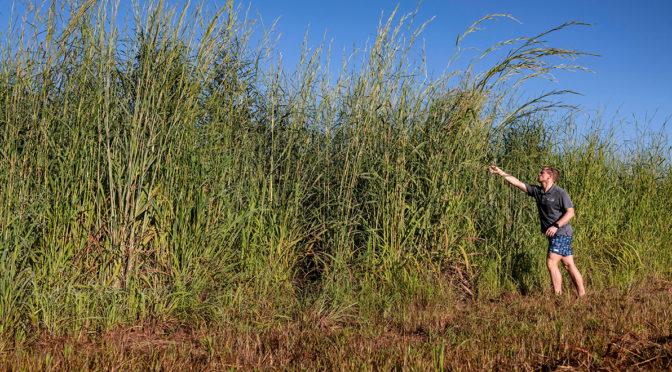
Gamba grass can grow up to four metres high and forms dense tussocks which can burn as large, hot fires late in the dry season.
Credit: NESP Northern Australia Hub.

Researchers from CSIRO, Charles Darwin University and The University of Western Australia have developed a machine-learning approach that reliably detects invasive gamba grass from high-resolution satellite imagery.
 
Gamba grass, originally from Africa, is listed as a Weed of National Significance, and is one of five introduced grass species that pose extensive and significant threats to Australia’s biodiversity.
 
The perennial grass can grow to four metres in height and forms dense tussocks which can burn as large, hot fires late in the dry season.
 
Mapping where gamba grass occurs is essential to managing it effectively, but northern Australia is so vast and remote that on-the-ground mapping and even airborne detection of the weed is too labour-intensive.

So, the researchers turned to high-quality satellite imagery and developed a technique that could help detect and prioritise gamba grass for management.
 
Dr Shaun Levick from Australia’s national science agency, CSIRO, said that the research team used field data to ‘train’ a machine-learning model to detect gamba grass from high-resolution, multispectral satellite imagery.
 
“Under optimum conditions, our method can detect gamba grass presence with about 90 per cent accuracy,” Dr Levick said.
 
The researchers commissioned the WorldView-3 satellite to capture very high-resolution imagery across 16 spectral bands for an area of 205 square kilometres near Batchelor in the Northern Territory – an area of dense gamba grass infestation.
 
The wide range of spectral data allowed them to use factors unseen to the human eye, such as leaf moisture levels and chlorophyll content, to differentiate between gamba grass and native grass species.
 
Dr Natalie Rossiter-Rachor, of Charles Darwin University, said that the project drew on extensive on-ground research into the life cycle of gamba grass to help achieve such accurate detection rates.
 
“We knew that gamba grass tends to stay green longer into the dry season than native grasses, so we timed the capture of the satellite imagery for this period,” Dr Rossiter-Rachor said.
 
“Understanding the ecology of the problem was essential to informing the remote sensing and machine-learning solution to the problem.”
 
The project, funded by the Australian Government’s National Environmental Science Program under the Northern Australia Environmental Resources Hub, is part of a larger effort to detect and map gamba grass throughout the north.
 
“Our longer-term goal is to move to a system where we can use free, open-access imagery to map gamba grass. We want to develop a technique that is accessible to anyone and that can help improve land management in northern Australia,” Dr Levick said.
 
Associate Professor Samantha Setterfield from The University of Western Australia said that accurate maps of where gamba grass occurs are essential to control the spread of the weed.
 
“Mapping gamba grass using satellite imagery unlocks the potential to frequently map large areas so we can get a better picture of where gamba grass is across northern Australia, and how quickly it is spreading,” Dr Setterfield said.
 
“Managers can then target areas that are the highest priority for control, such as biodiversity-rich areas or culturally important sites.”
 
To read the paper Leveraging High-Resolution Satellite Imagery and Gradient Boosting for Invasive Weed Mapping, go to https://ieeexplore.ieee.org/abstract/document/9154553

Bulk ore sorting goes Olympic

One of the world’s biggest resources companies recently engaged the services of an Australian research consortium to examine deployment of cutting edge preconcentration techniques.

Olympic Dam is 560 kilometres north of Adelaide and is one of the world’s most significant deposits of copper, gold, silver, and uranium. This large BHP site is made up of underground and surface operations and conducts fully integrated processing from ore to metal.

The South Australian operation is one of the locations where BHP is actively examining bulk ore sensing and sorting opportunities – techniques within the Grade Engineering® suite of preconcentration technologies.

Grade Engineering is a key innovation of the Cooperative Research Centre for Optimising Resource Extraction (CRC ORE). It is an integrated approach to coarse rejection that matches a suite of separation technologies to ore specific characteristics and compares the net value of rejecting low value components in current feed streams to existing mine plans as part of a system-view.

CRC ORE was requested by BHP to assist in the assessment of bulk ore sorting opportunities at Olympic Dam.

BHP Principal Technology Lee Bolden said that as a CRC ORE Participant, the diversified miner had watched with interest the sorting and sensing work that CRC ORE is undertaking in open pit and underground operations.

“It made sense for us to have CRC ORE provide us with valuable insights on this work and input into our bulk ore sorting plans,” Mr Bolden said.

BHP received a high-level bulk ore sorting deployment strategy from CRC ORE for Olympic Dam, along with a framework and calculator for the quantification and ranking of bulk ore sorting strategies at the operation.

CRC ORE also identified the critical work and data required to strengthen the evaluation of bulk ore sorting with the Olympic Dam Project team.

CRC ORE Chief Operating Officer Dr Luke Keeney said there were several deployment options among the opportunities assessed.

“We explored sublevel open stoping under the current mining environment, along with block caving as part of future-state mining options,” Dr Keeney said.

As part of the assessment, BHP received a high-level estimate of value from these deployment options.

Dr Keeney said the engagement of CRC ORE at Olympic Dam demonstrated the commitment of big miners to apply innovation to their processes.

“With the need for valuable minerals continuing to grow and mining these minerals becoming ever more difficult, mine operators need to think differently,” Dr Keeney said.

“Bulk ore sorting, and other Grade Engineering opportunities become increasingly competitive and complementary solutions where mined grades decline and mining dilution increases.”

More information on Grade Engineering can be found at crcore.org.au/gradeengineering.

CSIRO and partners take aim at ending plastic waste

CSIRO, Australia’s national science agency, is developing a major research program to tackle plastic waste and reimagine the future of plastics.

The Plastics Mission, one of 12 missions in development by CSIRO is using science and technology, to address Australia’s plastics waste issue.

Each year, 90 billion tonnes of primary materials are extracted and used globally for plastics. Only 9 per cent is recycled, with economic, social, environmental and health impacts. In Australia, we generate an estimated 67 million tonnes of waste every year.

CSIRO Senior Principal Research Scientist Dr Denise Hardesty said CSIRO was working with collaborators through the Plastics Mission to apply technological solutions to the entire plastics supply chain and prevent rubbish ending up in the environment.

“Our research is helping to understand the extent of plastic pollution in Australia and globally, and how to reduce it,” Dr Hardesty said.

“Rethinking plastic packaging is just one way of reducing waste, through better design, materials and logistics. We can also transform the way we use, manufacture and recycle plastics by creating new products and more value for plastics.”

New solutions under development include plastics detection using artificial intelligence, implementing and optimising waste monitoring systems, and establishing recycling standards and best practices to reduce contamination.

Machine learning and camera sensor technologies

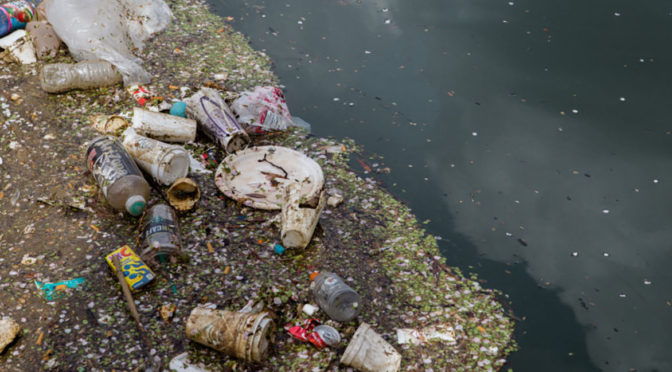
Machine learning and camera sensor technologies are fast-tracking data collection to detect and classify items of rubbish in our rivers.

This project, in partnership with Microsoft, helps inform waste management strategies, highlighting where intervention is needed to stop plastic from entering waterways.

Microsoft Australia chief technology officer Lee Hickin highlighted the importance of supporting the efforts to aid in the development of a national baseline to measure litter accumulation in the environment, which was key for measuring and reacting to change.

“Microsoft artificial intelligence image recognition is underpinning the identification of plastic pollution,” Mr Hickin said.

“By using AI to accelerate the detection and classification of rubbish in our waterways, we can simply react more quickly and work to improve the quality of water faster than if done manually.”

Camera sensor technologies are also being applied to waste traps, commonly used by councils to prevent rubbish flowing through stormwater drains into the environment.

City of Hobart Lord Mayor Anna Reynolds said the City was working with CSIRO to develop an autonomous sensor network to provide real-time reporting on the amount of rubbish being captured.

“Gross pollutant traps capture rubbish that ends up in stormwater drains,” Cr Reynolds said. “But maintenance can be costly and time-consuming.”

“By tapping into CSIRO’s modelling capabilities, we can optimise our operations to avoid the release of pollutants, while improving safety and reducing environmental harm.”

Turning resources to riches

CSIRO is also collaborating with Chemistry Australia and their Plastics Stewardship Australia initiative to inform ways to more sustainably use, re-use and recycle plastic products.

Director Strategy Energy and Research for Chemistry Australia Peter Bury said new technologies and initiatives to recover and transform what are important resources into commodities supports the UN’s Sustainability Development Goals and can help drive Australia’s circular economy.

“With a pending export ban for Australian waste, the time is now to address the plastic waste problem,” Mr Bury said.

“Leading science will help establish standards to ensure product security and inform decision-making.

“Leveraging the capability of industry for plastic products at their end of life will also generate new types of products and design, and help build new industries and jobs across a range of sectors.”

References

CSIRO Missions Program
CSIRO is working with government, universities, industry and the community on a new missions program to bolster Australia’s COVID-19 recovery and build long term resilience.
The program of large scale, major scientific and collaborative research initiatives, is aimed at solving some of Australia’s greatest challenges, focused on outcomes that lead to positive impact, new jobs and economic growth.

Plastics Mission
These projects are part of CSIRO’s Plastics Mission to end plastic waste, which is one of 12 missions in development.

Early collaborators working to co-design a mission to end plastic waste include:
Chemistry Australia and Plastics Stewardship Australia.
Working together on initiatives to support the sustainable use and recovery of plastics. This includes establishing best practices and standards to ensure product reliability, food security, sustainability; and partnering with Operation Clean Sweep® to prevent plastic pellet loss into the environment.
Hobart City Council
Pilot project partner for cameras to measure waste flows and smart sensor and decision support technologies to reduce costs, increase safety and better manage gross pollutant trap assets.
Microsoft
Microsoft computer vision technologies is enabling CSIRO researchers to detect and classify the rubbish in rivers, infer litter abundance and distribution and inform councils and decision makers in order to build more suitable policies and waste management systems.
NSW Government
CSIRO is supporting the Regional Growth NSW Development Corporation on a program of long-term engagement in the NSW Special Activation Precincts in Parkes, Wagga Wagga, Moree, Snowy Mountains and Williamtown. Our collaboration with the NSW Government as well as NSW universities and industry in these Precincts will assist to accelerate NSW economic recovery by creating future industries and highly skilled jobs.
Ocean Protect
Ocean Protect is an implementing partner for gross pollutant traps in stormwater drains to optimise performance, reduce costs and increase safety.

Standards Australia
CSIRO is working with Standards Australia to design and implement a clear set of guidelines for plastics recycling and recycled content to decrease contamination and increase the value of recycled stocks.


Super-charging Australia’s biggest renewables project

Australia doesn’t yet export renewable energy. But the writing is on the wall: demand for Australia’s fossil fuel exports is likely to dwindle soon, and we must replace it at massive scale.

The proposed Asian Renewable Energy Hub (AREH) will be a huge step forward. It would eventually comprise 26,000 megawatts (MW) of wind and solar energy, generated in Western Australia’s Pilbara region. Once complete, it would be Australia’s biggest renewable energy development, and potentially the largest of its type in the world.

Recently, the federal government granted AREH “major project” status, meaning it will be fast-tracked through the approvals process. And in another significant step, the WA government this month gave environmental approval for the project’s first stage.

The mega-venture still faces sizeable challenges. But it promises to be a game-changer for Australia’s lucrative energy export business and will reshape the local renewables sector.

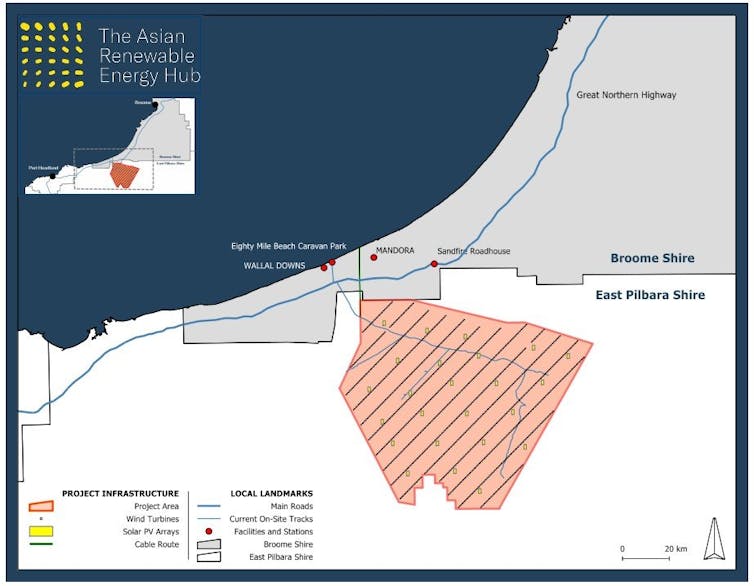
Map showing proposed location of the Asian Renewable Energy Hub.
Map showing proposed location of the Asian Renewable Energy Hub. AREH

Writing on the wall

Australia’s coal and gas exports have been growing for decades, and in 2019-20 reached almost A$110 billion. Much of this energy has fuelled Asia’s rapid growth. However, in recent weeks, two of Australia’s largest Asian energy markets announced big moves away from fossil fuels.

China adopted a target of net-zero greenhouse emissions by 2060. Japan will retire its fleet of old coal-fired generation by 2030, and will introduce legally binding targets to reach net-zero emissions by 2050.

There are signs other Asian nations are also moving. Singapore has weak climate targets, but on Monday inked a deal with Australia to cooperate on low-emissions technologies.

Export evolution

The Asian Renewable Energy Hub (AREH) would be built across 6,500 square kilometres in the East Pilbara. The first stage involves a 10,000MW wind farm plus 5,000MW of solar generation – which the federal government says would make it the world’s largest wind and solar electricity plant.

The first stage would be capable of generating 100 terawatt-hours of renewable electricity each year. That equates to about 40% of Australia’s total electricity generation in 2019. AREH recently expanded its longer term plans to 26,000MW.

The project is backed by a consortium of global renewables developers. Most energy from AREH will be used to produce green hydrogen and ammonia to be used both domestically, and for shipping to export markets. Some energy from AREH will also be exported as electricity, carried by an undersea electrical cable.

Another Australian project is also seeking to export renewable power to Asia. The 10-gigawatt Sun Cable project, backed by tech entrepreneur Mike Cannon-Brookes, involves a solar farm across 15,000 hectares near Tennant Creek, in the Northern Territory. Power generated will supply Darwin and be exported to Singapore via a 3,800km electrical cable along the sea floor.

The export markets for both AREH and Sun Cable are there. For example, both South Korea and Japan have indicated strong interest in Australia’s green hydrogen to decarbonise their economies and secure energy supplies.

But we should not underestimate the obstacles standing in the way of the projects. Both will require massive investment. Sun Cable, for example, will cost an estimated A$20 billion to build. The Asian Renewable Energy Hub will reportedly require as much as A$50 billion.

The projects are also at the cutting edge of technology, in terms of the assembly of the solar array, the wind turbines and batteries. Transport of hydrogen by ship is still at the pilot stage, and commercially unproven. And the projects must navigate complex approvals and regulatory processes, in both Australia and Asia.

But the projects have good strategic leadership, and a clear mission to put Australian green energy exports on the map.

Shifting winds

Together, the AREH and Sun Cable projects do not yet make a trend. But they clearly indicate a shift in mindset on the part of investors.

The projects promise enormous clean development opportunities for Australia’s north, and will create thousands of jobs in Australia – especially in high-tech manufacturing. As we look to rebuild the economy after the COVID-19 pandemic, such stimulus will be key. All up, AREH is expected to support more than 20,000 jobs during a decade of construction, and 3,000 jobs when fully operating.

To make smart policies and investments, the federal government must have a clear view of the future global economy. Patterns of energy consumption in Asia are shifting away from fossil fuels, and Australia’s exports must move with them.


John Mathews, Macquarie University; Elizabeth Thurbon, UNSW; Hao Tan, University of Newcastle, and Sung-Young Kim, Macquarie University

John Mathews, Professor Emeritus, Macquarie Business School, Macquarie University; Elizabeth Thurbon, Scientia Associate Professor in International Relations / International Political Economy, UNSW; Hao Tan, Associate professor, University of Newcastle, and Sung-Young Kim, Senior Lecturer in International Relations, Discipline of Politics & International Relations, Macquarie School of Social Sciences, Macquarie University

This article is republished from The Conversation under a Creative Commons license. Read the original article.

How to live in space: what we’ve learned from 20 years of the International Space Station

NASA / Tracy Caldwell Dyson

Alice Gorman, Flinders University and Justin St. P. Walsh, Chapman University

November 2 marks 20 years since the first residents arrived on the International Space Station (ISS). The orbiting habitat has been continuously occupied ever since.

Twenty straight years of life in space makes the ISS the ideal “natural laboratory” to understand how societies function beyond Earth.

The ISS is a collaboration between 25 space agencies and organisations. It has hosted 241 crew and a few tourists from 19 countries. This is 43% of all the people who have ever travelled in space.


Read more: Explainer: the International Space Station


As future missions to the Moon and Mars are planned, it’s important to know what people need to thrive in remote, dangerous and enclosed environments, where there is no easy way back home.

A brief history of orbital habitats

The fictional ‘Brick Moon’ was constructed from bricks because they are heat-resistant. NASA

The first fictional space station was Edward Everett Hale’s 1869 “Brick Moon”. Inside were 13 spherical living chambers.

In 1929, Hermann Noordung theorised a wheel-shaped space station that would spin to create “artificial” gravity. The spinning wheel was championed by rocket scientist Wernher von Braun in the 1950s and featured in the classic 1968 film 2001: A Space Odyssey.

Instead of spheres or wheels, real space stations turned out to be cylinders.

The first space station was the USSR’s Salyut 1 in 1971, followed by another six stations in the Salyut programme over the next decade. The USA launched its first space station, Skylab, in 1973. All of these were tube-shaped structures.

In Stanley Kubrick’s 1968 film 2001: A Space Odyssey, a spinning wheel-like space station creates gravity using centripetal force.

The Soviet station Mir, launched in 1986, was the first to be built with a core to which other modules were added later. Mir was still in orbit when the first modules of the International Space Station were launched in 1998.

Mir was brought down in 2001, and broke up as it plummeted through the atmosphere. What survived likely ended up under 5000 meters of water at the bottom of the Pacific Ocean.

The ISS now consists of 16 modules: four Russian, nine US, two Japanese, and one European. It’s the size of a five-bedroom house on the inside, with six regular crew serving for six months at a time.

The fully assembled International Space Station. Roscosomos/NASA

Read more: Space invasions: what to do when stuff falls from the sky


Adapting to space

Yuri Gagarin’s voyage around Earth in 1961 proved humans could survive in space. Actually living in space was another matter.

Contemporary space stations don’t spin to provide gravity. There is no up or down. If you let go of an object, it will float away. Everyday activities like drinking or washing require planning.

Spots of “gravity” occur throughout the space station, in the form of hand or footholds, straps, clips, and Velcro dots to secure people and objects.

In the Russian modules, surfaces facing towards Earth (“down”) are coloured olive-green while walls and surfaces facing away from Earth (“up”) are beige. This helps crew to orient themselves.

Colour is important in other ways, too. Skylab, for example, was so lacking in colour that astronauts broke the monotony by staring at the coloured cards used to calibrate their video cameras.

In movies, space stations are often sleek and clean. The reality is vastly different.

The ISS is smelly, noisy, messy, and awash in shed skin cells and crumbs. It’s like a terrible share house, except you can’t leave, you have to work all the time and no-one gets a good night’s sleep.

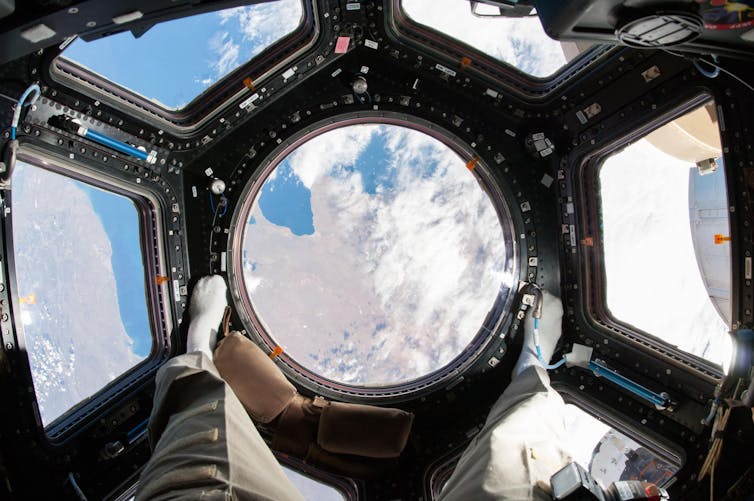
There are some perks, however. The Cupola module offers perhaps the best view available to humans anywhere: a 180-degree panorama of Earth passing by below.

Astronaut Rick Mastracchio looks towards Earth from the Cupola in 2016. NASA

‘A microsociety in a miniworld’

The crew use all kinds of objects to express their identities in this miniworld, as space habitats were called in a 1972 report. Unused wall space becomes like your refrigerator door, covered with items of personal and group significance.

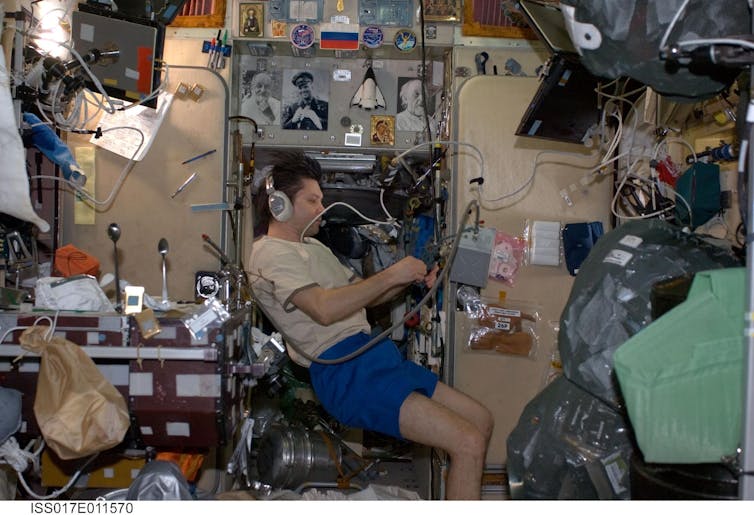
In the Zvezda module, Orthodox icons and pictures of space heroes like Konstantin Tsiolkovsky and Gagarin create a sense of belonging and connection to home.

Oleg Kononenko in the Zvezda module in 2008, showing icons and space heroes pinned on the wall in the background. NASA

Food plays a huge role in bonding. Rituals of sharing food, celebrating holidays and birthdays, help form camaraderie between crew of different national and cultural backgrounds.

It’s not all plain sailing. In 2009, toilets briefly became a source of international conflict when decisions on the ground meant Russian crew were forbidden to use the US toilets and exercise equipment.

In this “microsociety”, technology isn’t only about function. It plays a role in social cohesion.

The future of living in space

The ISS is massively expensive to run. NASA’s costs alone are US$3-4 billion a year, and many argue it’s not worth it. Without more commercial investment, ISS may be de-orbited in 2028 and sent to the ocean floor to join Mir.

The next stage in space-station life is likely to occur in orbit around the Moon. The Lunar Gateway project, planned by a group of space agencies led by NASA, will be smaller than the ISS. Crews will live on board for up to a month at a time.

Its modules, based on the design of the ISS, are due to be launched into lunar orbit in the next decade.

One preliminary habitat design for the Lunar Gateway has four expandable crew cabins, to give people a little more space. But the sleeping, exercise, latrine, and eating areas are all much closer together.


Read more: Living in a bubble: inflatable modules could be the future of space habitats


Since ISS crews like to create improvised visual displays, we might suggest including spaces reserved for such displays in next-generation habitats.

In popular culture, the ISS has become Santa’s sleigh. In recent years, parents around the world have taken their children outside on Christmas Eve to spot the ISS passing overhead.

The ISS has shaped the space culture of the 20th and 21st centuries, symbolising international cooperation after the Cold War. It still has much to teach us about how to live in space.

Alice Gorman, Associate Professor in Archaeology and Space Studies, Flinders University and Justin St. P. Walsh, Associate professor of art history and archaeology, Chapman University

This article is republished from The Conversation under a Creative Commons license. Read the original article.

Why we work better together

Dr Cathy Foley, Chief Scientist, CSIRO

University science is the lifeblood of translational research, and in collaboration with industry and publicly funded agencies like the CSIRO, builds new industries that bolster our economic recovery. 

It’s a relationship that has thrived across over a century, and has underscored the development of new vaccines, created new ways of looking at the stars, developed new approaches to medicine, new ways of communicating and of generating clean energy.

In fact there are few areas of our lives where collaborations between university science and the CSIRO haven’t impacted. And in each of these areas, new industries have arisen from the combination of fundamental research, community involvement, research translation and innovation.

University science works with the CSIRO to build communities around new and groundbreaking areas of research as well as facilitating connections and collaborations with industry. It could hardly be more critical that this relationship continues to thrive as we face the extraordinary challenges from climate change, COVID, water shortages, increased energy and data demands, the need for advanced manufacturing and for new industries and jobs that can rebuild economies globally.

When COVID-19 struck in early 2020, the University of Queensland’s vaccine candidate was one of the earliest to go into testing and was scaled-up at CSIRO’s Advanced Biologics Manufacturing Facility in Melbourne. We are also collaborating with the University of Queensland and others on research into the detection of the virus in wastewater, on therapeutics and on the survivability of the virus on various surfaces.

Australia has world-class research capability and the potential to lead in future industries like advanced manufacturing, hydrogen, space and quantum technologies. We can also lead in new industries created by advances in science research in climate, biology and agriculture-related technologies.

Collaborative research and partnerships will be essential to creating and growing these industries. University science and the CSIRO work in tandem with industry to foster an ecosystem that turns Australian inventions into innovations that support our economic recovery and future resilience. 

Translation is a key part of this, because research doesn’t end with the publishing of a paper.

Translation works best when we have a strong network of researchers from university science, publicly funded agencies like the CSIRO and industry working together to turn an invention into something that can have impact in our world. Working together, we will build the industries today that our society will rely on in the future.

Five ways science is fuelling new industries

Swinburne University of Technology’s Dr Ivan Maksymov improving invertebrate robots.

Australia’s strong science research and training are integral to driving new economies. Universities have a critical role as partners in establishing innovation and technological change in industry.

As science delivers new insights and tools, new industries are emerging, and people with science skills will be essential to these new industries. Australian University Science magazine highlights these stories, showcasing exceptional science teams and Australian science graduates working in industry.

Here are five ways university science is fuelling new industries.

1. Improving invertebrate robots

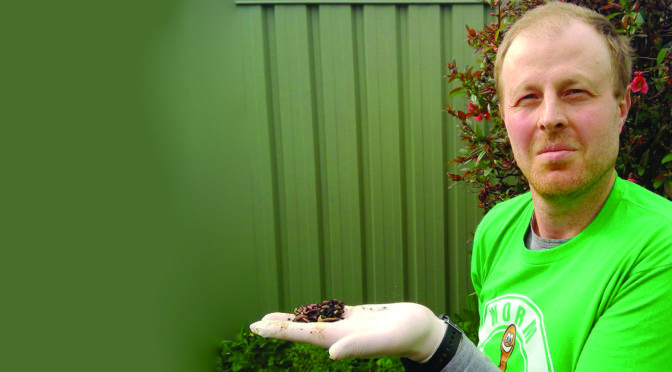
A physicist and a mathematician from Swinburne University of Technology demonstrated the existence of fundamentally important Faraday waves on the surface of vertically vibrated living earthworms. The research could help advance work on human-machine interfaces, autonomous soft robotics and mechatronics.

The work earned Dr Ivan Maksymov and Dr Andriy Pototsky the 2020 Ig Nobel award in Physics for their amusing experiment involving four species of earthworms vibrated on a sub-woofer speaker and anaesthetised with dilute vodka.

“Recently, there have been experimental demonstrations of prototypes of soft autonomous robots that move by crawling across surfaces by contracting segments of their body, much like earthworms,” says Maksymov.

The research was published in the journal Scientific Reports. (Post-experiment, all worms lived out their days in a worm farm).

2. Advancing drug manufacturing

University of South Australia pharmeceutical scientist Professor Clive Prestidge and team have developed an oral formulation for the leading prostate cancer drug Abiraterone acetate (marketed as Zytiga).

Pre-clinical trials showed the oral form improved the drug’s effectiveness by 40%, allowed a lower dose to be used, and could dramatically reduce current side-effects, including joint swelling. One in six men are diagnosed with prostate cancer before the age of 85 and there were 1.28 million cases globally in 2018.

3. Developing new medical tech

University of Western Australia physicist Professor Michael Tobar has collaborated on a project that has found a new way to measure tiny forces and use them to control objects without contact — a practical application of a theoretical physics phenomenon called the Casimir force. The discovery has applications in nanotechnology and in nano-electromechanical systems, including membranes used in precision medicine such as targeted drug therapies.

4. Re-formulating ancient ferments

Biochemist Dr Cristian Varela from the Australian Wine Research Institute has led a study in collaboration with the University of Adelaide investigating processes used by the Tasmanian Palawa people to produce a fermented alcoholic beverage from the sweet sap of the Tasmanian cider gum, Eucalyptus gunnii. The researchers worked with local Aboriginal communities to understand traditional processes and gather soil, bark and sap from the trees.

Their research used DNA sequencing to identify the complex microbial communities associated with the natural fermentation of sap, finding some new classifications of yeast and bacteria not previously described that are unique to Australia and could be used to help revive lost practices or develop new ones. 

5. Commercialising kangaroo tendons

At the University of Sydney, biomechanics researcher Dr Elizabeth Clarke has developed a product that uses kangaroo tendons for ligament reconstruction in human subjects in tandem with a 3D-printed biomaterial to connect it to bone. The invention is being commercialised by Allegra Orthopaedics, the Innovative Manufacturing Cooperative Research Centre and Bone Ligament Tendon Ltd.

Read next: Building better economic futures through university science.

Building better economic futures

UTS’ Dr Alexandra Thomson in the Deep Green Biotech Hub

The new era in advanced manufacturing is driven by long-term science from Australia’s universities.

Advanced manufacturing sits at the heart of the Morrison government’s multibillion-dollar, five-year blueprint to reshape Australia’s post-pandemic economy, create millions of future jobs and boost local manufacture of industrial goods.

The strategy supports growth across the medical technology, biotech, agriculture, food technology, defence, fintech and resources sectors and will push research commercialisation and enhanced collaboration between universities, governments and the private sector.

Key to developing these new industries is long-term university science in chemistry, physics and biology addressing major global challenges around energy, pollution and health.

Establishing future energy industries

The expansion of our energy needs, and the ability to meet these sustainably, is one such challenge.

“Australia has almost unlimited energy resources through sunlight, so scientists are thinking about how we can export our sunlight to countries like Korea and Japan that don’t have those resources,” says Queensland University of Technology (QUT) Professorial Fellow Peter Talbot.

He says that as demand for mobile devices, electric vehicles and remote sensor networks skyrockets globally, developing new battery technology is one way to deliver this energy.

Talbot established Australia’s first lithium ion battery manufacturing plant, the QUT Advanced Battery Facility, and leads several other programs in future energy storage and hydrogen fuel. The world lithium-ion battery market is growing at over 14% a year and industry analyst Technavio predicts it will grow by $66.76 billion between 2020 and 2024. 

Talbot says Australia is well positioned to be a major battery processing, advanced manufacturing and trading hub. “There is a once-in-a-generation shift underway in how we generate and store energy, which is driving an enormous industry worldwide,” he says. “Australia is perfectly placed to take advantage of this huge opportunity.”

Australia exports nine of the 10 mineral elements required for lithium-ion batteries and has commercial reserves of the remaining element — graphite.

Critical to the growth of this industry is talent from our universities. Talbot says the battery industry will need scientists from various disciplines: from geologists to find deposits, to electrochemists, physicists, mathematicians and computer scientists to optimise the properties and develop viable commercial products for sale and export. 

Creating green futures 

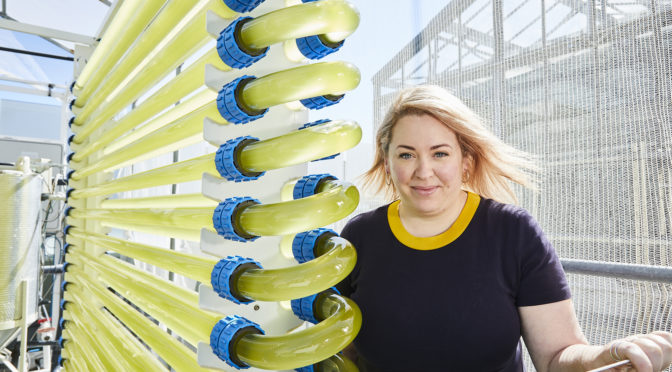
UTS opened its Deep Green Biotech hub in 2016 to focus on all things algae, from single-celled freshwater microalgae to large ocean kelp species, with a direct focus on using its research expertise to generate new industries.

Algae is used in pharmaceuticals, foods, fertilisers and building materials. It has significant sustainability benefits, using just 2% of the land and water required to grow the equivalent volume in beef protein, and instead of generating greenhouse emissions during production, it absorbs them.

The Deep Green Biotech Hub is a completely different approach to building relationships with university and industry: 10 business start-ups have already graduated from the Hub’s five-month business accelerator programs, which team companies with a research mentor to help them innovate using algae, kick-starting a potentially huge new industry based on fundamental science.

“The scientific expertise we provide is incredibly valuable to these companies and it’s essential for them to be able to innovate and be successful,” says Dr Alexandra Thomson, who heads up the Hub. 

Globally, the algae industry is estimated to be worth $62.15 billion by 2024, she says. “We’ve been benchmarking the Australian industry and since 2018 the number of companies that are involved in microalgae has grown by 30%.” 

“Australia is in a prime position to take advantage of this developing economy, we have a whole bunch of kelps that are endemic and can leverage these amazing native seaweed species to address different products.”

Head of the Australian Seaweed Institute, Jo Kelly says the burgeoning Australian seaweed industry could generate over $100 million by 2025 and create up to 1200 direct jobs in regional, coastal communities if universities are on board.

“Scientists will play a key role in industry development with the current key challenges to close lifecycles, scale cultivation and create high value bioproducts,” she says. 

Metabolising materials for health research leads to new advanced manufacturing opportunities

At the University of Queensland, bioengineering expert Professor Lars Nielsen’s metabolic modelling work ranges from using stem cells to produce blood cells for transfusions, to designing complex biological systems from bacteria to baker’s yeast and sugarcane.

Like many in university science, Nielsen works directly with industry and has helped develop new ways to produce products spanning antibiotics to aviation fuels, proteins and agricultural bio-pesticides. 

“We apply biology to engineer living cells, which involves chemical engineers working with biologists, chemists, physicists and mathematicians,” he says. 

Queensland’s 10-year Biofutures roadmap predicts a billion-dollar export-oriented biotechnology industry by 2026, creating thousands of jobs. 

Nielsen says government investment in synthetic biology is on the rise in countries where there’s concern over the pandemic’s disruption to global supply chains. 

“In a more nationalist world nations may want to rely on themselves for certain products more; in Australia, for example, we are asking if we want more local production of fuels, and if we need to expand our fuel reserves?”

Synthetic biology could enable local production for drugs such as antibiotics — the vast majority of which are currently produced in China — and for other products including fuels. 

Adding up new products 

David Winkler is a Professor of Biochemistry and Genetics at La Trobe University who has spent more than 30 years on the development of new drugs and biomaterials for advanced manufacturing.

He recently contributed to the development of a biopolymer that passively blocks fungi and could replace chemical fungicides, prevent harmful fungi spoiling crops, or even protect implanted medical prostheses from fungal infection.

“I use computational chemistry, machine learning and AI to model the molecular interactions of materials with biology,” he explains. 

Machine learning helps scientists navigate vast complexities required to model new materials and molecules, opening up production of an essentially infinite number of new materials with extremely broad industrial applications. 

Winkler’s computational design of drug candidates and materials has generated 25 patents, contributed to four start-up companies, and could potentially deliver the first effective treatment for the fatal blood cancer myelofibrosis. 

Once a bioactive material is successfully translated into a drug treatment, medical device or diagnostic tool, there’s often a billion-dollar-per-year market – and the core research takes place in university science departments.  – Fran Molloy

First published in Australian University Science, November 2020

Read next: The advanced manufacturing flagship

Profile: Re-inventing medical diagnostics

University of Sydney science graduate and entrepreneur Adjunct Professor Alison Todd has worked with her SpeeDx co-founder Dr Elisa Mokany for almost two decades. 

Todd and Mokany started out as colleagues at Johnson & Johnson as well as supervisor and PhD student at UNSW. With 120 patents to her name and 40 pending, Todd is primarily an inventor, but she says their skillsets overlap.

Together, they invented and patented the PlexZyme platform technology for genetic analysis. When Johnson & Johnson fell prey to the global financial crisis, Todd and Mokany negotiated the assignment of their technology and founded SpeeDx to take it to market. This year, the pair’s groundbreaking medical diagnostic technology earned them the Clunies Ross Award for Innovation.

PlexZyme drives the diagnostic tests developed by SpeeDx that detect both the organism causing an infection and its antibiotic resistance status, allowing doctors to tailor treatment to each patient. In a study of sexually transmitted infections caused by Mycoplasma genitalium, using SpeeDx diagnostics to guide treatment increased cure rates from 40% to 93%. 

Both founders are actively involved in the Australian university community, mentoring the next generation of scientists and entrepreneurs. Over 20 years, Todd has supervised many higher degree students, delivering research for SpeeDx while giving the students a grounding in both industry and academia. “It’s very hard to get any basic research done in a busy company that is pumping out products,” Todd says.

CPATHWAYS

Career Pathway

Adjunct Prof Alison Todd – Bachelor of Science (Hons) & PhD, University of Sydney. Founder & Chief Scientific Officer, SpeeDx

Dr Elisa Mokany. Bachelor of Advanced Science & PhD, UNSW. Founder & Chief Technical Officer, SpeeDx

Profile: Synthesising new materials

Dr Michael Dong Han Seo has developed a process to convert waste biomass into a unique form of graphene with important applications in water treatment. 

Patented as ‘GraphAir’, the concept sprang from Seo’s PhD research at the University of Sydney, where he investigated ways of transforming waste oil products into graphene, a unique material consisting of a single atomic layer of carbon. Graphene has many useful applications, including as supercapacitor electrodes. 

Seo later duplicated the oil-to-graphene transformation using thermal processing at CSIRO, patenting the process in Australia and China. 

Seo’s thermally synthesised graphene contains unique nano-channels, which only allow water to pass through. This means it can be used to purify contaminated water, desalinate seawater or separate water from oil. What’s more, the material’s surface doesn’t become clogged – no matter how contaminated the water. The research led to two publications in the journal Nature Communications.

Now at UTS, Seo is developing a robust membrane and simple treatment process to improve the way we recycle water and tackle future water shortages. Seo says his Australian university science education equipped him with a systematic thinking process and the curiosity to think about why things happen.

— Nadine Cranenburgh

Career Pathway

Dr Michael Dong Han Seo. Bachelor of Science/Commerce (Hons) & PhD, University of Sydney. Postdoctoral Fellow, CSIRO. Research Scientist, CSIRO. Chancellor’s Postdoctoral Research Fellow, UTS

Three examples of bold quantum science

Accelerated by university research, quantum technology goes far beyond computers.

1. Secret scanners on the seafloor

Researchers at the University of Adelaide are working to create tiny atomic detectors, known as quantum magnetometers. Anchored to the sea floor, these could detect the passage of nearby submarines and alert coastal defences. 

“Submarines are giant metal objects, so they’ve got a magnetic field associated with them,” says physicist Prof Andre Luiten. “The great thing about these detectors is they have no power requirements, they’re just atoms in a glass cell. Changes in the strength of the magnetic field at each of numerous quantum detectors on the seabed allows us to determine the speed and direction of the submarine.” 

2. Uncrackable hacks

Essential to both military and civilian networks, cryptography relies on scrambling data with complex mathematical formulae that take decades of computer time to crack.

In 2006, ANU physicists were the first to commercialise quantum-enhanced cybersecurity solutions, creating Quintessence Labs. Problem is, quantum cryptography works best over short distances and on secure fibre networks. So ANU physicists at the Department of Quantum Science are developing a quantum-encrypted laser communications system that would allow quantum cryptography via satellite.

These would depend on ‘quantum memories’ — also being developed at ANU — that capture and store information encoded in laser beams without reading or tampering with the data, keeping its quantum cryptography state intact. Snapping up just 5% of the market with quantum-enhanced cybersecurity and network technologies would, by 2040, generate $820 million in annual revenue and 3300 new jobs in Australia, according to the May 2020 Growing Australia’s Quantum Technology Industry roadmap.

3. Precision healthcare

Quantum sensing is already delivering dazzling applications in healthcare and medicine, such as enabling early disease detection and the imaging of human biology with exquisite precision, relying on the quantum effect of fluorescent nano-diamonds. A leading player is the ARC Centre of Excellence in Nanoscale BioPhotonics (CNBP), a consortium led by the universities of Adelaide, Macquarie, RMIT, Griffith and UNSW. “We ask questions at the nanoscale of biological life because it’s at the nanoscale where we see the inner workings of cells,” says the University of Adelaide’s Prof Mark Hutchinson, director of CNBP. “It is at the nanoscale that we can observe life begin, watch the triggers of pain be activated, and observe disease evolve. And that’s delivering really bold science.” 

The Quantum Revolution scales up

UNSW’s Scientia Professor Michelle Simmons.

Below the size of atoms, the world functions strangely: particles can be waves and vice versa, and can exchange information without traversing space.

Known as quantum mechanics, these strange phenomena are embedded in technologies we take for granted, like computer memory, lasers and solar cells.

Now, decades of persistent work by university science in Australia and overseas is ushering in the second quantum revolution, which by 2040 could be a $4 billion sector and create 16,000 jobs.

“Quantum technology – harnessing the strangest effects in quantum physics as resources – will be as transformational in the 21st century as harnessing electricity was in the 19th,” says physicist Prof Michael Biercuk, director of the Quantum Control Lab at the University of Sydney

A race towards supercomputing

Biercuk’s lab is a node of the ARC Centre of Excellence for Engineered Quantum Systems (EQUS) one of six such university-led centres in Australia either wholly or partly focused on quantum technologies.

EQUS itself is a partnership between five universities – Sydney, Macquarie, Queensland, Western Australia and the Australian National University (ANU) – along with Australia’s Defence Science and Technology Group (DST) and industry partners like Microsoft and Lockheed Martin.
Another 20 Australian research institutions and 14 universities work in the field, along with 16 private companies – either university spin-offs or offshoots of overseas giants like Microsoft or IBM, all part of the quantum revolution looking to bring quantum technologies to market.

Silicon Quantum Computing (SQC), a spin-off of University of New South Wales (UNSW) research, aims to build a full-scale quantum computer in silicon. With the world’s $530 billion semiconductor industry based on silicon since the 1950s, SQC is thought to be a strong contender to develop the first commercially viable quantum computer.

Professor Michael Biercuk. Photo: Jessica Hromas

UNSW is also the home of the ARC Centre of Excellence for Quantum Computation and Communication Technology (CQC2T), a collaboration of almost 200 researchers across six universities – UNSW, Melbourne, Queensland, Griffith, Sydney, ANU and University of Technology Sydney (UTS) – as well as DST, the Australian Signals Directorate and another 17 universities and four corporate partners overseas.

“A quantum computer would be able to solve problems in minutes that would otherwise take thousands of years,” says Prof Michelle Simmons, head of CQC2T and a former Australian of the Year, who also sits on SQC’s board.

This could include the simulation of new materials, financial risk analysis, optimising speech, facial and object recognition for self-driving cars, looking at optimising aircraft design, or targeting drug development to a patient’s DNA, she says.

Simmons, an ex-research fellow at the University of Cambridge, was attracted to the Australian university system by its openness to pursuing challenging science. “I wanted to build something that could prove to be useful,” she recalls. “Australia offered the freedom of independent fellowships and the ability to work on large-scale projects.”

Bold science from the quantum revolution

Accelerated by university research, the quantum revolution goes far beyond computers.

Eric Shartner with an optical fibre that differentiates normal breast tissue from cancerous tissue

Secret scanners on the seafloor

Researchers at the University of Adelaide are working to create tiny atomic detectors, known as quantum magnetometers. Anchored to the sea floor, these could detect the passage of nearby submarines and alert coastal defences. 

“Submarines are giant metal objects, so they’ve got a magnetic field associated with them,” says physicist Prof Andre Luiten.

“The great thing about these detectors is they have no power requirements, they’re just atoms in a glass cell. Changes in the strength of the magnetic field at each of numerous quantum detectors on the seabed allows us to determine the speed and direction of the submarine.” 

Uncrackable hacks

Essential to both military and civilian networks, cryptography relies on scrambling data with complex mathematical formulae that take decades of computer time to crack. In 2006, ANU physicists were the first to commercialise quantum-enhanced cybersecurity solutions, creating Quintessence Labs.

Problem is, quantum cryptography works best over short distances and on secure fibre networks. So ANU physicists at the Department of Quantum Science are developing a quantum-encrypted laser communications system that would allow quantum cryptography via satellite.

These would depend on ‘quantum memories’ — also being developed at ANU — that capture and store information encoded in laser beams without reading or tampering with the data, keeping its quantum cryptography state intact. Snapping up just 5% of the market with quantum-enhanced cybersecurity and network technologies would, by 2040, generate $820 million in annual revenue and 3300 new jobs in Australia, according to the May 2020 Growing Australia’s Quantum Technology Industry roadmap.

Precision healthcare

Quantum sensing is already delivering dazzling applications in healthcare and medicine, such as enabling early disease detection and the imaging of human biology with exquisite precision, relying on the quantum effect of fluorescent nano-diamonds. A leading player is the ARC Centre of Excellence in Nanoscale BioPhotonics (CNBP), a consortium led by the universities of Adelaide, Macquarie, RMIT, Griffith and UNSW.

“We ask questions at the nanoscale of biological life because it’s at the nanoscale where we see the inner workings of cells,” says the University of Adelaide’s Prof Mark Hutchinson, director of CNBP. “It is at the nanoscale that we can observe life begin, watch the triggers of pain be activated, and observe disease evolve. And that’s delivering really bold science.” – Wilson da Silva

Read next: The Quantum Gamble

A Reverse Engineering Journey

Dr Maryam Parviz has a PhD in Biomedical Engineering. Her company SDIP Innovations, develops new bone implants for bone repair and replacement. Maryam attributes her lifelong passion for creating medical devices to her childhood experiences.

“My mum used a hearing aid when I was a little girl. I always wanted a small hearing aid of my own – you know, one of those that are preferred for a discreet look. This technology was not available 25 years ago, when my mother was in her 20s,” she said.

Inspired to help her mum, Maryam chose to study Biomedical Engineering. She worked as a Quality Engineer for almost two years, running tests for customers, including startups. After she completed a PhD, Maryam developed her career in an ARC industrial hub at UTS, which allowed her to spend time with startups working on research translation.

“I have always stayed in the same space, although I never got into the hearing industry. The idea of my current company was initially developed by my co-founder to avoid removal surgeries,” she said.

With 33% of planned orthopaedic surgeries involving the removal of bone implants, Maryam and her cofounder developed and tested their commercialisation idea as part of the NSW Health-Medical Device Commercialisation Training Program. They formed a company, and 4 months later, Maryam left her university role.

“Our story is mostly a reverse Engineering journey when I look back now,” she said. “The initial problem was brought to my co-founder’s attention by an orthopaedic surgeon in Westmead hospital, and the research was initiated to solve that issue.”

In scoping out their business, the pair conducted more than 150 interviews with surgeons, patients, and potential partners and market channels to identify the product requirements and customer demand. 

With strong technical knowledge and a scientific background, Maryam also trained herself in all aspects of the commercialisation side of business through participating in courses and gaining relevant workplace experience.

“In addition to completing the MDCTP program, I worked directly with startups during my post-doc,” she said. “I then completed the CICADA Innovation MedLab accelerator program for 4 months and had an opportunity to be incubated in San-Francisco.”

Encouraging scientists into business

To help redress Australia’s shortfall of scientists pursuing business opportunities,  Maryam would like to see younger scientists provided with commercialisation training during their bachelor study.

“This understanding will shape their way of thinking when they are looking for ideas for doing different university projects or defining their thesis subject,” she said.

“During their postgraduate study, they may try to develop an IP, and their learnings from the past will impact their journey significantly. This will even change their way of thinking when they are planning about their career after graduation.” 

Startups have more impact than papers

Dr Maryam Parviz will join Dr Debbie Saunders and Professor Tony Weiss in a Spark Festival discussion at 12 noon on 15 October from 12 pm. Crazy Works – Startups have more impact than papers will consider how academic researchers can be better prepared to create startups. 

This event is part of Spark Festival, Australia’s largest event for startups, innovators and entrepreneurs. Register here to gain access to the full livestream, running daily from Oct 12 – 23, and check out the range of STEM related events here

Image courtesy of Dr Maryam Parviz. Guest post by Jackie Randles, Manager Inspiring Australia NSW. https://inspiringnsw.org.au/ 

Using drones to conserve wildlife

Dr Debbie Saunders tracks wildlife using radio technology and drones. A conservation ecologist at the Australian National University, her research has focused on improving conservation of threatened migratory birds. Now she develops technology solutions to solve research problems.

Debbie recently succeeded in translating her long-term research into a $1 million habitat restoration project. She has also been instrumental in the development of the world’s most advanced radio-tracking drone system for rapidly and remotely locating radio-tagged animals. 

This includes establishing start-up company, Wildlife Drones, building up an expert team and translating a research prototype into viable product that can be used by endangered species managers, invasive species controllers and land managers globally. 

As the recipient of multiple business innovation awards for her creative solutions for challenging research problems, Debbie believes that drones are a highly valuable and flexible tool that provide unprecedented opportunities for new insights into the world’s most complex and fascinating natural ecosystems. She came up with the idea for using drones to track wildlife because she had a research problem she needed to solve.

“I needed to address a research obstacle, and it turned out that others were also having the same problem!” Debbie said. “I was soon approached by people from all over the world who were interested in gaining access to the tech we developed.”

Debbie’s customer base is extensive and spans wildlife researchers, government parks and wildlife, conservation NGOs, zoos, environmental consultants, invasive species managers, also search and rescue organisations and agribusinesses who are looking for tech solutions to manage agriculture and cattle.

As a wildlife researcher facing what turned out to be a common problem, Debbie quickly identified a global market for her technology.

“Despite its strong market potential, our initial research project did not yield the support we were seeking from the university, so I developed networks through the innovation community in Canberra,” said Debbie who eventually achieved success for Wildlfe Drones independently from her academic role.

Some of the challenges Debbie initially faced in establishing her startup were educating herself on how to translate technology ideas into commercial products, finding the right combination of team members who were willing to work for free, and securing mentorship from experienced businesswomen. 
In less than two years since she first secured investment funding, she is now scaling up her business and has expanded her team from 3 volunteers to 13 staff, while continuing to work part-time for the university on a $1m wildlife conservation project she secured based on her PhD research.
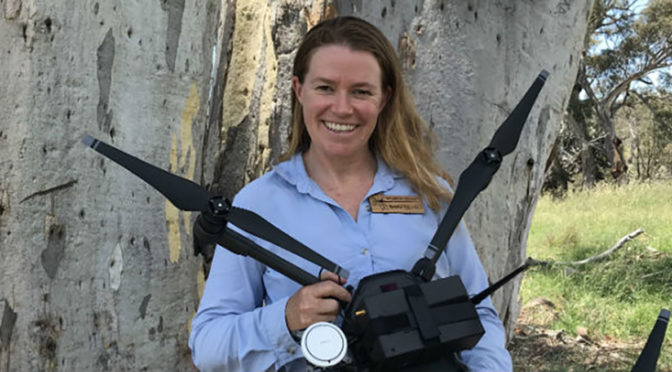
Startups have more impact than papers

Dr Debbie Saunders will join Dr Maryam Parviz and Professor Tony Weiss in a Spark Festival discussion at 12 noon on 15 October from 12 pm. Crazy Works – Startups have more impact than papers will be a lively discussion about how academic researchers can be better prepared to create startups.

This event is part of Spark Festival, Australia’s largest event for startups, innovators and entrepreneurs. Register here to gain access to the full livestream, running daily from Oct 12 – 23, and check out the range of STEM related events here

Image courtesy of Dr Debbie Saunders. Guest post by Jackie Randles, Manager Inspiring Australia NSW. https://inspiringnsw.org.au/ 

Medtech entrepreneur finds success in commercialisation

Inspiring Australia NSW is partnering with Uniseed and Sydney Knowledge Hub to present a Spark Festival discussion on 15 October. Speaking on the panel will be Professor Tony Weiss from the University of Sydney.

While academic studies investigate big questions and can solve global problems when new knowledge is taken to market, Australia still lags in its commercialisation of science and technology research developed in universities. Inspiring Australia NSW is partnering with Uniseed and Sydney Knowledge Hub to present a Spark Festival discussion on 15 October looking at this continuing shortfall and how academic researchers can be better prepared to create startups. 

A successful medtech entrepreneur, biochemist and molecular biotechnologist, Tony commercialised tropoelastin and founded a spinoff biotechnology company, Elastagen, from the University of Sydney. 

From 2008 to 2018, through ongoing research collaboration and further IP development through Tony’s lab at the University of Sydney, Elastagen, through its CEO and Board, raised $19,000,000 venture capital from investors in raised $19M in venture capital from investors in Australia, UK, Japan and South Korea.

The company also secured grant funding from renowned groups such as the Wellcome Trust in the UK and Australian grants totalling $6M, along with Ausindustry R&D tax credit funding. Tony’s inventions have since been recognised with 105 awarded patents in 22 patent families. 

In 2018, Elastagen was acquired by Allergan plc, one of the world’s 20 largest biopharmaceutical companies, in a transaction totalling US$260M, one of the largest completed in the Australian life science sector.

Tony, who is an active mentor of up-and-coming entrepreneurs at the University of Sydney, believes that there are increasingly more academic researchers considering commercial pathways.

“It’s driven by a range of motives, a lot to do with getting lab funding but also because researchers increasingly want to see their discoveries translate into something that helps society “ he said.

Tony advises researchers wishing to commercialise their inventions to interact with like-minded colleagues at technology parks and incubators. And while not critical to starting a business, he believes it helps to have mentors and broad support from a university.

“I found support in having smart colleagues and mentors, accessing strategic networks and the right types of funding,” Tony said. “The university resources that were most helpful to me included having access to a supportive tech transfer office and senior staff, a great lab and people willing to back my strong desire to succeed.”

Startups have more impact than papers

Professor Tony Weiss will join Dr Maryam Parviz and Dr Debbie Saunders in a Spark Festival discussion at 12 noon on 15 October from 12 pm. Crazy Works – Startups have more impact than papers will consider how academic researchers can be better prepared to create startups. 


This event is part of Spark Festival, Australia’s largest event for startups, innovators and entrepreneurs. Register here to gain access to the full livestream, running daily from Oct 12 – 23, and check out the range of STEM related events here

Image courtesy of University of Sydney. Guest post by Jackie Randles, Manager Inspiring Australia NSW. https://inspiringnsw.org.au/