All posts by Heather Catchpole

Overcoming academic barriers to innovation

In the Government’s National Innovation and Science Agenda, the messaging is as important as the content.

The agenda states that our future prosperity and well-being are intimately tied to the nation’s ability to innovate, that is, to draw on new ideas to develop new products and services.

This is of course not a new concern. For more than three decades governments have noted that Australia languishes at the low end of international measures of innovation and, in particular, lags well behind other developed nations when it comes to links between university research and the world of business.


“There is clearly a great deal more that can and must be done if we are to truly make the most of our national potential, and if we are to remain competitive in a knowledge-intensive global economy.”


Over the years many programs have been developed to remedy this state of affairs, and across the country we can see the fruits of these endeavours. Webs of connections have developed among our universities nationally, and from universities to the wider world of industry, government, professionals and the wider community.

But there is clearly a great deal more that can and must be done if we are to truly make the most of our national potential, and if we are to remain competitive in a knowledge-intensive global economy.

The fact that we remain behind the international pack in building productive links between our university researchers and those who might put research to practical use indicates that concerted efforts are needed at all levels to overcome some persistent barriers.

One of those barriers comes from what might be thought of as ‘business as usual’ within universities. One of the strengths of universities is that they provide a home for independent-minded and highly intelligent people to pursue their passions and to delve at depth into their areas of speciality.

This strength can be a weakness, however, if universities as a whole are unable to coordinate and support academic expertise in ways that make the whole more than the sum of the parts.

Even the most powerful universities, such as Harvard in the U.S., have long struggled with this issue.

At QUT we have sought to break the mould by making partnerships an integral feature of our research by, for example, establishing research institutes which are not stand-alone ‘research hotels’ but instead bring together researchers from multiple disciplines to work on carefully selected themes, alongside people who can make best use of the research findings.

This approach is most fully developed in health research, at the Institute of Health and Biomedical Innovation (IHBI), which is complemented by a range of research partnerships. These include other universities, research institutes, hospitals and other public health and clinical players, including the recently established Translational Research Institute.

The goal is not just to translate research into better health products and practice, but also to develop new interdisciplinary models of education and training. Particular examples are the following:

Examples of interdisciplinary models

1. The Centre for Emergency and Disaster Management within IHBI has been developing its international links, hosting 14 present and future leaders from the Maldives, the Philippines and Pakistan for a five-week intensive training program in 2014 to advance disaster risk reduction and management.

2. QUT’s Medical Engineering Research Facility (MERF) at the Prince Charles Hospital Chermside provides a comprehensive suite of research and training facilities in one location. MERF allows researchers in medical and healthcare robotics to develop applications that will be able to be translated directly to human use. Fellowships have been supported by orthopaedics company Stryker to provide training and research in hip and knee replacement surgery, and Professor Ross Crawford has supervised more than 40 PhD students in orthopaedic surgery techniques, with many of these students working in robotics.

Many of these initiatives are relatively new, and sustaining them will require commitment from all partners and ongoing innovation in our own models of working. QUT is determined to see that not only these efforts flourish, but that they also provide a model for innovation and partnerships in other fields. This is evidenced through the following examples.

Providing a model for innovation and partnerships in other fields

1. QUT has put considerable investment over time not only into the institutes but also into ensuring they integrate seamlessly with the rest of the university. For example, developing models of funding and recognition of research outputs that work across institute and faculty boundaries. This enables researchers to move between their academic “home” and the research institute, in contrast to the usual stand-alone model of a research institute.

The institute model is being extended in QUT’s Institute of Future Environments (IFE) which also adopts a multidisciplinary thematic focus to research in major areas of challenge in our natural, built and virtual environments. It also incorporates a range facilities on and off campus, including the Central Analytical Research Facility (CARF), the Samford Ecological Research Facility (SERF), the Banyo Pilot Plant Precinct and the Mackay Renewable Biocommodities Pilot Plant.

2. Within IHBI, research is being translated into improved therapies and support services for patients. Professor David Kavanagh launched a $6.5 million e-mental health initiative in 2014 to train primary health practitioners in the use of e-mental health services. Professor Kenneth Beagley led the development of a new oral vaccine that shows promise for protection against herpes simplex virus and Dr Willa Huston has developed a new chlamydia diagnostic for infertility in women.

3. The IFE’s Centre for Tropical Crops and Biocommodities researchers have had a significant breakthrough with the world’s first human trial of pro-vitamin A-enriched bananas. The genetically modified bananas have elevated levels of betacarotene to help African children avoid the potentially fatal conditions associated with vitamin A deficiency. This work has been supported by the Bill and Melinda Gates Foundation.

Professor Peter Coaldrake AO

Vice-Chancellor of QUT

Read next: Dr Krystal Evans, CEO of the BioMelbourne Network on Gender equality and innovation.

Spread the word: Help to grow Australia’s innovation knowhow! Share this piece using the social media buttons below.

Be part of the conversation: Share your ideas on innovating Australia in the comments section below. We’d love to hear from you!

National security relies on STEM

For Australia to be a prosperous, healthy and sustainable country it must be safe and secure. We expect our defence forces and national security agencies to be at the leading edge in their capabilities. Increasingly, this edge is underpinned by science and technology, which requires recruiting and developing our country’s most gifted scientists and engineers.

These talented professionals do not emerge by accident. They must be encouraged in our schools and tertiary institutions and then nurtured and supported through dedicated programs to achieve fulfilling careers. Australian institutions, including the Department of Defence, must be deeply committed to developing a future workforce with skills in science, technology, engineering and mathematics (STEM).


“In this age of digital disruption, the most secure countries will rely on platforms that are powered by STEM knowledge.”


STEM skills will underpin effective national security as Australia acquires sophisticated, multi-billion dollar platforms, including Future Submarine, Future Frigate, Joint Strike Fighter, Air Warfare Destroyer, Unmanned Aircraft and Cyber capabilities. All of these platforms will require STEM support during acquisition and throughout their service life.

Australia’s defence and national security sectors need to stay ahead of the technology curve to both create and prevent strategic surprise. Autonomous systems, cyber technology, electronic warfare, quantum computing and space exploitation are potentially game-changing technologies. In this age of digital disruption, the most secure countries will rely on platforms that are powered by STEM knowledge.

It is vital that our nation builds a ’talent pipeline’ to ensure a steady flow of highly trained scientists, technologists and engineers who can develop innovative solutions for future national security challenges.

A model for fostering talent in STEM 

The Department of Defence is actively engaged in a wide variety of STEM-focused initiatives, ranging from a ‘Scientists and Mathematicians in Schools’ program through to undergraduate and PhD scholarships.

We support further education by offering our employees generous study leave, and encourage diversity in STEM through scholarships and cadetships dedicated to women and Indigenous Australians.

We also encourage undergraduate university students to undertake summer vacation work and other paid work placements with Defence, both short-term and long-term.

In 2015–16, Defence provided over 100 STEM scholarships, cadetships and work placements. A number of sponsored students went on to win awards such as the South Australian Early Career STEM Professional Award (Mark McKenzie, 2013 and Tristan Goss, 2015), the South Australian Apprentice of the Year  (Dale Goldfinch, 2012), the inaugural Aerospace Australia Defence Innovation Scholarship (Luke Vandewater, 2012) and Materials Australia’s Ray Reynoldson Award for research (Genevieve Hart, 2013).

These success stories are testament to the promising rewards reaped by investing in Australia’s future STEM workforce.

Dr Alex Zelinsky

Chief Defence Scientist and Head of the Defence Science and Technology Group

Read next: Vish Nandlall, Chief Technology Officer of Telstra on To code or not to code?

Spread the word: Help to grow Australia’s innovation knowhow! Share this piece using the social media buttons below.

Be part of the conversation: Share your ideas on innovating Australia in the comments section below. We’d love to hear from you!

Bridging the innovation gap

Professor Fiona M Wood, FRACS AM, is the inventor of spray-on skin, and Director of the Burns Service of Western Australia and Burn Injury Research Unit at the University of Western Australia.

We encounter innovation at every turn in our daily lives. The capacity to live as we do today is through the evolution of yesterday’s ideas. But is this as good as it gets? Clearly the answer is ‘No!’ – we continually learn from today to ensure tomorrow is better.

We innovate by identifying a problem and seeking answers. The chain of activities from question to answer is long and complex: discovering a problem, chasing down a solution (supported by a rigorous research framework), dealing with regulatory safety hurdles, scaling the solution from the lab to the marketplace, and delivering it in a practical and cost-effective way – a process that requires tenacity above all else.

Australia enjoys a level of excellence in a number of areas of research, and it is time to connect these areas and realise their potential on the world stage. There are plenty of hurdles on the path to commercialisation; however, those who have succeeded in creating innovative, commercially successful outcomes provide us with the encouraging examples we need to keep going.

Linking problems with solutions is a skill we need to teach at every opportunity. Science, technology, engineering and mathematics (STEM) are pivotal to the success of our economy, but their potential lies in their utilisation: in problem solving, and in developing the skills to collaborate and progress along the innovation chain.

Professor Fiona M Wood, FRACS AM

Director of the Burns Service of WA and Burn Injury Research Unit at the University of Western Australia

Read next: Dr Alan Finkel AO, Chief Scientist of Australia on Engineering solutions.

Spread the word: Help to grow Australia’s innovation knowhow! Share this piece using the social media buttons below.

Be part of the conversation: Share your ideas on innovating Australia in the comments section below. We’d love to hear from you!

HoloLens to revolutionise training

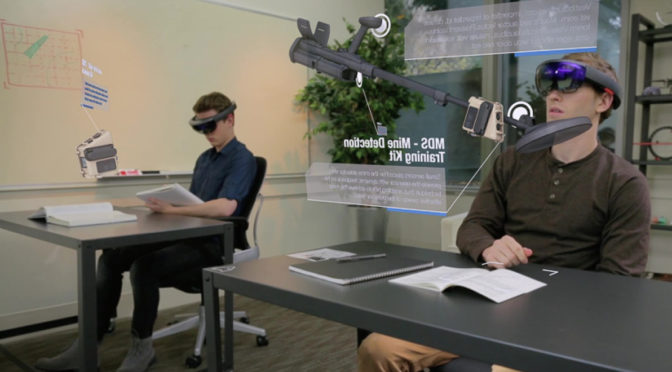
The Australian arm of global company Saab has partnered with Microsoft to build a range of ground-breaking training, education and other complex 3D Holographic applications for HoloLens.

Worn as goggles by users, Microsoft HoloLens is the first fully untethered, holographic computer, enabling interaction with high‑definition holograms.

Saab Australia, based in the South Australian capital Adelaide, is a defence, security and traffic management solutions provider specialising in computer based command and control systems.

Head of Training and Simulation Inger Lawes said the company had identified three initial markets: its traditional defence and security market, the enterprise market – primarily large corporations wanting bespoke applications to address a specific need – and internal applications for the company’s own development.

“A year or so ago we came across Microsoft’s work with holograms and specifically HoloLens and pretty quickly saw that this was a piece of technology that had the potential to revolutionise the way that training can be delivered but also a whole range of other things we are broadly involved in,” Lawes said.

“We want to produce applications that are at the sophisticated end of what HoloLens can do. For example there are a lot of games on this thing that are a lot of fun but that’s not where we want to be, we want to be at the upper end of what’s possible.”

Lawes said applications could range from training programs for school students and defence company employees to advanced assembly software for high-value manufacturers.

He said the company was initially focusing on internal training applications for HoloLens but would deliver an application for its first external customer in September.

“It’s pretty exciting because there’s nothing better than going from good ideas to actually fielding something in a relatively short time,” he said.

“We want to stay within our business of defence and security but we also want to explore applied markets such as using HoloLens to support sophisticated manufacturing.”

“We’re in such a great position with this technology because we really are in uncharted waters. We really don’t know what’s going to happen – we know it’s going to be fantastic but what direction we go we’ll see.”

Lawes said Microsoft had “gone out of its way” to help Saab establish a HoloLens studio in Adelaide and would provide the necessary hardware.

He said English language skills and an existing relationship with Microsoft made Saab Australia a logical choice.

“Microsoft are interested in helping us because Australia is a close friend of the United States, we speak English – everything that’s deployed on Hololens at the moment is in English – we’re able to work in the defence and security market and have developed a strong working relationship with their opposite numbers at Microsoft,” he said.

“Our plan is to set up globally in Adelaide. Our market then becomes near region but going into Europe on the back of our existing business relationships is also a real possibility.

“So when we are up and running this time next year we’ll be an export business as well as a domestic supplier.

“Every conversation we have with this technology reveals another good idea and for us it’s really exciting to be involved.”

– Andrew Spence

This article was first published by The Lead on 13 April 2016. Read the original article here.

Real-time irrigation monitoring

The biggest challenge farmers face is often underfoot – maintaining healthy soil. But there is no direct method for farmers to measure how effectively they are feeding their plants.

Farmers can measure general soil parameters like pH with handheld probes, but detailed measurements require sending soil samples to a commercial lab, which is costly and time-consuming.

The lack of feedback can lead to under- or over-fertilisation, the latter of which can result in ground and surface water contamination.

CRC CARE (Contamination Assessment and Remediation of the Environment) is addressing the issue through probeCARE, a real-time irrigation monitoring system.

“We can identify the specific elements, like sodium and potassium, that are in fertilisers,” explains Dr Liang Wang, head researcher on the project.

Wang says unlike a lab soil test, probeCARE will only read ‘free’ nutrients – these are not tied up in the soil and are more readily absorbed by plants.

Improvements on current systems are thus threefold: measurements are cheaper, immediate and give more relevant data to farmers than a lab test.

The small, portable and wireless probes will send data over the mobile phone network from the field to a farmer’s computer. The technology is currently in prototype while CRC CARE secures international patent rights.

– Brett Szmajda

CRCCARE.com

Wearable diabetes patch

Featured image above: type-1 diabetes patch, which consists of wearable sensors (Humidity, Glucose, pH, Strain, and Temperature sensors) and a co-integrated feedback drug delivery system. Credit: Hui Won Yun, Seoul National University

Recent technological advances in painless, wearable electronic devices could help make life easier for diabetics and their carers.

To keep their blood sugar levels in check, diabetics need to draw blood from their fingertips to measure glucose concentration, and then calculate the amount of insulin they need to inject, several times a day. This is painful and tedious, and often leads to poor management, with dangerous consequences.

Type-1 diabetes is a lifelong disease, one of the most common in children, and the incidence is increasing in Australia.

Now, Korean scientists have created a skin patch to measure glucose in sweat, and published the results in March 2016 in Nature Nanotechnology. They demonstrate that glucose concentrations in sweat closely followed changes in blood glucose. When the skin patch senses elevated glucose levels (or hyperglycemia), the microneedles embedded in the patch then deliver a glucose-lowering drug – metformin – under the skin.

The patch contains an array of sensors also detecting humidity, pH and temperature – parameters used to calibrate the glucose reading in sweat. When hyperglycemia is detected, a built-in heater dissolves the protective coating on the microneedles to infuse metformin.

Biomedical engineers in the USA described a similar device last year called Smart Insulin Patch. In this skin patch, the insulin-loaded microneedles themselves are sensitive to hyperglycemia, which triggers their dissolution, delivering insulin into the body when needed.

Glucose monitoring and management

The GlucoWatch was the first non-invasive real-time glucometer on the market, over a decade ago. “The technology was brilliant. The new skin patch sensors are more sophisticated versions of this,” says Professor Justin Gooding, co-director of the Australia Centre for Nanomedicine at UNSW Australia, and Editor-in-Chief of the journal, ACS Sensors.

The problem with continuous glucose monitors, which are implanted under the skin, is that they can’t be worn for more than a week or two before they need to be replaced, says Gooding.

Other continuous monitors available measure glucose via a fine needle under the skin, and have been reported to irritate the skin with prolonged wear. Non-invasive sweat sensors could eliminate this problem.

Wearable devices that monitor and manage blood glucose levels automatically, build on ideas for an artificial pancreas (also called closed-loop system) from the 80’s, says Gooding. This is a network of devices that together mimic the function of a healthy pancreas.

Gooding explains that it’s challenging to create a skin patch device that can deliver different doses of insulin at different times, like an insulin pump can. Most systems deliver a constant dose, or they just dump.

“Closing the loop is the Holy Grail for diabetes management,” says , a clinical endocrinologist at Prince of Wales Hospital, Randwick and researcher at the Centre for Diabetes, Obesity and Endocrinology, Westmead.

“It’s still a bit of an art to work out how much insulin someone needs,” she says. The biggest hurdle to closing the loop is the right algorithm to calculate the correct dose of insulin to be injected at the right time.

The skin patch devices could be useful to maintain steady blood sugars between meals, but a large dose of insulin still needs to be injected for glucose spikes after a meal, says Lau. “Often you need to anticipate the spike and inject before a meal to effectively control blood sugars”, she explains.

Clinical trials of an artificial pancreas using existing constant glucose monitors and insulin pumps teamed with new advanced algorithms – to calculate insulin doses – have been scheduled to begin in 2016 by the creators from Harvard University and University of Virginia, USA.

Advances in different research areas take us closer to the possibility of a minimally invasive artificial pancreas that can be worn as a skin patch.

“Research into closed-loop systems is really important because they help us understand how technology can be used to control diabetes,” says Lau.

– Sue Min Liu

Fighting corrosion in the desert

Natural gas pipelines are a vital part of our infrastructure, bringing energy from distant fields to households and industry. Maintaining the integrity of pipelines is a crucial factor to keeping the gas flowing – a major concern of the Energy Pipelines CRC (EPCRC), which is tasked with enabling safer, more efficient and reliable pipelines to meet Australia’s growing energy needs.

Deakin University PhD student Ying Huo had first-hand experience of the impact of the work of the EPCRC during a three-week industry placement last year, working with a team detecting corrosion in pipelines on just a small section of Australia’s 35,000 km long gas pipeline network.

Corrosion can be caused by a number of factors related to the environment around the pipeline. The damage caused by corrosion can potentially affect the pipeline’s integrity. Inspection technology uses ultrasound and magnetic measurements to find corrosion and determine its area and depth. Pipeline operators can then decide how best to deal with the corrosion.

“Every student should get the chance to get out in the field to see how industry works,” says Huo.

“I was able to observe firsthand how technology and asset management decisions are used to ensure the safe and continued operation of pipelines in Australia.”

This opportunity would not have been possible without the strong collaboration between the Australian pipeline industry and the EPCRC.

– David Ellyard

www.epcrc.com.au

Investing in small business

Featured image above: Charles W. Wessner is a distinguished scholar and research professor in Global Innovation Policy at Georgetown University, and director of the Technology, Innovation and Entrepreneurship program at the National Academies.

Innovation is recognised as a key to growing and maintaining a country’s competitive position in the global economy. Australian scientists produce top-quality research and punch above their weight in terms of peer-reviewed publications; however, Australia is much less successful in creating innovative products and processes based on research investment. If we want more innovation, university and government policies need to change.

Part of this change requires learning from the successes of other nations. Successful policy changes include increased support for universities and research centres, growing funding for competitively awarded applied research, sustained support for small businesses, and a focus on partnerships among government, industry and universities in bringing research ideas to market.

The USA is the land of free-market capitalism, but it is also an active entrepreneurial state. A highly effective US government initiative, for example, is the Small Business Innovation Research (SBIR) program, which has been in existence for 25 years and was recently renewed by Congress.

Instrumental in this renewal was an assessment by the National Academy of Sciences, which found the SBIR program “sound in concept and effective in operation”.

The program provides highly competitive, phased innovation awards to small businesses and start-ups to develop products that meet agency mission objectives or provide social value. The awards range from US$150,000 to more than US$1 million. The grants are often linked to the procurement process, for example in the case of military acquisition and support. In other fields, such as health and energy, grants provide a means to push good ideas to market.

SBIR has a strong track record. In recent years, it garnered 20–25% of the top 100 R&D awards for the US economy as a whole, and helped agencies like NASA address specific needs such as instruments for exploring Mars. SBIR doesn’t replace venture capital, but rather augments it by de-risking ideas to the point where private investors can step forward. Reflecting its success in the USA, SBIR has been adopted by a number of other countries.

While SBIR is a success, it is not a panacea. Effective innovation policy is multidimensional, and a supportive policy framework that encourages universities to commercialise new products and processes is required. Policies that facilitate start-ups and encourage small to medium-sized businesses are also needed.

Governments need to invest in places where researchers and companies can meet, learn, cooperate and grow. For example, science and technology parks near universities, incubators, accelerator programs, and innovation awards that facilitate collaboration.

Adopting pro-innovation policies does not guarantee instant success – but not adopting them guarantees long-term stagnation.

– Charles W. Wessner

Microcapsules for type-1 diabetes

Curtin University researchers are a step closer to establishing a way for people with type-1 diabetes to introduce insulin into the body without the need for injections, through the development of a unique microcapsule.

People with type-1 diabetes, a condition where the immune system destroys cells in the pancreas, generally have to inject themselves with insulin daily and test glucose levels multiple times a day.

Dr Hani Al-Salami from Curtin’s School of Pharmacy is leading the collaborative project using cutting-edge microencapsulation technologies to design and test whether microcapsules are a viable alternative treatment for people with type-1 diabetes.

“Since 1921, injecting insulin into muscle or fat tissue has been the only treatment option for patients with type-1 diabetes,” Al-Salami says.

“The ideal way to treat the illness, however, would be to have something, like a microcapsule, that stays in the body and works long-term to treat the uncontrolled blood glucose associated with diabetes.”

The microcapsule contains pancreatic cells which can be implanted in the body and deliver insulin to the blood stream.

“We hope the microcapsules might complement or even replace the use of insulin in the long-term, but we are still a way off. Still, the progress is encouraging and quite positive for people with type-1 diabetes,” Al-Salami says.

Researchers say the biggest challenge in the project to date has been creating a microcapsule that could carry the cells safely, for an extended period of time, without causing an unwanted reaction by the body such as inflammation or graft failure.

“We are currently carrying out multiple analyses examining various formulations and microencapsulating methods, in order to ascertain optimum engineered microcapsules capable of supporting cell survival and functionality,” Al-Salami says.

The research was conducted in partnership with the University of Western Australia. Click here to read the scientific paper, published in Biotechnology Progress.

– Susanna Wolz

This article was first published by Curtin University. Read the original media release here.

 

Australia’s STEM workforce

Featured image above from the Australia’s STEM Workforce Report

Australians with qualifications in science, technology, engineering and mathematics (STEM) are working across the economy in many roles from wine-makers to financial analysts, according to a new report from The Office of the Chief Scientist.

Australia’s Chief Scientist Dr Alan Finkel says Australia’s STEM Workforce is the first comprehensive analysis of the STEM-qualified population and is a valuable resource for students, parents, teachers and policy makers. The report is based on data from the 2011 Census, the most recent comprehensive and detailed data set of this type of information. The report will serve as a benchmark for future studies.

“This report provides a wealth of information on where STEM qualifications – from both the university and the vocational education and training (VET) sectors – may take you, what jobs you may have and what salary you may earn,” Finkel says.

“Studying STEM opens up countless job options and this report shows that Australians are taking diverse career paths.”

The report investigates the workforce destinations of people with qualifications in STEM fields, looking at the demographics, industries, occupations and salaries that students studying for those qualifications can expect in the workforce.

STEM workforce

Click here to see an infographic of key facts from the Australia’s STEM Workforce Report

The report found that fewer than one-third of STEM university graduates were female, with physics, astronomy and engineering having even lower proportions of female graduates. Biological sciences and environmental studies graduates were evenly split between the genders. In the vocational education and training (VET) sector, only 9% of those with STEM qualifications were women.

Finkel says that even more worrying than the gender imbalance in some STEM fields, is the pay gap between men and women in all STEM fields revealed in the report. These differences cannot be fully explained by having children or by the increased proportion of women working part-time.

The analysis also found that gaining a doctorate is a sound investment, with more STEM PhD graduates in the top income bracket than their Bachelor-qualified counterparts. However, these same STEM PhD holders are less likely to own their own business or work in the private sector.

Finkel says that preparing students for a variety of jobs and industries is vital to sustaining the future workforce.

“This report shows that STEM-qualified Australians are working across the economy. It is critical that qualifications at all levels prepare students for the breadth of roles and industries they might pursue.”

Click here to download the full Australia’s STEM Workforce report.

Click here to read Alan Finkel’s Foreword, or click here to read the section of the report that interests you.

This information was first shared by Australia’s Chief Scientist on 31 Mar 2016. Read the original media release here

A 3D printed smile

Featured image above: Professor Saso Ivanovski. Credit: Griffith University

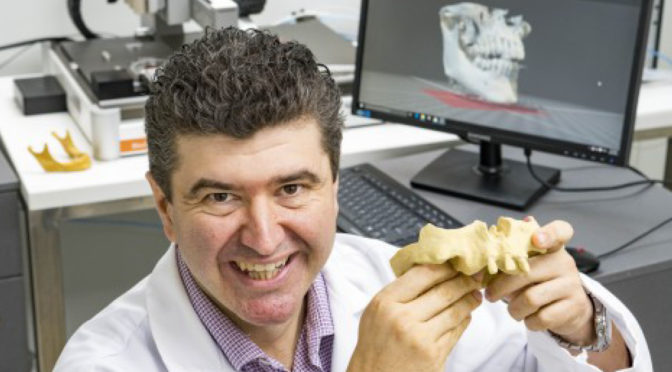
The discomfort and stigma of loose or missing teeth could be a thing of the past as Griffith University researchers pioneer the use of 3D bioprinting to replace missing teeth and bone.

The three-year study, which has been granted a National Health and Medical Research Council Grant of $650,000, is being undertaken by periodontist Professor Saso Ivanovski from Griffith’s Menzies Health Institute Queensland.

As part of an Australian first, Ivanovski and his team are using the latest 3D bioprinting to produce new, totally ‘bespoke’, tissue-engineered bone and gum that can be implanted into a patient’s jawbone.

“The groundbreaking approach begins with a scan of the affected jaw, prior to the design of a replacement part using computer-assisted design,” he says.

“A specialised bioprinter, which is set at the correct physiological temperature (in order to avoid destroying cells and proteins) is then able to successfully fabricate the gum structures that have been lost to disease – bone, ligament and tooth cementum – in one single process. The cells, the extracellular matrix and other components that make up the bone and gum tissue are all included in the construct and can be manufactured to exactly fit the missing bone and gum for a particular individual.

“In the case of people with missing teeth who have lost a lot of jawbone due to disease or trauma, they would usually have these replaced with dental implants,” he says.

“However, in many cases there is not enough bone for dental implant placement, and bone grafts are usually taken from another part of the body, usually their jaw, but occasionally it has to be obtained from their hip or skull.

“These procedures are often associated with significant pain, nerve damage and postoperative swelling, as well as extended time off work for the patient,” says Ivanovski. “In addition, this bone is limited in quantity.”

A less invasive method

“By using this sophisticated tissue engineering approach, we can instigate a much less invasive method of bone replacement,” says Ivanovski.

“A big benefit for the patient is that the risks of complications using this method will be significantly lower because bone doesn’t need to be removed from elsewhere in the body. We also won’t have the problem of limited supply that we have when using the patient’s own bone.”

Currently in pre-clinical trials, Ivanovski says the aim is to trial the new technology in humans within the next one to two years.

Regarding the anticipated cost of treatment, he says that this should be a less costly way of augmenting deficient jaw bone, with the savings expected to be passed onto the patient.

– Louise Durack

This article was first published by Griffith University on 30 March 2016. Read the original article here.

Biobank speeds autism diagnosis

The Autism CRC is building Australia’s first Autism Biobank, with the aim of diagnosing autism earlier and more accurately using genetic markers. Identifying children at high risk of developing autism at 12 months of age was “a bit of a holy grail”, says Telethon Kids Institute’s head of autism research Professor Andrew Whitehouse, who will be leading the Biobank. Researchers think the period between 12–24 months of age is “a key moment” in brain development, he adds.

Autism Diagnosis

Professor Andrew Whitehouse, Head of the Developmental Disorders Research Group at the Telethon Kids Institute

As with other neurodevelopmental disorders, a diagnosis of autism is based on certain behaviours, but these only begin to manifest at a diagnosable level between the ages of two and five. Whitehouse says while there are great opportunities for therapy at these ages, researchers believe an earlier diagnosis will make the therapy programs more effective. Some 12-month-old children already exhibit behaviours associated with the risk of developing autism, for example not responding to their name, but currently doctors can’t conclusively diagnose autism at this early age.

“If we can start our therapies at 12 months, we firmly believe they’ll be more effective and we can help more kids reach their full potential,” says Whitehouse.

The biology of autism varies greatly between individuals, and it appears a combination of environmental factors and genes are involved – up to 100 genes may play a role in its development. Studying large groups of people is the only way to get a full understanding of autism and potentially identify genes of importance.

To do this, the Biobank collects DNA samples from 1200 families with a history of autism – children with autism aged 2–17 years old, who are recruited through therapy service providers, and their parents – as well as samples from control families who do not have a history of autism.

autism diagnosis

DNA samples are taken at the Telethon Kids Institute and sent to the ABB Wesley Medical Research Tissue Bank to be analysed for genetic biomarkers. Credit: Telethon Kids Institute

The samples are then shipped to the ABB Wesley Medical Research Tissue Bank in Brisbane for the Biobank’s creation. Here, they are analysed for genetic biomarkers using genome wide sequencing – determining DNA sequences at various points along the genome that are known to be important in human development. Whitehouse says they are also planning to conduct metabolomic and microbiomic analyses on urine and faeces.

“It’s the biggest research effort into autism ever conducted in Australia,” he says.

The goal is to use the results to develop a genetic test that can be conducted with 12-month-old children who are showing signs of autism. The samples will also be stored at the Biobank for future research.

The aim is to expand internationally, so that researchers can exchange data with teams around the globe who are doing similar work, thus increasing the sample size.

– Laura Boness

If your child has been diagnosed with autism and you would like to find out about participating in the Autism CRC Biobank, click here.

www.autismcrc.com.au

Australia’s biofuture

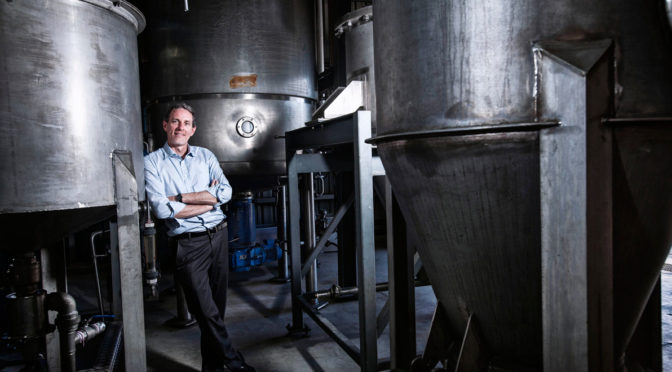
Featured image above: Associate Professor Ian O’Hara at the Mackay Biocommodities Pilot Plant. He is pictured inside the plant with the giant vats used for fermentation. Credit: QUT Marketing and Communication/Erika Fish

QUT is supporting the Queensland Government to develop a strategy, including the creation of a 10-year Biofutures Roadmap, for the establishment of an industrial biotechnology industry in Queensland.

Associate Professor Ian O’Hara, principal research scientist at QUT’s Centre for Tropical Crops and Biocommodities (CTCB), says we are facing big challenges: the world needs to produce 70% more food and 50% more energy by 2050, while reducing carbon emissions.

At the same time, says O’Hara, there are opportunities to add value to existing agricultural products. “Waste products from agriculture, for example, can contribute to biofuel production.”

QUT funded a study in 2014 examining the potential value of a tropical biorefinery in Queensland. It assessed seven biorefinery opportunities across northeast Queensland, including in the sorghum-growing areas around the Darling Downs and the sugarcane-growing areas around Mackay and Cairns.

O’Hara says they mainly focused on existing agricultural areas, taking the residues from these to create new high-value products.

But he sees more opportunity as infrastructure across north Queensland continues to develop.

The study found the establishment of a biorefinery industry in Queensland would increase gross state product by $1.8 million per year and contribute up to 6500 new jobs.

“It’s an industry that contributes future jobs in regional Queensland – and by extension, opportunities for Australia,” O’Hara says.

The biorefineries can produce a range of products in addition to biofuels. These include bio-based chemicals such as ethanol, butanol and succinic acid, and bio-plastics and bio-composites – materials made from renewable components like fibreboard.

O’Hara says policy settings are required to put Queensland and Australia on the investment map as good destinations.

“We need strong collaboration between research, industry and government to ensure we’re working together to create opportunities.”

The CTCB has a number of international and Australian partners. The most recent of these is Japanese brewer Asahi Group Holdings, who CTCB are partnering with to develop a new fermentation technology that will allow greater volumes of sugar and ethanol to be produced from sugarcane.

“The biofuels industry is developing rapidly, and we need to ensure that Queensland and Australia have the opportunity to participate in this growing industry,” says O’Hara.

– Laura Boness

www.qut.edu.au

www.ctcb.qut.edu.au

Mining money-saver

, which took out Curtin University’s science and engineering category last September, finds optimal waste rock dumping and haulage solutions using trade secret algorithms developed by a small team led by Professor Erkan Topal.

With material haulage costs typically accounting for up to half of a West Australian open cut mine’s operational costs during the recent boom years, Topal says the costs of building waste dumps are often neglected by mining operations.

“Yet it presents great potential to reduce costs and to generate environmentally friendly waste dumps if we schedule the waste rock dump using a smarter scheduler,” he says.

“It is definitely a good tool to use at the mining downturn, as cost cutting becomes a focus point, and good planning and scheduling will become a key to achieve this target.”

The conventional waste rock dumping practice of using the shortest route possible in the early years of mining is not likely to stack up economically over the longer term.

TopDump tackles this issue but also manages how reactive and non-acid forming rocks are layered in the dumps to minimise acid rock drainage – an industry-wide challenge when rain and oxidisation generate environmentally damaging sulphuric acid from waste rock.

The software was trialled in the modelling of a WA gold mining project with a mine life of 10 years including four open pits that encompassed more than 4 km in total length.

“The results have demonstrated significant improvement on cost saving with an environmentally friendly waste dump design,” Topal says, with the project since becoming a mining operation.

“The TopDump model is ideal for greenfield deposit, but can be used for any open pit mining operations.”

Another trial found that a TopDump-generated plan gave an existing mine the opportunity to save at least 20% in waste-related haulage costs compared to the mine’s existing dump scheduling plan.

Negotiations with prospective industry customers remain underway, and how TopDump is implemented and marketed is subject to change at this early stage of commercialisation.

“It can be an add-in tool for any mining design software suite but we are also considering the licensing option in a cloud system,” Topal says.

“Currently, we have a software interface that any mining professional can use without detailed optimisation knowledge.”

– Blair Price

This article was first published by Science Network Western Australia on 20 March 2016. Read the original article here

Watch Curtin University’s video about TopDump:

The services boom

Australia’s mining industry stands at a crossroads. This presents new opportunities for the industry, says one of the experts in the field: Dan Sullivan, CEO of METS Ignited, the new government-backed body charged with building the fortunes of one of the nation’s most important revenue earners – the mining equipment, technology and services industry (METS).

“Mining has to improve its productivity. The industry’s boom years are over,” says Sullivan. “But we have to make a choice about how we are going to do that. Either we find new reserves of high-grade ore or we invest in innovations that will make existing mines more productive.”

Sullivan says that if the first course of action is chosen, it will inevitably take the industry overseas. “In Australia, the easy-to-find resources have largely been discovered. If we want high-grade ores, we’ll have to go deep underground or to other mineral rich countries in Asia like Laos.” However, when mining companies go overseas they have to deal with issues of sovereignty and politics over which they have little control.

The alternative is to become much more efficient at locating, extracting and processing ores in Australia – but to do that the industry must innovate. Hence the creation of METS Ignited, one of six Industry Growth Centres set up by the Australian Government to improve the nation’s industrial competitiveness.

The six Growth Centres are dedicated to food and agri-business; medical technologies and pharmaceuticals; oil, gas and energy resources; advanced manufacturing; cybersecurity and METS.

These Growth Centres are charged with facilitating better links between scientists and researchers; to harmonise regulations that control industry; to make better use of human capital – the workforce and management of companies; and to get better access to global supply chains. “These centres are led by industry, but are government-funded,” adds Sullivan, who served as Australia’s Consul-General in Lima and who worked for the Australian Trade Commission in Chile where he led a team that worked on developing business opportunities for Australia.

Launched in October 2015, METS Ignited is preparing a 10-year strategic plan to promote Australian mining innovation and support stronger collaboration between companies and research organisations. The plan should also ensure that Australian mining technology companies – the firms that build the sensors, drill heads, pipes, trucks and other machines that make mining possible – hold a strong position in global supply chains.

“The mining industry is on the cusp of a transformation, and where there is change there is opportunity,” says Sullivan.

services boom

During the early years of the 21st century, the Australian mining industry – fuelled by demands from China for our ore and minerals – went through an extraordinary boom.

It was “one of the largest shocks to the Australian economy in generations”, says Peter Tulip, senior research manager at the Reserve Bank of Australia.

Average incomes across the country rose substantially, while the boom triggered a large appreciation of the Australian dollar.

More importantly, Australia’s deposits of iron, gold and copper were aggressively mined.

The output of these mines has declined significantly since the boom, and operators now have to use 70% more energy because they have to dig deeper to access deposits.

Despite the extra effort, mine output has continued to decline. In 2000, goldmines produced 3 g of gold for each tonne of basic ore. By 2010, they produced under 2 g. “Productivity was already declining at the turn of the century,” says Sullivan. “The boom just masked it.”

Today Australia, which depends heavily on its mineral wealth, is expending more and more energy to dig up less and less iron, gold and other ores and minerals. Given the massive importance of mining to the Australian economy, this is cause for concern. The problem is that more than 80% of Australia’s mineral production comes from mines that are more than 30 years old, says Professor Richard Hillis, CEO of the Deep Exploration Technologies CRC (DET CRC). “We haven’t found new mines to develop – which is why we’re mining our old ones so severely.”

The situation is summed up by Elizabeth Lewis-Gray, Chair of METS Ignited: “The mining industry is facing challenges – deeper mines, lower grades, community opposition and more remote operations.” At the same time, there has been a relentless drive to cut costs.

“These challenges require solutions,” adds Lewis-Gray, who is also co-founder and chair of Gekko Systems, which specialises in designing and manufacturing mineral processing equipment.

One approach is to focus on exports of Australian mining technology, says Lewis-Gray. At present, this market is worth about $15 billion. The aim of the METS Growth Centre is to double the exports so they reach about $30 billion by 2030. “This is one of the reasons for branding the centre with a new METS Ignited Australia,” says Lewis-Gray.

What is needed, says Sullivan, are more sensors in mines, and more data, robotics and analysis of the total operation of finding, extracting, transporting and processing of minerals.

But this will require considerable investment. “The good news,” says Sullivan, “is that much technology already exists in other industries. If you look at the manufacturing or aerospace industries, materials and activities are sensed and analysed to maximise activity. The mining industry is just beginning to implement this sort of technology.”

services boom

Australia is ranked highly for its research in mining technology. Consider the example of the work of Hillis with DET CRC. It devised a system to simplify the lengthy process involved in cutting a rock core and sending it for analysis to an assay laboratory.

DET CRC’s researchers developed sensors that lie behind the drill bit and can analyse, in real time, the material that is being dug up, and assess if it contains worthwhile amounts of gold or copper. “It means you can stop drilling immediately if you find a deposit is worthless, without having to wait months for the assay report,” says Hillis. This is impressive, and gives an indication of the innovative quality of Australian R&D in mining technology.

Less auspicious, however, is Australia’s reputation for commercialisation. This a key factor to improve the industry focus and commercial rate of Australian mining innovation.

Sullivan points to the example of the Anglo-American mining corporation, which is holding open forums with NASA experts and advisers in advanced manufacturing and other industries to stimulate ideas. “A mine operating in a remote desert has a lot to learn from a NASA program placing robot vehicles on Mars,” he says.

Many mining innovations have already made it, of course. Caterpillar trucks are fitted with sensors that can tell when a driver is fatigued. Other devices can monitor tyre pressure, and can tell when a bucket is unbalanced because it has a huge rock inside it.

But not enough care is taken to study the data to create patterns revealing routes to further innovations. “The data is not being pooled and so cannot be optimised,” says Sullivan.

“It’s not rocket science. It’s really just a matter of getting the mining industry to aggregate the data it acquires so it can learn and go on to develop new products that will improve efficiency and cut costs.”

METS Ignited’s main challenge is finding a way to change the mining industry’s perception of itself as ‘a fast follower’; an industry that lets others experiment and take the risks before it then adopts the successful outcomes.

Such an approach means that, at its heart, the industry is reluctant to innovate. The function of METS Ignited is therefore going to involve helping the Australian mining sector make choices that will put it on the road to success.

“It’s a challenge, but it is certainly an achievable one,” says Sullivan.

– Robin McKie

detcrc.com.au


The new carbon industry

The Paris 2015 agreement presented cities with a global challenge. “Buildings and cities contribute upwards of 40% of global carbon emissions,” says Professor Deo Prasad, CEO of the Low Carbon Living CRC (CRCLCL).

Leveraging the knowledge of researchers from the CSIRO and five of Australia’s top universities, as well as experts in the field, the CRCLCL is heading up efforts to deliver a low carbon built environment in Australia. Its ambitious aim is to cut residential and commercial carbon emissions by 10 megatonnes by 2020.

“The CRCLCL is at the forefront of driving technological and social innovation in the built environment to reduce carbon emissions,” says Prasad.

Recognised as a world-leading research organisation by the United Nations Environment Programme, the CRCLCL collaborates with industry partners like AECOM and BlueScope, and universities and governments.

“We’re looking to bring emissions down, and in the process we want to ensure global competitiveness for Australian industry by helping to develop the next generation of products, technologies, advanced manufacturing and consulting services,” says Prasad.

CRCLCL activities range from urban sustainable design and solar energy to software and community engagement.

“By working effectively with government, researchers and industry, we employ an ‘end-user’ driven approach to research that maximises uptake and utilisation,” says Prasad.

– Carl Williams

lowcarbonlivingcrc.com.au

CO₂ cuts nutrition

Climate change is affecting the Earth, through more frequent and intense weather events, such as heatwaves and rising sea levels, and is predicted to do so for generations to come. Changes brought on by anthropogenic climate change, from activities such as the burning of fossil fuels and deforestation, are impacting natural ecosystems on land and at sea, and across all human settlements.

Increased atmospheric carbon dioxide (CO₂) levels – which have jumped by a third since the Industrial Revolution – will also have an effect on agriculture and the staple plant foods we consume and export, such as wheat.

Stressors on agribusiness, such as prolonged droughts and the spread of new pests and diseases, are exacerbated by climate change and need to be managed to ensure the long-term sustainability of Australia’s food production.

Researchers at the Primary Industries Climate Challenges Centre (PICCC), a collaboration between the University of Melbourne and the Department of Economic Development, Jobs, Transport and Resources in Victoria, are investigating the effects of increased concentrations of CO₂ on grain yield and quality to reveal how a more carbon-enriched atmosphere will affect Australia’s future food security.

CO₂ cuts nutrition

An aerial view of the Australian Grains Free Air CO₂ Enrichment (AGFACE) project, where researchers are investigating the effects of increased concentrations of carbon dioxide on grain yield and quality.

Increasing concentrations of CO₂ in the atmosphere significantly increase water efficiency in plants and stimulate plant growth, a process known as the “fertilisation effect”. This leads to more biomass and a higher crop yield; however, elevated carbon dioxide (eCO₂) could decrease the nutritional content of food.

“Understanding the mechanisms and responses of crops to eCO₂ allows us to focus crop breeding research on the best traits to take advantage of the eCO₂ effect,” says Dr Glenn Fitzgerald, a senior research scientist at the Department of Economic Development, Jobs, Transport and Resources.

According to Fitzgerald, the research being carried out by PICCC, referred to as Australian Grains Free Air CO₂ Enrichment (AGFACE), is also being done in a drier environment than anywhere previously studied.

“The experiments are what we refer to as ‘fully replicated’ – repeated four times and statistically verified for accuracy and precision,” says Fitzgerald. “This allows us to compare our current growing conditions of 400 parts per million (ppm) CO₂ with eCO₂ conditions of 550 ppm – the atmospheric CO₂ concentration level anticipated for 2050.”

The experiments involve injecting CO₂ into the atmosphere around plants via a series of horizontal rings that are raised as the crops grow, and the process is computer-controlled to maintain a CO₂ concentration level of 550 ppm.

CO₂ cuts nutrition

Horizontal rings injecting carbon dioxide into the atmosphere as part of the AGFACE project. Credit: AGFACE

“We’re observing around a 25–30% increase in yields under eCO₂ conditions for wheat, field peas, canola and lentils in Australia,” says Fitzgerald.


Pests and disease

While higher CO₂ levels boost crop yields, there is also a link between eCO₂ and an increase in viruses that affect crop growth.

Scientists at the Department of Economic Development, Jobs, Transport and Resources have been researching the impact of elevated CO₂ levels on plant vector-borne diseases, and they have observed an increase of 30% in the severity of the Barley Yellow Dwarf Virus (BYDV).

CO₂ cuts nutrition

Higher CO₂ levels are linked with an increase in the severity of Barley Yellow Dwarf Virus.

Spread by aphids, BYDV is a common plant virus that affects wheat, barley and oats, and causes yield losses of up to 50%.

“It’s a really underexplored area,” says Dr Jo Luck, director of research, education and training at the Plant Biosecurity Cooperative Research Centre. “We know quite a lot about the effects of drought and increasing temperatures on crops, but we don’t know much about how the increase in temperature and eCO₂ will affect pests and diseases.

“There is a tension between higher yields from eCO₂ and the impacts on growth from pests and diseases. It’s important we consider this in research when we’re looking at food security.”


This increased yield is due to more efficient photosynthesis and because eCO₂ improves the plant’s water-use efficiency.

With atmospheric CO₂ levels rising, less water will be required to produce the same amount of grain. Fitzgerald estimates about a 30% increase in water efficiency for crops grown under eCO₂ conditions.

But nutritional content suffers. “In terms of grain quality, we see a decrease in protein concentration in cereal grains,” says Fitzgerald. The reduction is due to a decrease in the level of nitrogen (N2) in the grain, which occurs because the plant is less efficient at drawing N2 from the soil.

The same reduction in protein concentration is not observed in legumes, however, because of the action of rhizobia – soil bacteria in the roots of legumes that fix N2 and provide an alternative mechanism for making N2 available.

“We are seeing a 1–14% decrease in grain-protein concentration [for eCO₂ levels] and a decrease in bread quality,” says Fitzgerald.

“This is due to the reduction in protein and because changes in the protein composition affect qualities such as elasticity and loaf volume. There is also a decrease of 5–10% in micronutrients such as iron and zinc.”

This micronutrient deficiency, referred to as “hidden hunger”, is a major health concern, particularly in developing countries, according to the International Food Research Policy Institute’s 2014 Global Hunger Index: The challenge of hidden hunger.

There could also be health implications for Australians. As the protein content of grains diminishes, carbohydrate levels increase, leading to food with higher caloric content and less nutritional value, potentially exacerbating the current obesity epidemic.

The corollary from the work being undertaken by Fitzgerald is that in a future CO₂-enriched world, there will be more food but it will be less nutritious. “We see an increase in crop growth on one hand, but a reduction in crop quality on the other,” says Fitzgerald.

Fitzgerald says more research into nitrogen-uptake mechanisms in plants is required in order to develop crops that, when grown in eCO₂ environments, can capitalise on increased plant growth while maintaining N2, and protein, levels.

For now, though, while an eCO₂ atmosphere may be good for plants, it might not be so good for us.

– Carl Williams

www.piccc.org.au

www.pbcrc.com.au

Nuclear waste solution

Featured image above: Alejandra Siverio-Gonzalez of the Synroc team. Credit: ANSTO

Synroc technology is an innovative and versatile nuclear waste management solution developed by the Australian Nuclear Science and Technology Organisation (ANSTO).

ANSTO’s Synroc technology locks up radioactive elements in ‘synthetic rock’ allowing waste, like naturally occurring minerals, to be kept safely in the environment for millions of years.

Nuclear waste solution

Synroc processing technology immobilises radioactive waste in a durable, solid rock-like material for long-term storage. Credit: ANSTO

Synroc technology offers excellent chemical durability and minimises waste and disposal volumes, decreasing environmental risks and lowering emissions and secondary wastes.

ANSTO’s Synroc team is developing a waste treatment processing plant using Synroc technology for Australia’s molybdenum-99 (Mo-99) waste; Mo-99 is the parent nuclide for technetium-99m, the most widely used radioisotope in nuclear medicine. The plant will be the first of its kind, and will lead the world in managing nuclear wastes from Mo-99 production.

nuclear waste solution

ANSTO’s Synroc technology. Credit: ANSTO

Dr Daniel Gregg, leader of the Synroc waste form engineering team at ANSTO, says the plant will demonstrate Australia’s commitment to providing technology solutions to the global nuclear community.

“We hope to partner with others and build several more plants around the world using Synroc technology,” he says.

nuclear waste solution

Dr Daniel Gregg, leader of the Synroc waste form engineering team at ANSTO. Credit: ANSTO.

Gregg says several countries are looking to build new Mo-99 production facilities, and regulators want assurances that facilities will be able to treat the resulting waste streams.

“With national regulators around the world putting more and more pressure on waste producers to deal with nuclear wastes, opportunities exist for Synroc as a leading option for nuclear waste treatment.” This places Synroc and Australia in an enviable position, adds Gregg.

“Synroc is a cost-effective, environmentally responsible option to treat and appropriately dispose of nuclear wastes without leaving a burden to future generations.”

In developing the plant, the Synroc team has designed process engineering technology and a fully integrated pilot plant that can treat large volumes of waste under a continuous process mode.

The team is also collaborating with national laboratories around the world to demonstrate strategies to treat radioactive waste for commercial benefit.

The focus is on waste streams – such as the growing stockpiles of long-lived nuclear waste – that are problematic for existing treatment methods. The real advantage, says Gregg, is Synroc’s ability to immobilise these problematic waste forms.

“Waste producers are required to immobilise nuclear wastes, and Synroc and Australia will be at the forefront of waste management technology.”

– Laura Boness

nuclear waste solution

The Synroc team. Credit: ANSTO

www.ansto.gov.au/synroc


Top 25 R&D Spin-off Awards

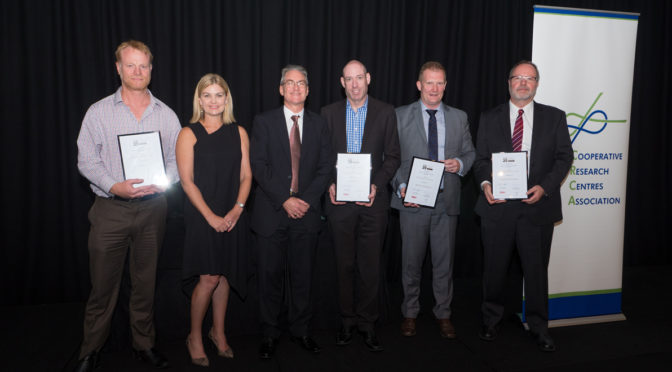
Featured image above: Top 25 winners accepting their awards with Refraction Media‘s CEO, Karen Taylor. Left to right: executives from iCetana, Refraction Media, Vaxxas, Fibrotech Therapeutics and SmartCap Technologies. Credit: Dave Dwyer Video Production and Photography

The Cooperative Research Centres Association (CRCA) presented the Top 25 R&D Spin-off Awards last week at their annual conference, The Business of Innovation. The awards honoured the Top 25 Science Meets Business R&D spin-off companies – a list of Australian businesses that have successfully moved their R&D from the lab to the marketplace.

The Top 25 companies were compiled by Refraction Media and supported by data from Thomson ReutersThey were judged by a panel comprising of: Dr Peter Riddles, biotechnology expert and director on many start-up enterprises; Dr Anna Lavelle, CEO and Executive Director of AusBiotech; and Tony Peacock, Chief Executive of the Cooperative Research Centres Association.

For each company, the panel considered total market value, annual turnover, patents awarded and cited, funding and investment, growth year-on-year, social value, overseas expansion and major partnerships.

Cloud collaboration

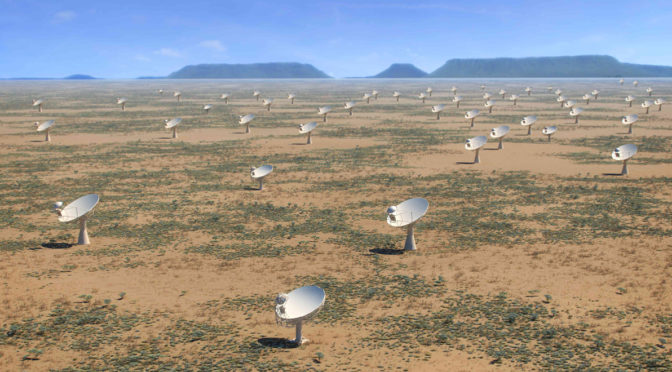
Featured image above: the Square Kilometre Array (SKA) by SKA Organisation

Cloud services – internet resources available on demand – have created a powerful computing environment, with big customers like the US Government and NASA driving developments in data and processing.

When building the infrastructure to support the Square Kilometre Array (SKA), soon to be the world’s biggest radio telescope, the International Centre for Radio Astronomy Research (ICRAR) benefitted from some heavyweight cloud computing experience.

ICRAR’s executive director, Professor Peter Quinn, says the centre approached cloud computing services company Amazon Web Services (AWS) to assess whether it could process the data from the SKA.

When operational in 2024, the SKA will generate data rates in excess of the entire world’s internet traffic.

Cloud collaboration

An artist’s impression of the Square Kilometre Array’s antennas in Australia. © SKA Organisation

ICRAR used an international consortium of astronomers to conduct a survey with the Janksy-VLA telescope, employing AWS to process the data, and they are now trying to determine how the services will work with a larger system.

Head of ICRAR’s Data Intensive Astronomy team, Professor Andreas Wicenec, says there are many options from AWS.

“Things are changing quickly – if you do something today, it might be different next week.”

Quinn says cloud systems assist international collaboration by providing all researchers with access to the same data and software. They’re also cost-effective, offering on-demand computing resources where researchers pay for what they use.

– Laura Boness

www.icrar.org


Algorithms making social decisions

In this Up Close podcast episode, informatics researcher Professor Paul Dourish explains how algorithms, as more than mere technical objects, guide our social lives and organisation, and are themselves evolving products of human social actions.

“Lurking within algorithms, unknown to people and certainly not by design, can be all sorts of unconscious biases and discriminations that don’t necessarily reflect what we as a society want.”

The podcast is presented by Dr Andi Horvath. Listen to the episode below, or read on for the full podcast transcript.

Professor Paul Dourish

Dourish is a Professor of Informatics in the Donald Bren School of Information and Computer Sciences at University of California, Irvine, with courtesy appointments in Computer Science and Anthropology.

His research focuses primarily on understanding information technology as a site of social and cultural production; his work combines topics in human-computer interaction, social informatics, and science and technology studies.

He is the author, with Genevieve Bell, of Divining a Digital Future: Mess and Mythology in Ubiquitous Computing (MIT Press, 2011), which examines the social and cultural aspects of the ubiquitous computing research program. He is a Fellow of the Association for Computing Machinery (ACM), a member of the Special Interest Group for Computer-Human Interaction  (SIGCHI) Academy, and a recipient of the American Medical Informatics Association (AMIA) Diana Forsythe Award and the Computer Supported Co-operative Work (CSCW) Lasting Impact Award.

Podcast Transcript

VOICEOVER: This is Up Close, the research talk show from the University of Melbourne, Australia.

HORVATH: I’m Dr Andi Horvath. Thanks for joining us. Today we bring you Up Close to one of the very things that shapes our modern lives. No, not the technology as such, but what works in the background to drive it: the algorithm, the formalised set of rules governing how our technology is meant to behave.

As we’ll hear, algorithms both enable us to use technology and to be used by it. Algorithms are designed by humans and just like the underpinnings of other technologies, say like drugs, we don’t always know exactly how they work. They serve a function but they can have side-effects and unexpectedly interact with other things with curious or disastrous results.

Today, machine learning means that algorithms are interacting with, or developing other algorithms, without human input. So how is it that they can have a life of their own? To take us Up Close to the elusive world of algorithms is our guest, Paul Dourish, a Professor of Informatics in the Donald Bren School of Information and Computer Science at UC Irvine. Paul has written extensively on the intersection of computer science and social science and is in Melbourne as a visiting Miegunyah Fellow. Hello, and welcome to Up Close.

DOURISH: Morning, it’s great to be here.

HORVATH: Paul, let’s start with the term algorithm. We hear it regularly in the media and it’s even in product marketing, but I suspect few of us really know what the word refers to. So let’s get this definition out of the way: what is an algorithm?

DOURISH: Well, it is a pretty abstract concept so it’s not surprising if people aren’t terrible familiar with it. An algorithm is really just a way of going about doing something, a set of instructions or a series of steps you’ll go through in order to produce some kind of computational result. So for instance, you know, when we were at school we all learned how to do long multiplication and the way we teach kids to do multiplication, well that’s an algorithm. It’s a series of steps that you can go through and you can guarantee that you’re going to get a certain kind of result. So algorithms then get employed in computational systems, in computer systems to produce the functions that we want.

HORVATH: Where do we find algorithms? If I thought about algorithm-spotting say on the way to work, where do we actually encounter them?

DOURISH: Well, if you were to take the train, for instance, algorithms might be controlling the rate at which trains arrive and depart from stations to try to manage a stable flow of passengers through a transit system. If you were to Google something in the morning to look up something that you were going to do or perhaps to prepare for this interview, well an algorithm not only found the information for you on the internet, but it was also used to sort those search results and decide which one was the one to present to you at the top of the list and which one was perhaps going to come further down. So algorithms are things that lie behind the operation of computer systems; sometimes those are computer systems we are using directly and sometimes they are computer systems that are used to produce the effects that we all see in the world like for instance, the flow of traffic.

HORVATH: So Paul, we use algorithms every day in everything, whether it’s work, rest, play, but are we also being used by algorithms?

DOURISH: Well, I guess there’s a couple of ways we could think about that. One is that we all produce data; the things that we do produce data that get used by algorithms. If we want to think about an algorithm for instance that controls the traffic lights and to manage the flow of people through the streets of Melbourne, well, the flow of people through the streets of Melbourne is also the data upon which that algorithm is working. So we’re being used by algorithms in the sense perhaps that we’re all producing the data that the algorithm needs to get its job done.

But I think there’s also a number of ways in which we might start to think that we get enrolled in the processes and effects of algorithms, so if corporations and government agencies and other sorts of people are making use of algorithms to produce effects for us, then our lives are certainly influenced by those algorithms and by the kinds of ways that they structure our interaction with the digital world.

HORVATH: So algorithms that are responsible for say datasets or computational use, the people who create them are quite important. Who actually creates these algorithms? Are they created by governments or commerce?

DOURISH: They can be produced in all sorts of different kinds of places and if you were in Silicon Valley and you were the sort of person who had a brand new algorithm, you might also be the sort of person who would have a brand new start-up. By and large, algorithms are produced by computer scientists, mathematicians and engineers.

Many algorithms are fundamentally mathematical at their heart and one of the ways in which computer scientists are interested in algorithms is to be able to do mathematical analysis on the kinds of things that computers might do and the sort of performance that they might have. But computer scientists are also generally in the business of figuring out ways to do things and that means basically producing algorithms.

HORVATH: One of the reasons we hear algorithms a lot these days is because they’ve caused problems, or at least confusion. Can you give us some tangible examples of where that’s happened?

DOURISH: Sure. Well, I think we see a whole lot of those and they turn up in the paper from time to time, and some are kind of like trivial and amusing and some have serious consequences. From the trivial side and the amusing side we see algorithms that engage in classification, which is an important area for algorithmic processing, and classifications that go wrong, places where an algorithm decides that because you bought one product you are interested in a particular class of things and it starts suggesting all these things to you.

I had a case with my television once where it had decided because my partner was recording Rocky and Bullwinkle, which is an old 1970s cartoon series [for just] America featuring a moose and a squirrel, that I must be interested in a hunting program so it started recording hunting shows for me. So although they’re silly, they begin to show the way that algorithms have a role.

The more serious ones though are ones that begin to affect commerce and political life. A famous case in 2010 was what was called the flash crash, a situation in which the US stock market lost then suddenly regained a huge amount of value, about 10 per cent of the value of their system, all within half an hour, and nobody really knew why it happened. It turned out instead of human beings buying and trading shares, it was actually algorithms buying and trading shares. The two algorithms were sort of locked in a loop, one trying to offer them for sale and one trying to buy them up, and suddenly it spiralled out of control. So these algorithms, because they sort of play a role in so many different systems and appear in so many different places, can have these big impacts and in even those small trivial cases or ones that begin to alert us or tune us to where the algorithms might be.

HORVATH: Tell us about privacy issues; that must be something that algorithms don’t necessarily take seriously.

DOURISH: Well, of course the algorithm works with whatever data it has to hand, and data systems may be more or less anonymised, they may be more or less private. One of the interesting problems perhaps is that the algorithm begins to reveal things that you didn’t necessarily know that your data might reveal.

For example, I might be very careful about being tracked by my phone. You know, I choose to turn off those things that say for instance where my home is, but if an algorithm can detect that I tend to be always at the same place at 11 o’clock at night or my phone is always at the same place at 11 o’clock at night and that’s where I start my commute to work in the morning, then those patterns begin to build up and there can be privacy concerns there. So algorithms begin to identify patterns in data and we don’t necessarily know what those patterns are, nor are we provided necessarily with the opportunity to audit, control, review or erase data. So that’s where the privacy aspects begin to become significant.

HORVATH: Is there an upsurge about societal concerns about algorithms? Really, I’m asking you the question, why should we care about algorithms? Do we need to take these more seriously?

DOURISH: I think people are beginning to pay attention to the ways in which there can be potentially deleterious social effects. I don’t want to sit here simply saying that algorithms are dangerous and we need to be careful, but on the other hand there is this fundamental question about knowing what it is the algorithm is doing and being conscious of its fairness.

On the trivial side, there is an issue that arose around the algorithm in digital cameras to detect faces, when you want to focus on the face. It turned out after a while that the algorithms in certain phones looked predominantly for white faces but were actually very bad at detecting black faces. Now, those kinds of bias aren’t very visible to us, as the camera just doesn’t work. Those are perhaps where as a society we need to start thinking about what is being done for us by algorithms, because lurking within those algorithms, unknown to people and certainly not by design, can be all sorts of unconscious biases and discriminations that don’t necessarily reflect what we as a society want.

HORVATH: Are we being replaced by algorithms? Is this something that’s threatening jobs as we know it?

DOURISH: Well, I certainly see plenty of cases where people are concerned about that and talk about it, and there’s been some in the press in the last couple of years that talk for instance about algorithms taking over HR jobs in human resources, interviewing people for jobs or matching people for jobs. By and large though, lots of these algorithms are being used to supplement and augment what people are doing. I don’t think we’ve seen really large-scale cases so far of people being replaced by algorithms, although it’s certainly a threat that employers and others can hold over people.

HORVATH: Sure. Draw the connection for us between algorithms and this emerging concept of big data.

DOURISH: Well, you can’t really talk about one without the other; they go together so seamlessly. Actually, one of the reasons that I’ve been talking about algorithms lately is precisely because there’s so much talk about big data just now. The algorithms and the data go together. The data provides the raw material that the algorithm processes and the algorithm is generally what makes sense of that data.

We talk about big data not least in terms of this idea of being able to capture and collect, to get information from all sorts of sensors, from all sorts of things about the world, but it’s the algorithm that then comes in and makes sense of that data, that identifies patterns and things that we think are useful or interesting or important. I might have a large collection of data that tells me what everybody in Victoria has purchased in the supermarket for the last month, but it’s an algorithm that’s going to be able to identify within that dataset well, here are dual income families in Geelong or the sort of person who’s interested in some particular kind of product and amenable to a particular kind of marketing. So they always go together; you never have one without the other.

HORVATH: But surely there are problems in interpretation and things get lost in translation.

DOURISH: That’s a really interesting part of the whole equation here. It’s generally human beings have to do the interpretation; the algorithm can identify a cluster. It can say, look, these people are all like each other but it tends to be a human being who comes along and says now, what is it that makes those people like each other? Oh, it’s because they are dual income families in Geelong. There’s always a human in the loop here. Actually, the problem that we occasionally encounter, and it’s like that problem of inappropriate classification that I mentioned earlier, the problem is that often we think we know what the clusters are that an algorithm has identified until an example comes along that shows oh, that wasn’t what it was at all. So the indeterminacy of both the data processing part and the human interpretation is where a lot of the slippage can occur.

HORVATH: I’m Andi Horvath and you’re listening to Up Close. In this episode, we’re talking about the nature and consequences of algorithms with informatics expert Paul Dourish. Paul, given that algorithms are a formalised set of instructions, can’t they simply be written in English or any other human language?

DOURISH: Well, algorithms certainly are often written in English. There’s all sorts of ways in which we write them down. Sometimes they are mathematical equations that live on a whiteboard. They often take the form of what computer scientists call pseudo-code, which looks like computer code but isn’t actually executable by a computer, and sometimes they are in plain English. I used the example earlier of the algorithm that we teach to children for how to do multiplication; well, that was explained to them in plain English. So they can take all sorts of different forms. Really, that’s some of the difficulty about the notion of algorithm is this very abstract idea and it can be realised in many different kinds of ways.

HORVATH: So the difference between algorithms and codes and pseudo-codes are different forms of abstraction?

DOURISH: In a way, yes. Computer code is the stuff that we write that actually makes computers do things, and the algorithm is a rough description of what that code might be like. Real programs are written in specific programming languages. You might have heard of C++ or Java or Python, these are programming languages that people use to produce running computer systems. The pseudo-code is a way of expressing the algorithm that’s independent of any particular programming language. So if I have a great algorithm, an idea for how to produce a result or sort a list or something, I can express it in the pseudo-code and then different programmers who are working in different programming languages can translate the algorithm into the language that they need to use to get their particular work done.

HORVATH: Right. Now, I’ve heard one of the central issues is that we can’t really read the algorithm once it’s gone into code. It’s like we can’t un-cook the cake or reverse engineer it. Why is that so hard?

DOURISH: Well, we certainly can in some cases; it’s not a hard and fast rule. In fact, most computer science departments, like the one here at Melbourne, will teach people how to write code so that you can see what’s going on. But there are a couple of complications that certainly can make it more difficult.

The first is that the structure of computer systems requires that you do more things than simply what the algorithm describes. An algorithm is an idealised version of what you might do, but in practice I might have to do all sorts of other things as well, like I’m managing the memory of the computer and I’m making sure the network hasn’t died and all these things. My program has lots of other things in it that aren’t just the algorithm but are more complicated.

Another complication is that sometimes people write code in such a way that it hides the algorithm for trade secret purposes. I don’t want to have somebody else pick up on and get my proprietary algorithm or the secret source for my business or program, and so I write the software in a deliberately somewhat obscure way.

Then the other problem is that sometimes algorithms are distributed in the world, they don’t all happen in one place. I think about the algorithms for instance that control how data flows across the internet and tries to make sure there isn’t congestion and too much delay in different parts of the network. Well, those algorithms don’t really happen in one place, they happen between different computers. Little bits of it are on one computer and little bits of it are on the other and they act together in coordination to produce the effect that we desire, so it can be often hard to spot the algorithm within the code.

HORVATH: Tell us more about these curious features of algorithms. They almost sound like a life form.

DOURISH: Well, I think what often makes algorithms seem to take on a life of their own, if you will, is that intersection with data that we were talking about earlier, because I said data and algorithms go together. There is often a case for instance where I can know what the algorithm does but if I don’t know enough about the data over which the algorithm operates, all sorts of things can happen.

There’s a case that I like to use as an example that came from some work that a friend of mine did a few years ago where he was looking at the trending topics on Twitter, and he was working particularly with people in the Occupy Wall Street movement who were sure that they were censored because their movement, the political discussion around Occupy Wall Street, never became a trending topic on Twitter. People were outraged, how can Justin Bieber’s haircut be more important than Occupy Wall Street? When they talked to the Twitter people, the Twitter people were adamant that they weren’t censoring this, but nonetheless they couldn’t really explain in detail why it was that Occupy Wall Street had not become a trending topic.

You can explain the algorithm and what it does, you can explain the mathematics of it, you can explain the code, you can show how a decision is made, but that decision is made about a dataset that’s changing rapidly, that’s to do with everything that’s being Tweeted online, everything that’s being retweeted, where it’s being retweeted, where it’s being retweeted, how quickly it’s being retweeted. What the algorithm does, even though it’s a known, engineered artefact, is still itself somehow mysterious.

So the lives that algorithms take on in practice for us when we encounter them in the world or when they act upon us or when they pop up in our Facebook newsfeed or whatever, is often unknowable and mysterious and lively, precisely because of the way the algorithm is entwined with an ever roiling dataset that keeps moving.

HORVATH: I love the term machine learning, and it’s really about computers interacting with computers, algorithms talking to other algorithms without the input of humans. That kind of spooks me. Where are we going?

DOURISH: Yeah. Well, I think the huge, burgeoning interest in machine learning has been spurred on by the big data movement. Machine learning is something that I was exposed to when I was an undergraduate student back more years ago than I care to remember; it’s always been there. But improvements in statistical techniques and the burgeoning interest in big data and the new datasets mean that machine learning has taken on a much greater significance than it had before.

What machine learning algorithms typically do is they identify again patterns in datasets. They take large amounts of data and then they tell us what’s going on in that. Inasmuch are we are generating more and more data and inasmuch as more and more of our activities move online and then become, if you like, “datafiable”, things that can now be identified as data rather than just as things we did, there is more and more opportunity for algorithms, and particularly for machine learning algorithms, to identify patterns within that.

I think the question, as we said, is to what extent one knows what a machine learning algorithm is saying about one. Indeed, even, as I suggested with the Twitter case, even for people who work in this space, even for people who are developing the algorithms, it can be hard for them to know. It’s that sort of issue of knowing, of being able to examine the algorithms, of making algorithms accountable to civic, political and regulatory processes, that’s where some of the real challenges are that are posed by machine learning algorithms.

HORVATH: We’re exploring the social life of algorithms with computer and social scientist Paul Dourish right here on Up Close. And yes, we’re coming to you no doubt thanks to several useful algorithms. I’m Andi Horvath. Let’s keep moving with algorithms. You say that algorithms aren’t just technical, that they’re social objects. Can you tell us a bit more what that means?

DOURISH: Well, I think we can come at this from two sides. One side is the algorithms are social as well as technical because they’re put to social uses. They’re put to uses that have an impact on our world. For example, if I’m on Amazon and it recommends another set of products that I might like to look at, or it recommends some and not others, there’s some questions in there about why those ones are just the right ones. Those are cases where social systems, systems of consumption and purchase and identification and so forth are being affected by algorithms. That’s one way in which algorithms are social; they’re put to social purposes.

But of course, the other way that algorithms are social is that they are produced by people and organisations and professions and disciplines and all sorts of other things that have a grounding in the social world. So algorithms didn’t just happen to us, they didn’t fall out of the sky, we have algorithms because we make algorithms. And we make algorithms within social settings, and they reflect our social ideas or our socially-constructed ideas about what’s desirable, what’s interesting, what’s possible and what’s appropriate. Those are all ways in which the algorithms are pre-social. They’re not just social after the fact but they are social before the fact too.

HORVATH: Paul, you’ve mentioned how algorithms are kind of opaque, but yet you also mention that we need to make them accountable, submit them to some sort of scrutiny. So how do we go about that?

DOURISH: This is a real challenge that a number of people have been raising in the last couple of years and perhaps especially in light of the flash crash, that moment where algorithmic processing produced a massive loss of value on the US stock market. There are a number of calls for corporations to make visible aspects of their own algorithms and processing so that it can be deemed to be fair and above board. If you just think for a moment about how much of our daily life in the commercial sector is indeed governed by those algorithms and what kind of impact a Google search result ordering algorithm has; there’s lots of consequences there, so people have called for some of those to be more open.

People have also called for algorithms to be fixed. This is one of the other difficulties is that algorithms shift and change; corporations naturally change them around. There was some outrage when Facebook indulged in an experiment in order to see whether they could tweak the algorithms to give people happier or less happy results and see if that actually changed their own mood and what kinds of things they saw. People were outraged at the idea that Facebook would tweak an algorithm that they felt, even though it obviously belonged to Facebook, was actually an important part of their lives. So keeping algorithms fixed in some sense is one sort of argument that people have made, and opening things up to scrutiny.

But the problem with opening things up to scrutiny is well, first, who can actually evaluate these things? Not all of us can. And also of course that in the context of machine learning, the algorithm identifies patterns in data, but what’s the dataset that we’re operating over? In fact, we can’t even really identify what those things are, we’re only saying there’s a statistical pattern and that some human being is going to come along and assign some kind of value to that. So some of the algorithms are inherently inscrutable. The algorithm processes data and we can say what it says about the data, but if we don’t know what the data is and we don’t know what examples it’s been trained on and so forth, then we can’t really say what the overall effect and impact is.

HORVATH: Will scrutiny of algorithms, whether we audit or control them, be affected by, say, intellectual property laws?

DOURISH: Well, this is a very murky area, and in particular it’s a murky area internationally, where there are lots of different standards in different countries about what kind of things can be patented, controlled and licensed and so forth. Algorithms themselves are patentable objects. Many people choose to patent their algorithms, but of course patenting something requires disclosing it and so lots of other corporations decide to protect their algorithms as trade secrets, which are basically just things you don’t tell anybody.

The question that we can ask about algorithms is actually also how they move around in the world and those intellectual property issues, licensing rights, patenting and so forth are actually ways that algorithms might be fixed in one place within a particular corporate boundary but also move around in the world. So no one has really I think got a good handle on the relationship between algorithms and intellectual property.

They are clearly valuable intellectual property, they get licensed in a variety of ways, but this is again one of these places where the relationship between algorithm and code is a kind of complicated one. We have developed an understanding of how to manage those things for code; we have a less good understanding right now of how to manage those things for algorithms. I should probably say, since we’re also talking about data, no idea at all about how to do this for data.

HORVATH: These algorithms, they’ve really got a phantom-like presence and yet they’ve got so much potential and possibility. They are practical tools that help with our lives. But what are the consequences of further depending upon the algorithms in our world?

DOURISH: I think it’s inevitable and not really problematic. From my perspective, algorithms in and of themselves are not necessarily problematic objects. Again, if we say that even the things that we teach our children for how to do multiplication are algorithms, there’s no particular problem about depending on that. I think again it’s the entwining of algorithms and data, and one of the things that an algorithmic world demands is the production of data over which those algorithms can operate, and all the questions about ownership and about where that algorithmic processing happens matter.

For example, one manifestation of an algorithmic and data-driven world is one in which you own all your data and you do the algorithmic processing and then make available the results if you so choose. Another version of that algorithmic and [data-centred/data-central] world is one in which somebody else collects data about you and they do all the processing and then they tell you the results, and there’s a variety of steps in between. So I don’t think the issue is necessarily about algorithms and how much we depend on algorithms. Some people have claimed we’re losing our own ability to remember things because now Google is remembering for us.

HORVATH: It’s an outsourced memory.

DOURISH: Yes, that’s right, or there’s lots of things about people using their Satnav and driving into the river, right, because they’re not anymore remembering how to actually drive down the road or evaluate the things in front of them, but I’m a little sceptical about those. I do think the question about how we want to harness the power of algorithmic processing, how we want to make it available to people, and how it should inter-function with the data that might be being collected from or about people, those are the questions that we need to try to have a conversation about.

HORVATH: Paul, I have to ask you, just like we use our brain to understand our brain, can we use algorithms to understand and scrutinise algorithms?

DOURISH: [Laughs] Well, we can and actually, we do. One of the ways in which we do already is that when somebody develops a new machine learning algorithm we have to evaluate how well it does. We have to know is this algorithm really reliably identifying things. We sort of pit algorithms against each other to try to see whether the algorithm is doing the right work and evaluate the results of other kinds of algorithms. So that actually already happens.

Similarly, as I suggested on the internet, the algorithm for congestion control is really a series of different algorithms happening in different places that work cooperative or not in order to produce or not a smooth flow of data. Though we don’t have to worry just yet I think about a sort of war between the algorithms or any kind of algorithmic singularity.

HORVATH: Paul, what do you mean by the singularity? Is this really a Skynet moment?

DOURISH: Well, the singularity is this concept that suggests that at some point in the development of intelligent systems, they may become so intelligent that they can design their own future versions and the humans become irrelevant to the process of development. It’s a scary notion; it’s one I’m a little sceptical about, and I think actually the brittleness of contemporary algorithms is a great example of why we’re not going to get there within any short time.
I think the question though is still how do we want to understand the relationship between algorithms and the data over which they operate? A great example is IBM’s Watson, which a couple of years ago won the Jeopardy TV show, and this was a real breakthrough for artificial intelligence. But on the other hand you’ve got to task, what is it that Watson knows about? Well, a lot of what Watson knows it knows from Wikipedia and I’m not very happy when my students cite Wikipedia and I’m not terribly sure that I need to be afraid of the machine intelligence singularity that also is making all its inferences on the basis of Wikipedia.

HORVATH: Paul, thanks for being our guest on Up Close and allowing us to glimpse into the world of the mysterious algorithm. I feel like I’ve been in the movie Tron.

DOURISH: [Laughs] Yes, well, we don’t quite have the glowing light suits unfortunately.

HORVATH: We’ve been speaking about the social lives of algorithms with Paul Dourish, a professor of informatics in the Donald Bren School of Information Computer Science at UC Irvine. You’ll find a full transcript and more info on this and all our episodes on the Up Close website. Up Close is a production of the University of Melbourne, Australia. This episode was recorded on 22 February 2016. Producer was Eric van Bemmel and audio recording by Gavin Nebauer. Up Close was created by Eric van Bemmel and Kelvin Param. I’m Dr Andi Horvath. Cheers.

VOICEOVER: You’ve been listening to Up Close. For more information visit upclose.unimelb.edu.au. You can also find us on Twitter and Facebook.

– Copyright 2016, the University of Melbourne.

Podcast Credits

Host: Dr Andi Horvath
Producer: Eric van Bemmel
Audio Engineer: Gavin Nebauer
Voiceover: Louise Bennet
Series Creators: Kelvin Param, Eric van Bemmel

This podcast was first published on 11 March 2016 by The University of Melbourne’s Up Close. Listen to the original podcast here

Top 25 insights: spin-off start-ups

Seven leaders of the Top 25 Science Meets Business R&D spin-off companies answer the question: What insights can you share with other R&D spin-off start-ups in Australia?


CATAPULT GROUP INTERNATIONAL LTD

Fill a market need and lead that market; don’t fill a product gap and complicate your market with a technology push.

It doesn’t matter how technical your product or service is, it needs to be easily explained and have a story that resonates for it to be successful in any market, let alone overseas markets.

Shaun_intext

– Shaun Holthouse, Chief Executive Officer


SMARTCAP TECHNOLOGIES PTY LTD

A few words of wisdom.

1. Make sure there is a viable, readily accessible market that is sufficiently large to support a spin-off company.

2. The actual invention is only the trigger to start a company – you are establishing a company that will need to innovate on an ongoing basis if it wants to be successful. Make sure that innovation capability and desire exists and thrives in the spin-off.

3. Identify competent board and management capability to direct the business and generate revenue for the company. Most often the management capability is not the same people who carried out the research, but sometimes it can be. Without the right people running the show, the spin-off will not be successful. 

4. Make sure you have sufficient funding available to get the company through to a viable revenue stream, and ideally flexible funding arrangements. Unexpected things will happen and you need capability to accommodate those changes.

– Kevin Greenwood, Chief Operating Officer


PHARMAXIS LTD

“Most start-ups are focused on development plans that contain binary events and marginal financing. This makes them vulnerable to unforeseen delays and additional development steps that require additional funding.

I believe that we should be looking to generate portfolios of innovation under experienced management teams that give our projects the best chance of success – and adequate funding to reach proof of concept in whatever market we are targeting – but at the same time help to spread risk.

venture capital

– Gary J Phillips, Chief Executive Officer


ACRUX DDS PTY LTD

“Ensuring a strong board, CEO, and a quality management team will be critical to success. The availability of funds for programs is an often-discussed barrier to rapid progress. Underfunded companies and poorly thought-out product concepts or technologies are more likely to fail early.

Michael Kotsanis_intext

– Michael Kotsanis, Chief Executive Officer


SPINIFEX PHARAMCEUTICALS PTY LTD

“1. For biotechnology R&D spin-off start-ups in Australia, major hurdles are the dearth of seed capital as well as access to large follow-on venture funds that are needed to build successful biotechnology companies.

2. There is a mismatch between the 10-year life span of a venture capital fund in Australia and the 15+ years needed to translate research findings into a novel drug or biologic product for improving human health. 

3. Hence, these systemic issues are major impediments to building successful biotechnology companies in Australia and these issues need to be addressed.”

– Professor Maree Smith, Executive Director of the Centre for Integrated Preclinical Drug Development and Head of the Pain Research Group at The University of Queensland


ADMEDUS

Start-up companies may consider moving overseas, especially if the Government stops or reduces the R&D tax rebates and doesn’t establish some innovation stimulus packages.

venture capital

– Dr Julian Chick, Chief Operating Officer


REDFLOW

Nothing ever goes 100% smoothly – perseverance is a prerequisite.

Stuart Smith_intext

– Stuart Smith, Chief Executive Officer

Click here to see the full list of Top 25 Science Meets Business R&D spin-off companies, or for further insights from the Top 25 leaders, read their interviews on attracting venture capital, learning from overseas marketsgetting past the valley of death and overcoming major start-up challenges.

Top 25 insights: start-up challenges

Eight leaders of the Top 25 Science Meets Business R&D spin-off companies answer the question: What major challenge did you face as you were moving to market and how did you tackle it?


iCETANA PTY LTD

As we understood more about the market, we believed our product was most differentiated and better suited to very large enterprise customers.

But understandably, such large customers are not inclined to buy off an unproven, unknown start-up. So we spent a lot of time trialling our product with smaller early adopters and leveraging the results to win over increasingly bigger customers.

– Gary Pennefather, Chief Executive Officer


PHARMAXIS LTD

“In the biotechnology/pharmaceutical space the major challenge that is often outside our control is the time taken to get the regulatory and pricing approvals necessary to enter markets where the only purchasers are governments.

We faced significant delays and hold-ups that required a different set of competencies to tackle than the scientific and clinical experience that had got us to that point.

Your business model has to be robust enough to withstand delays in time to market and increasing regulatory costs. Having a plan that only works if everything goes well is asking for trouble.

venture capital

– Gary J Phillips, Chief Executive Officer


CATAPULT GROUP INTERNATIONAL LTD

An ongoing challenge when moving into new markets is educating the value of the technology based on experiences in other regions, and trying to keep down the cost of individual sales with a complex technology.

We’ve alleviated this challenge with staff based around the world and by setting up established offices in Chicago (USA) and Leeds (UK), but you still need to get creative in penetrating new markets and generating revenue right away while demonstrating value.

Shaun_intext

– Shaun Holthouse, Chief Executive Officer


ADMEDUS

With two platform technologies and an extensive number of possible R&D programs, determining the right projects to progress forward and balancing capital allocation are key. Detailed program and market understanding is also essential.

We’ve overcome this by maintaining regular and consistent communication with our investors and working closely with our customers to understand their needs.

venture capital

– Dr Julian Chick, Chief Operating Officer


SMARTCAP TECHNOLOGIES PTY LTD

The most difficult challenge ended up being establishing the right management team for the business – it is difficult to identify and parachute in the skilled, motivated management team a start-up needs; one that is able to operate effectively with researchers, investors, and so on.

For this to happen, CRCMining, as the major shareholder, first ensured the company had an independent governance arrangement in place by establishing a board for SmartCap with significant successful commercial experience – one that we felt was very competent, able to ask hard questions, and make difficult decisions. 

The board led the process of putting in place a management team that has resulted in the company reaching the point of being a very well-run organisation.

– Kevin Greenwood, Chief Operating Officer


ACRUX DDS PTY LTD

“We chose to partner our lead product with a strong international pharmaceutical company rather than working through alternative go-to-market strategies. On that basis, selecting and negotiating a good commercial deal is critical.

Not all partners are created equal. On that basis, there are other challenges prior to this step that must be appropriately addressed.

The quality of the commercialisation partner and the strength of your position in a negotiation with that partner are the result of good outcomes in the pivotal steps prior to your licensing negotiations.”

Michael Kotsanis_intext

– Michael Kotsanis, Chief Executive Officer


SPINIFEX PHARAMCEUTICALS PTY LTD

“Once clinical proof-of-concept was successfully announced by Spinifex in August 2012– that is, the Phase 2a clinical trial in patients with postherpetic neuralgia, which is a type of peripheral neuropathic pain that is often intractable – the Spinifex Board again needed to raise capital to progress from Phase 2a to Phase 2b clinical trials.

However, these funds were not available in Australia and so the company had to move to the USA in early 2014. Soon after, they successfully raised $45M in the USA to progress the clinical development program.”

– Professor Maree Smith, Executive Director of the Centre for Integrated Preclinical Drug Development and Head of the Pain Research Group at The University of Queensland


REDFLOW

Identifying early adopters.

Stuart Smith_intext

– Stuart Smith, Chief Executive Officer

Click here to see the full list of Top 25 Science Meets Business R&D spin-off companies, or for further insights from the Top 25 leaders, read their interviews on attracting venture capital, learning from overseas markets and overcoming the valley of death.

Top 25 insights: valley of death

There are two potential ‘valleys of death’ for R&D spin-off companies. One is in translating their research concepts into prototype products. The other is in maturing from prototype to full commercialisation.

Here, leaders of the Top 25 Science Meets Business R&D spin-off companies answer the question: Which valley of death was most difficult for your company, and what was key to getting over the hurdle?


ADMEDUS

Taking the prototype through to full commercialisation was probably more difficult for us due to the complexities involved.

This included high-tech scale-up manufacturing, which we do at our bio-manufacturing facility in Malaga. Today, we have the ability to expand production as necessary, as well as refine and develop our processes in-house to accommodate new products and product improvements.

There was also a focus on generating sales once CardioCel was commercialised. Just because a product is approved doesn’t necessarily mean that it will be used straight away by the intended customers.

We’ve focused on educating the market about the benefits of CardioCel, such as its biocompatibility and lack of calcification (hardening) at the site of surgery. We’ve also built a strong global sales and marketing team who work closely with our customers to understand their needs.

As a result, we’ve seen continued quarter-on-quarter growth in CardioCel sales, and the product is now used in over 135 heart centres globally.

venture capital

– Dr Julian Chick, Chief Operating Officer


PHARMAXIS LTD

“For pharmaceuticals the so called ‘second valley of death’ is by far the most significant.

Lack of funding often prevents companies from attempting to cross this valley and causes them to license their technology at an earlier stage and to realise rewards as the licensor takes their innovation to market.

For a small company with limited resources, the key to success here is to understand the commercialisation risks, link the higher-risk projects with partners and try to make that step themselves for markets with lower entry costs and higher clinical need.

If done well, they should end up with a portfolio approach with the risks mitigated but still significant opportunity for value appreciation.”

venture capital

– Gary J Phillips, Chief Executive Officer


SMARTCAP TECHNOLOGIES PTY LTD

SmartCap Technologies had substantial industry support to develop the prototype products, however even with this it was a very challenging process to deliver working prototypes. 

SmartCap was exceedingly fortunate in that CRCMining provided substantially more financial support for SmartCap than originally envisaged, enabling it to finally deploy the prototype products. Those prototypes were sufficiently effective to generate commercial interest from some large mining companies.

So despite having robust plans in place, it always helps to have access to further funding, via investors or other stakeholders with a high level of commitment as well as deep pockets, to overcome unforeseen eventualities.”

– Kevin Greenwood, Chief Operating Officer


CATAPULT GROUP INTERNATIONAL LTD

“The biggest hurdle may be the combination of the two – translating research concepts (i.e. technical information associated with the technology) following commercialisation into an immature market.

Catapult‘s technology is not a consumer product and therefore is very high touch in terms of its service and client support. Due to the perceived complexity of the information obtained from the technology, part of the trick is to simplify the underlying research concepts to new markets that need a low touch product.”

Shaun_intext

– Shaun Holthouse, Chief Executive Officer


iCETANA PTY LTD

“I would argue that you should have a prototype – before any spin-off. That way you can at least prove technical viability of your concept. Ideally you would also have done some level of customer validation.

The next step of full commercialisation is definitely the hardest.

In our case it was a matter of finding early customers that were willing to spend time assessing the product and its benefits – even though it was too early to commit to a purchase and full roll-out. This phase was key to understanding the market and adjusting our path.”

– Gary Pennefather, Chief Executive Officer


ACRUX DDS PTY LTD

“The first phase is the most difficult – a poor prototype will show its deficiencies later in development. A prototype needs to demonstrate a safe and efficacious profile, and that it will meet the need you have defined in the target market.”

Michael Kotsanis_intext

– Michael Kotsanis, Chief Executive Officer


SPINIFEX PHARAMCEUTICALS PTY LTD

“Translating research concepts into clinical proof-of-concept [was the most difficult] due to the dearth of venture capital available in Australia at that time.”

– Professor Maree Smith, Executive Director of the Centre for Integrated Preclinical Drug Development and Head of the Pain Research Group at The University of Queensland


ENGENEIC LTD

“We are in the middle of our valley of death translating our platform into the clinic and we have not yet overcome it. Data is key, but one needs the funds to produce the results! So, we are seeking investors wherever we can find them and buddying up to big pharmaceuticals who have the muscle to progress our technology.”

HimanshuandJennifer_intext

– Dr Jennifer Macdiarmid, pictured above with Dr. Himanshu Brahmbhatt, joint Chief Executive Officers and Directors 


REDFLOW LIMITED

“Both were as difficult – but they had different hurdles. Key for both was having the right staff and people to address each hurdle.”

Stuart Smith_intext

– Stuart Smith, Chief Executive Officer


Click here to see the full list of Top 25 Science Meets Business R&D spin-off companies.