Tag Archives: space news
Space roadmap unlocks future growth opportunities for Australia
Space: A Roadmap for unlocking future growth opportunities for Australia, was launched by the Hon Karen Andrews MP at the 18th Australian Space Research Conference on the Gold Coast, held on September 24-26, 2018.
Australian space industries already contribute $3.9 billion a year to the economy and the business opportunities and jobs growth potential is significant, said Minister Andrews.
Once dominated by billion-dollar government programs, the industry landscape of global space activity and space exploration is now composed of SMEs which provide an array of technology and services. “The benefits from a growing space industry are very local”, said Minister Andrews, highlighting Gold Coast rocket business Gilmour Space Technologies and Opaque Space, a Melbourne-based VR company working with NASA on an astronaut training simulator.
“We have what it takes to gain a greater share of the market and build a new industry for our nation.”
The industry roadmap report was developed by CSIRO Futures, the strategy advisory arm of Australia’s national space agency. It highlights three key areas for potential development: space exploration and utilisation, space-derived services and space object tracking.
- The reports recommends that Australia leverage our nation’s industrial and research strengths across astronomy, mining, manufacturing, medicine, agriculture and robotics, and apply these skills to support robotic and human space exploration missions. This will include the development of innovative systems for long-term settlement in space, including habitation and life support.
- Earth observation technology, including satellite communications and positioning, navigation and timing data, can aid in developing businesses which address disaster and water management.
- Australia can take advantage of our geographic position in the Southern Hemisphere to further our work with international programs to track and manage space debris and enable deep space communication.
Key technologies to focus on include power and propulsion systems, autonomous systems and robotics to make missions safer, habitat and life support (including food, protective clothing and housing) and in-situ resource utilisation. The report also emphasises the broader benefits of growing the Australian space industry, as a valuable source of innovation for Earth-based industries, such as communications, agriculture, mining and transport.
The Australian Space Agency (ACA) was established by the Government with the mandate to triple the size of our domestic space industry up to $12 billion by 2030 and generate 20,000 new jobs.
“Our purpose is to transform and grow a globally respected Australian space industry that inspires Australia”, said Dr Megan Clark AC, the head of the ACA.
Dr Larry Marshall, CSIRO Chief Executive, said that he looks forward to the partnership opening up Australian markets, improving productivity, creating new jobs, and securing our STEM talent pipeline into the future. “We are here to help Australia secure our footprint in the space ecosystem,” he said.
In 2017, CSIRO secured access to one of the world’s most advanced high-performance satellites, the NovaSAR satellite. The Satellite was launched on 17 September 2018 and the CSIRO holds a 10% share of tasking and acquisition time over the next seven years. This gives Australian scientists control over the satellite’s data collection over our region and will extend Australian Earth Observation capabilities.
A selection of the research projects associated with NovaSaR include disaster identification and monitoring, improved infrastructure and agriculture mapping, biomass monitoring, flood risk assessment and detection of illegal deforestation and shipping activities.
“A new space agency is not just about industry. It is about creating aspirations about exploring the universe,” said Minister Andrews. “Our space agency will help promote opportunities for our young people and give them the chance to aspire to something they many not even have thought about…Growing our space industry is about growing our future prosperity as a nation.”
– Larissa Fedunik
Lost satellite?
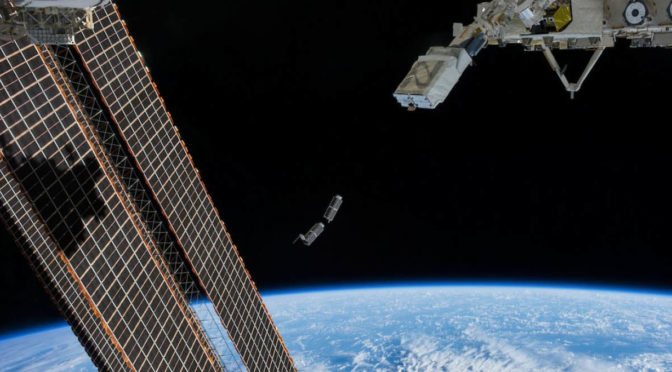
Featured image above: the Nanoracks CubeSat launcher on the Japanese arm of the International Space Station
The first Australian satellite in 15 years, UNSW-EC0, was successfully deployed from the International Space Station, but the UNSW engineers who built it were unable to establish contact when it made its first pass above Sydney.
UNSW-EC0 was ejected from the station at 3:25pm AEST on 26 May, and made its first pass over Sydney at 4:21pm. Engineers at UNSW’s Australian Centre for Space Engineering Research (ACSER) were unable to pick up the signal it is meant to send to confirm the cubesat is operating as designed.
“We’re not overly concerned yet,” said Elias Aboutanios, project leader of the UNSW-EC0 cubesat and deputy director of ACSER. “We’re troubleshooting a number of scenarios for why we didn’t detect it, from checking our ground equipment to exploring the possibility that the batteries might have discharged. But at the moment, we just don’t know.”
“If it is the batteries, the satellite has solar panels and will be able to recharge,” said Joon Wayn Cheong, a research associate at UNSW’s School of Electrical Engineering and Telecommunications and technical lead of the UNSW-EC0 cubesat. “But because it was deployed in the Earth’s shadow, we have to wait for it to make a few orbits before it has recharged, especially if it’s tumbling. So it could be 24 to 48 hours.”
The International Space Station, or ISS, will make four more passes over Sydney on Friday 25 May, and the UNSW team of 15 researchers and students will again try to establish contact, and run a series of tests for scenarios to explain the lack of a signal.
UNSW-EC0 is one of three Australian research satellites – two of them built at the UNSW – that blasted off just after on April 19 from Cape Canaveral Air Force Station in Florida. Its mission is to explore the little-understood region above Earth known as the thermosphere, study its atomic composition as well as test new robust computer chips and GPS devices developed at UNSW.
In addition, its chassis is made entirely from 3D-printed thermoplastic, itself an experiment to test the reliability of using 3D-printing to manufacture satellites, making them cheaper and much more customisable.
The cubesat is part of an international QB50 mission, a swarm of 36 small satellites – known as ‘cubesats’ and weighing about 1.3 kg each – that will carry out the most extensive measurements ever undertaken of the thermosphere, a region between 200 and 380 km above Earth. This poorly-studied and usually inaccessible zone of the atmosphere helps shield Earth from cosmic rays and solar radiation, and is vital for communications and weather formation.
“These are the first Australian satellites to go into space in 15 years,” said Andrew Dempster, director of ACSER at UNSW, and a member of the advisory council of the Space Industry Association of Australia. “There have only been two before: Fedsat in 2002 and WRESAT in 1967. So we’ve got more hardware in space today than Australia’s had in its history.”
UNSW-EC0 was deployed from the ISS from a Nanoracks launcher, a ‘cannon’ that eject cubesats at a height of 380 km (the same as the ISS), allowing them to drift down to a lower orbit where they can begin their measurements.
“This zone of the atmosphere is poorly understood and really hard to measure,” said Aboutanios. “It’s where much of the ultraviolet and X-ray radiation from the Sun collides with Earth, influencing our weather, generating auroras and creating hazards that can affect power grids and communications.
“So it’s really important we learn a lot more about it. The QB50 cubesats will probably tell us more than we’ve ever known about the thermosphere,” he added.
QB50 is a collaboration of more than 50 universities and research institutes in 23 countries, headed by the von Karman Institute (VKI) in Belgium. “This is the very first international real-time coordinated study of the thermosphere phenomena,” said VKI’s Davide Masutti. “The data generated by the constellation will be unique in many ways and they will be used for many years by scientists around the world.”
This article was first published by UNSW Engineering. Read the original article here.