On behalf of the Australian Government, the Australian Renewable Energy Agency (ARENA) announced on 6 September it has awarded $22.1 million in funding to 16 research projects to propel innovation in exporting renewable hydrogen to the world.
The funding has been offered to research teams from nine Australian universities and research organisations including the Australian National University, Macquarie University, Monash University, Queensland University of Technology, RMIT University, The University of Melbourne, University of New South Wales, The University of Western Australia and the Commonwealth Scientific and Industrial Research Organisation (CSIRO).
In December 2017, ARENA announced the funding round into hydrogen R&D. It is the first time ARENA had sought to fund research into the hydrogen energy supply chain.
The early stage research projects cover a diverse range of renewable solutions, with at least one project from each point in the supply chain – production, hydrogen carrier and end use. The projects include the development of a wide range of hydrogen-related technologies including concentrating solar thermal, electrolysis, biotechnology, carrier synthesis, thermochemical processes, fuel cell development and energy generation.
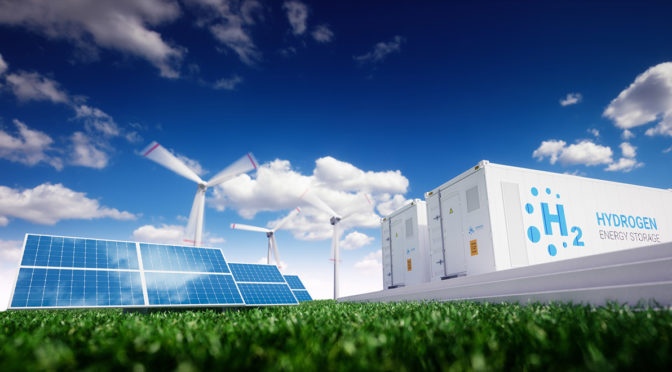
Hydrogen – or carriers like ammonia – are potentially ways for Australia to export renewable energy. Electrical energy can readily be converted into hydrogen via electrolysis. Renewable or green hydrogen involves producing hydrogen from renewable sources for example via electrolysers powered by solar and wind.
Hydrogen is poised to play a larger role, as the world moves to a low carbon economy. Hydrogen can potentially be used as a way for Australia to export renewable energy to other countries, particularly in Asia with demand expected to increase.
Earlier this month, ARENA also released a report that identified opportunities for Australia to export hydrogen as global demand for hydrogen increases in the next decade.
The report, prepared by ACIL Allen Consulting for ARENA, found there could be a significant increase in demand globally for hydrogen exports as other countries – such as Japan and the Republic of Korea – looked to transition to renewable energy. With the right conditions, hydrogen exports could be worth $1.7 billion annually and could generate 2,800 jobs in Australia by 2030.
ARENA is also part of the Hydrogen Strategy Group, led by Chief Scientist Dr Alan Finkel AO, which prepared a briefing paper on hydrogen for the COAG Energy Council.
ARENA CEO Darren Miller said the $22.1 million funding boost would help to maximise Australia’s opportunities in developing a cost-effective hydrogen export supply chain.
“Exporting renewable energy, such as by the use of hydrogen, involves developing and integrating emerging technologies. This funding will help bolster the research efforts of Australian scientists to drive innovation for what could become the next big export industry.
“Hydrogen is poised to play a big role in the world’s low carbon economy. Already, Japan and South Korea have committed to becoming major import markets for renewable hydrogen but as yet there are no exporters,” Mr Miller said.
“With its abundance of sun and wind, and experience as one of the world’s largest LNG exporters, Australia is ideally placed to become a global superpower in exporting renewable energy, and this work will help position us as leaders in this field,” he said.
Media release from ARENA. For more information, head to https://bit.ly/2M0juka.