
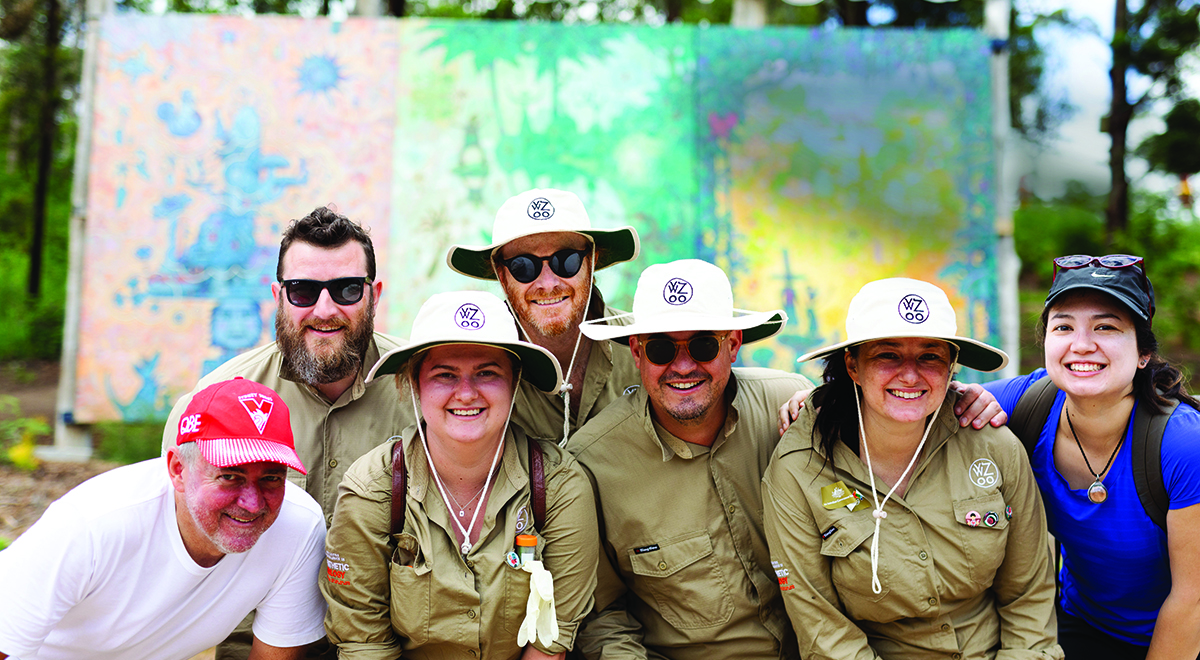
Image: Associate Professor Amy Cain and her team at the Woodford Folk Festival where they showcased synthetic biology, collecting microbes for the Wild Yeast Zoo. Supplied.
“People keep repeating that you can’t pick winners,” says Barry Jones, Federal Minister for Science 1983-1990. “That’s a sort of half truth.”
In reality, Jones says, successive Australian governments have always supported particular industries, companies and products. He says it’s part of the vital role of government in bringing good ideas to market and diversifying the Australian economy beyond minerals and agriculture. University science is a key part of this innovation ecosystem, along with industry, venture capitalists and government.
Along the way, government-led university-industry collaboration programs have helped support the revolving door between university science labs and industry sectors hoping to grow rapidly through access to cutting-edge science.
One of the stand-out successes in the past 35 years has been the advent of co-operative research centres (CRCs).
Tony Peacock, who was chief executive of the CRC Association for 10 years between 2010 and 2020, says that the concept came about because Barry Jones, while minister, had urged scientists to advocate more forcefully for government support. At the opening of Questacon — the National Science and Technology Centre in 1988, a group of scientists took him at his word and staged a public protest. Then-Prime Minister Bob Hawke got the message, and the CRC concept was sparked. A CRC takes a specific research problem and brings together a consortium of university, industry and government researchers to tackle it. Through a competitive grant process, they are funded for (usually) seven years.
Since the first CRC in 1990, the government has funded more than 250, investigating everything from invasive species to hearing loss to minerals exploration.
Serendipity at work
Peacock says the most successful CRCs were ones that had a clear, specific goal, and that fostered a culture of collaborative creativity. “The biggest impact is often the hardest to actually describe,” he says.
It’s a message echoed by Stella Valenzuela from the University of Technology Sydney. A professor of cell and molecular biology, she is also director of the IDEAL research hub, which brings together university, industry and government to create devices to detect trace molecules or cell types in complex systems.
She celebrates the hub for “the serendipity of just bringing people together and seeing what happens in that melting pot”. Given the latitude to explore ideas together, hub members developed concepts not originally slated, but that bore fruit nevertheless.
As policy has evolved over time, programs like the ARC Industry Fellowships and more recently the National Industry PhD Program have fostered collaboration to bring the world-class research Australian universities are known for into businesses large and small.
The National Industry PhD Program sees PhD candidates undertake research projects co-designed by university and industry or, alternatively, enables industry professionals to do a PhD while still working for their employer. For employers with talented workers keen to do a PhD, the program can help ensure they don’t lose them, and they can also benefit from closer ties to a university.
The ARC Industry Fellowships are offered at three levels — early career, mid-career and laureate, supporting university scientists to establish careers in industry, and industry-based scientists to work in university settings. The fellows also receive cash and in-kind contributions from their universities and industry partners. The fellowships have seen university scientists working with industry to solve challenges from recycling waste to transitioning to renewable energy and improving food security.
Bringing science to industry
ARC Industry Fellow and plant scientist Cailtin Byrt built a startup with her research team at ANU in 2021, developing nature-inspired separation technologies for harvesting nutrients, metals, minerals and clean water from industrial wastewater.
Along the way, the startup received research translation support from the ANU Agrifood Innovation Institute (AFII) hub. From here, the team was connected to the Canberra Innovation Network for startup training and introductions to the local innovation community.
In 2023 Byrt learnt about a global mining industry wastewater challenge opportunity created by mining giant Rio Tinto. Byrt and her team had been looking for an industrial wastewater separation problem, and the global wastewater challenge was looking for a solution, so it made for an ideal partnership. The ARC Fellowship is now allowing them to kick off research into developing Rare Earth Element (REE) selective components for use in separating REE resources from wastes.
Byrt says the fellowship has helped to expand networks within Rio Tinto and collaborating organisations working alongside it. “It has also created a pathway to apply laboratory-derived biotechnological innovations to addressing industrial waste and sustainability challenges,” she adds.
“Rio Tinto has connected us with brilliant industry and university colleagues across the globe who are focused on transforming the way critical materials are produced, used and recycled to make the process more environmentally, economically and socially sustainable.”
Freedom to solve the big issues
ARC Future Fellow Amy Cain says it’s often the desire to solve big global problems that sees scientists move between university-based research and industry.
As a biochemist, Cain has worked with pharmaceutical companies and universities on new drug development, but also with UK charity the Wellcome Sanger Institute on addressing the growing scourge of antibiotic resistance, and at a large hospital in Malawi setting up a program to screen for hospital pathogens. She’s now back at Macquarie University, using the expertise gained along the way to solve new challenges.
“I always say to people I mentor that you’ve got to balance getting in-depth knowledge of one subject with broad experience across different fields to have the best chance of having practical impacts with your research,” Cain says.
She helped spin out a new vaccine for a disease that is the biggest killer of horses in the world at Wellcome, and now in Australia as part of her ARC Future Fellowship has been applying research related to drug development to the completely different field of plastic waste.
At the ARC Centre of Excellence in Synthetic Biology, Cain had a mandate to use microbes to produce useful things and, while working on an ethical alternative to using mice for infectious diseases research, she saw how the larvae of the greater wax moth could voraciously eat certain types of plastic. “Now I’m building synthetic microbes that break down plastic, which is a completely different sort of science,” Cain says.
She credits the ARC for the support she has received for her work so far, and while she has contemplated a startup or spinout of some of her work, says it’s hard to beat the freedom universities offer to address challenges that may not be financially viable enough to appeal to industry.
“The main thing is encouraging people to take risks and removing barriers so scientists can freely move in and out of industry,” Cain says.
Written by Sara Phillips and Charis Palmer