
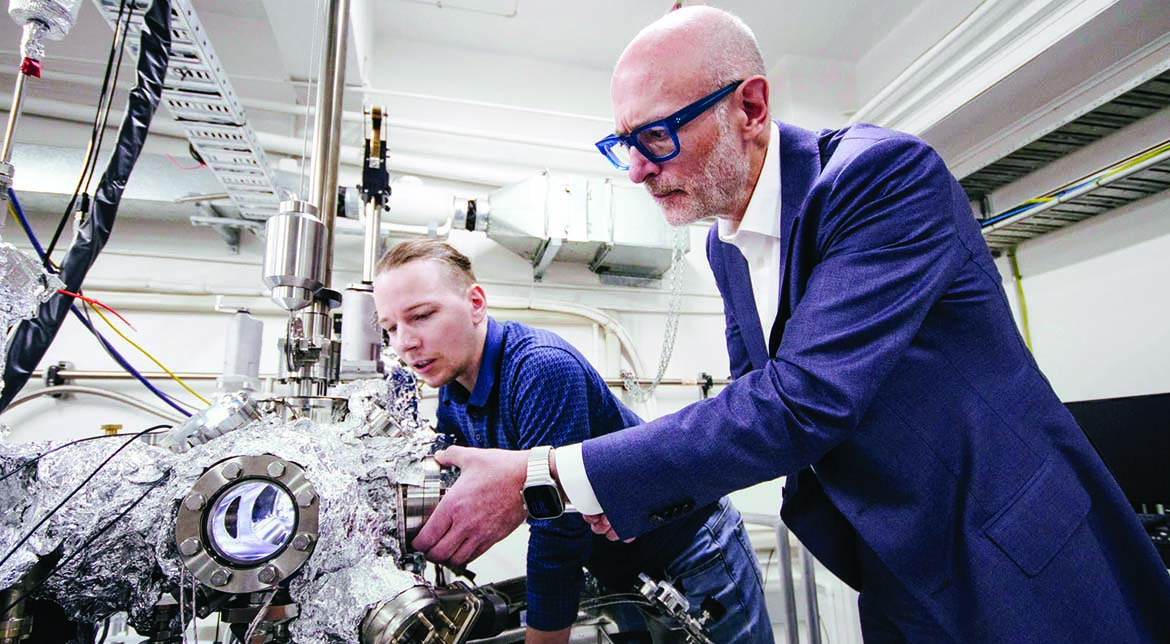
Image: Professor Sven Rogge, University ofNew South Wales. Supplied.
As funding tilts toward programmatic research and mission-led outcomes, Australian universities are under pressure to justify every research dollar. So what happens to curiosity, creativity and the risks that lead to unexpected breakthroughs?
A vision of blue sky
Light makes the sharpest of knives. Stretch a short laser pulse, amplify and squeeze it together again. That intense light burst, now the basis of laser eye surgery, originated as a way of exploring light’s interactions with matter in 1985. Its inventors, professors Donna Strickland and Gérard Albert Mourou, won a Nobel Prize for the discovery.
Neither could have foreseen the impact their laser research would have on millions of eyes around the world.
“Strickland is a pure scientist,” says Scientia Professor Sven Rogge, dean of the Faculty of Science at the University of New South Wales. “She doesn’t give a toss about any kind of application, [has] never done in her life. She just basically did it for the sake of doing amazing things in the lab.”
“Without fundamental, blue-sky discovery-driven research, we would not get the pipeline to the big things that change the world,” says Rogge.
But for the last few decades, Australian universities – the bastion of fundamental research – have increasingly followed the money.
Blue-sky research has declined by at least 20% since 1996, replaced by mission-driven program-based science.
“Time and dollar pressures are crucial differences between curiosity-driven and program-based science, says Professor Mark Hutchinson, interim director of the Institute for Photonics and Advanced Sensing (IPAS) at the University of Adelaide.
Industry prioritises deadlines over cost, academia values funding over speed, he says. “I think that there’s a mismatch there, especially in the Australian context.
Funding the future
Australian Research Council (ARC) and the National Health and Medical Research Council (NHMRC) account for most blue-sky research funding in Australia.
“The beauty of ARC funding is that an element of that discovery research is available to non-priority, non-mission driven activities,” according to Hutchison.
Although 47% of ARC Discovery Projects were funded for 2025, this is after 72% of the initial applications were removed at the expression of interest stage. In 2024, just 17% of Future Fellowships of Future Fellowships got up, with other schemes faring worse – between 10% and 32%.
Which means much curiosity – driven Australian science is unrealised.
What then is the future for such blue-sky research?
“That’s the critical question,” says Hutchinson, and “highlights why the health of Australia’s research sector is so important. Competition for ARC funding is fierce, and some excellent science will miss out.”
“However, for the first time, the ARC’s core mission to fund fundamental, blue-sky research is now protected by law.
This provides a guaranteed, stable home for those investigator-led projects,” she says. “We will keep working to increase the funding in a strategic and sustainable manner across the whole sector.”
Rogge is less sanguine. “What is very worrisome is that the ARC budget has basically been flat.” Total federal government research spend is 1.7% of GDP, well below the Organisation for Economic Co-operation and Development (OECD) average [2.7%].
“That is a serious problem for a country that should move away from only basically digging stuff up, but actually start to manufacture higher value chain products.”
Research provides a good “bang for buck” adds Rogge. “The government has to think, with industry, about how we can be attractive for that R&D and building more pathways to get knowledge outside, from the universities into societies. It’s a huge opportunity.”
“There’s a lot of very, very good fundamental research going on at universities,” he says. “Putting further pressure on that is counterproductive, because if you look at the way knowledge transforms into productivity, into dollars in the society, it’s a long pipeline”
Matching Indigenous community priorities
Curiosity-driven research must also match community-priorities, says Professor Bronwyn Fredericks, University of Queensland’s Deputy Vice Chancellor (Indigenous Engagement). Otherwise, it’s just knowledge mining for the good of the researchers, she says. Indigenous people have lost land and resources.
“The knowledge base may be the only thing some people have left.”
Dr Katrina Wruck of the Queensland University of Technology (QUT) agrees, and would like to see “Indigenous knowledge elevated so that people who go to university understand the depth of knowledge. Also so community can see their own
knowledge as being elevated in the curriculum, and then also providing opportunities for economic self-determination, commercialising traditional knowledges and patenting their own traditional knowledge and copyright.”
Wruck is 2025 Young Australian of the Year and descended from the Panaylayg Nation of Mabuyag Island, Zenadeth Kes/Torres Strait Islands.
“I think it comes down to the land councils and the communities or Aboriginal corporations working with universities and researchers to help find ways, new ways to help community,” she says.
Public understanding of science is the key. “The biggest problem is that the community does not understand the
impact and importance of science; the practical outcomes that are created,” says Rogge. “And since that’s not known, there’s not a lot of sympathy.”
The future Rogge would like to see is a mix of mission-based and curiosity-driven research. One where science is thriving and recognised for real-world contributions.
Where scientists are working on real-world problems, involved with Indigenous and other communities, in industry and community-based science, he says. Community involvement means more effective illustration of the power of science.
According to Rogge, it’s vital to “make the university a more porous place where we bring the public in to be part of the
science that happens”.
Written by: Richard Musgrove
First published in Australian University Science Issue 14