
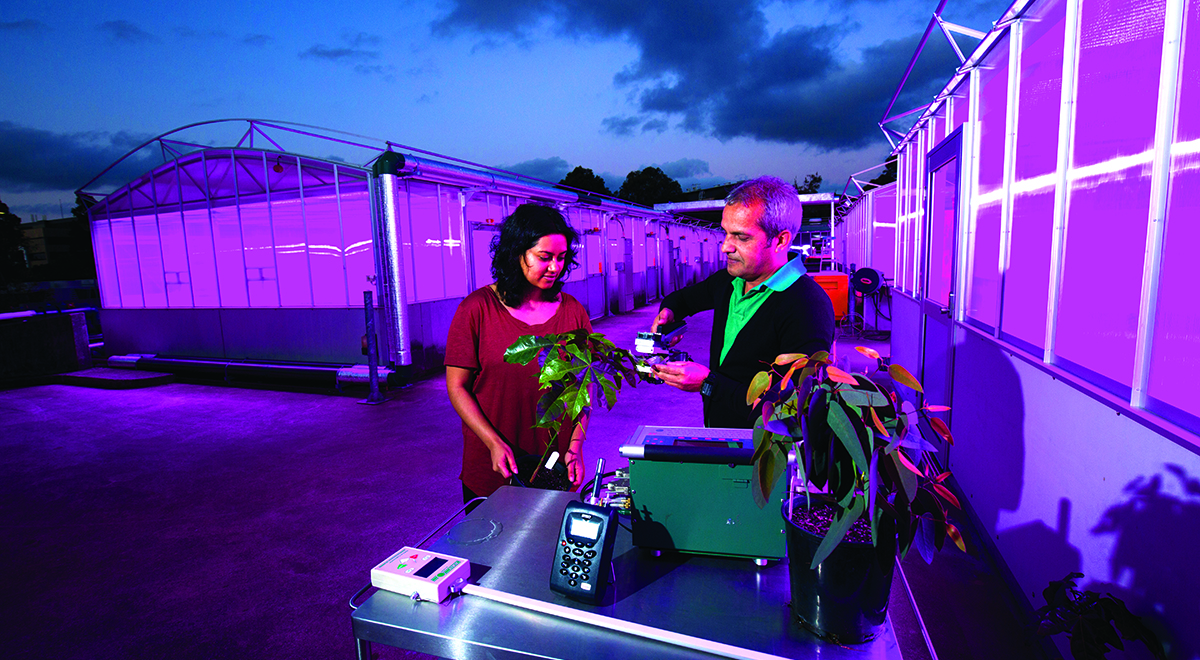
Image: Macquarie University’s Plant Growth Facility is helping to improve biodiversity though collaboration.Supplied.
Translating university science for the greater good is often the product of experience, networks and relationships built over several years. Here are four examples of successful partnerships
1. Partnering with government to address climate change adaptation
Macquarie University Distinguished Professor of Biology Lesley Hughes led the Biodiversity Node of the NSW Adaptation Research Hub during its five-year existence. Bringing together 64 researchers from 16 institutions and agencies across Australia, the Node developed an innovative model of collaborative research with projects co-designed and co-led by academic researchers in collaboration with government scientists and policy makers. The end result was shortened time frames between knowledge creation and implementation, saving money and helping ensure government decision-making was based on the best available evidence.
2. UNSW and Kandui Technologies reviving waste materials
Materials scientist Professor Veena Sahajwalla had been researching recycling of waste materials for more than a decade, during which, she met recycling company leader Andrew Douglas at a sustainability conference. Sahajwalla founded the Centre for Sustainable Materials Research and Technology (SMaRT) in 2008 and, in 2018, the world’s first ‘MICROfactorie’ was launched at the centre, using micro-recycling to revive waste materials onsite. Douglas established Kandui Technologies based on a licensing agreement with SMaRT to use its green ceramics MICROfactorie technology and now the company is building a ceramics business transforming waste into tiles and kitchen benchtops.
3. Improving cancer diagnosis
Medical imaging scientist Professor Patrick Brennan first published research in 2010 that would eventually go on to drive the development of a company with global reach. After finding that mammograms failed to detect 30% of breast cancers in Australia he teamed up with University of Sydney colleagues Professor Mary Rickard and Dr Moe Suleiman, and found shortfalls across a range of diagnostic methods. DetectedX was formed in 2019 and now boasts more than 7500 users in 150 countries. Its methods have been published in more than 100 scientific journals and it has supported the ongoing research of 30 PhD students.
4. Saving lives with Gardasil
Born out of research by Professor Ian Frazer and Dr Jian Zhou that started in 1990 at the University of Queensland, it wasn’t until 2006 that HPV vaccine Gardasil was launched on the global market. Along the path, UQ commercialisation company UniQuest brokered a licensing deal with CSL which funded further research and development. Thanks to the success of Gardasil, Australia is hopeful of becoming the first country in the world to eliminate cervical cancer by 2035.
Written by Charis Palmer