
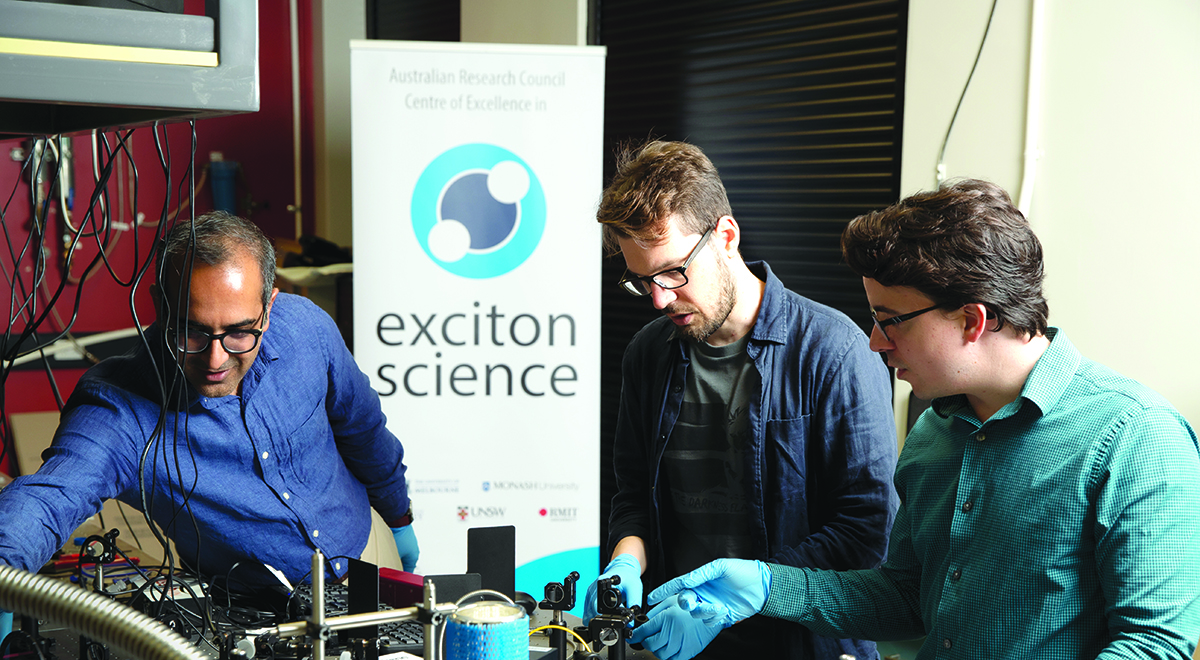
Image: Associate Professor Girish Lakhwani (left) with his team at the University of Sydney Centre of Excellence in Exciton Science. Supplied.
Recent weak National Accounts figures underscore the urgent need for greater investment in research and development to drive Australia’s economic growth. More industry investment is critical and university-industry partnerships are key to this effort, especially for small and medium-sized enterprises (SMEs), which make up over 99% of Australian businesses and contribute a third of the nation’s GDP.
Large companies dominate mining and finance, but SMEs play a critical role in other sectors, kickstarting innovation, providing localised solutions and adopting new technologies faster to meet emerging market needs.
“While we outperform in the creation of startups and small businesses against other OECD countries, our industry structure is overly skewed to small businesses with less than 20 employees. It’s hard to compete when you are small,” says Industry Innovation and Science Australia Chair Andrew Stevens.
Australia’s new science priorities and $392 million Industry Growth Program both call for the nation to address the “missing middle” that has held back Australia’s ability to scale up and absorb innovation.
“The outcome we need right now is the scaling of small businesses into medium-sized businesses. This will build sovereign capability and economic complexity in Australia,” Stevens says.
Collaborations with Australian university science are the key to helping businesses scale.
Collaborations with Australian university science are the key to helping businesses scale.
Research has found SMEs that collaborate with universities and research institutions experience higher innovation and economic performance. By establishing links with academic researchers, SMEs are able to engage in product and process innovation which, in turn, positively influences revenue growth, access to new markets or higher profitability.
Australia’s competitive university science schools bring expert problem solvers, lateral thinkers and inquiring and talented students who often go on to work with SMEs that they engage with during their study, says Warwick Dawson, Pro Vice-Chancellor Industry and Engagement at the University of Newcastle.
“Universities also bring world class research facilities that no SME would be able to afford to purchase on their own, and access to broader networks and related industry partners, connecting SMEs to each other as well as to researchers,” Dawson adds.
These unique university advantages are helping small businesses like EM Energy. In the process of trying to build a renewable battery, it found the organic material in it could be used to create hydrogen gas.
Founders Isabel Toasa and Chris Wilson knew they had made an important discovery, but the company didn’t have the facilities, people or equipment to help them test it.
During a University of Newcastle event, Toasa serendipitously met materials science researcher Peter Richardson, leading to a research project to test and validate EM Energy’s production of green hydrogen.
EM Energy became the first recipient of an R&D funding voucher as part of the government-backed Trailblazer for Recycling and Clean Energy (TRaCE), and Wilson says “it’s going to give us access to some of the really great resources within the university, such as the research staff, equipment and labs, helping us to accelerate our research and development activities for the company”.
Partnering from startup to scale
As the government seeks to incentivise and support the translation of science research into new industries and sustainable products, partnerships like that between the University of Queensland’s Food and Beverage Accelerator and deep-tech company Nourish Ingredients show the benefit of early connections on the path to scaling.
Nourish Ingredients is working with university scientists at FaBA to research how its new dairy-type lipid ‘Creamilux’ functions for use in various products.
“Companies have limited control over how an ingredient might be used in the future, so they want to know how their ingredient will interact with other ingredients,” says Professor Jason Stokes, UQ’s Premium Food and Beverage Program lead.
“They need to understand the product’s technical behaviour at different interfaces and understand the chemistry of how it will act,” Stokes adds.
Scientist and board chair Dr Leonie Walsh says while industry generally works on shorter time frames than university science, cooperative research centres have shown the benefit of partnerships that go further than early-stage validation of a product.
Walsh chairs the recently established Solving Plastic Waste CRC, and says she was drawn to it by the strategic approach bid leader Dr Ian Dagley took.
“He worked with the industry partners and identified what their problems were and the challenges along that plastics value chain. And then, based on those problems and challenges, he then approached the universities to look for the expertise that was best positioned to solve those challenges,” Walsh says.
The CRC has a combined $140 million in government and industry funding for its initial 10-year lifespan, and Walsh says it has taken a “quality over quantity” approach to partners.
“There’s a trend with CRCs that suggests ‘bigger is better’, but with the Solving Plastic Waste CRC we really focused on what are those problems and challenges that aren’t being addressed in the value chain today.
“We knew that if we helped plug those gaps, it would create a quantum effect that would support that whole sector.”
Walsh also sits on the board of solar thermal storage scale-up RayGen, which she says is constantly working to improve efficiencies in other aspects of its technology.
“And they work with three universities — UNSW Sydney, University of Adelaide and the Queensland University of Technology — to do that, targeting a specific skill set in areas where there is potential for further development. There are great opportunities to use that calibre of research to help finetune and continue to innovate in the technology area,” Walsh says.
Training the next generation of innovators
For businesses that are yet to be, universities act as incubators to provide the runway, networks and commercialisation skills necessary while ideas or discoveries are honed.
Sydney University’s Knowledge Hub, for example, is supporting the work of Associate Professor Girish Lakhwani and Dr Inseong Cho from the university’s Faculty of Science.
Cho completed his PhD at the University of Wollongong, where he was a member of the ARC Centre of Excellence for Electromaterials Science, and he’s now a member of the ARC Centre of Excellence in Exciton Science at the University of Sydney.
The researchers have found a way to manipulate laser light at a fraction of the cost of current technology, which could help drive down costs in industries including telecommunications, medical diagnostics and consumer optoelectronics.
Teams including Lakhwani and Cho’s took part in a four-day bootcamp and ongoing activities designed to build commercial skills as part of the Sydney Knowledge Hub’s PERIscope Commercialisation Award.
The program concludes with advice from commercialisation experts on whether the solution should be a new venture, a license with an existing company, or whether it should go back to the lab.
Written by Charis Palmer