
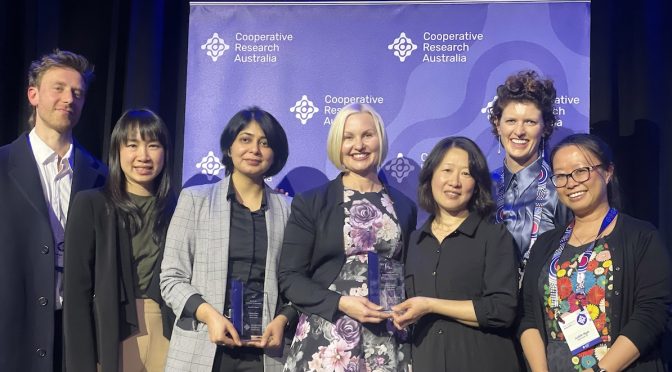
Image: Alessandro Luongo (DHCRC), Hui Mathews (DHCRC), Dr Tabinda Sarwar (RMIT), Vickie Irving (Telstra Health), Dr Jocelyn Ling (DHCRC), Dr Clare Morgan (DHCRC), Judith Ngai (DHCRC) at the Cooperative Research Australia awards in Brisbane. (Supplied by RMIT)
Winners of Cooperative Research Australia’s prestigious Excellence in Innovation Awards were announced tonight at the Collaborate Innovate conference.
From aged care improvements to transforming environmental sustainability for heavy industry, improving agricultural productivity to enhancing quality control and environmental assessments in the resources sectors, all four winning entries showcased the positive impact Australia’s established industry-research collaborations are having on its R&D and innovation system.
Australian-first electronic screening and risk prediction tool reliably detecting deterioration in frail aged care residents.
The Award for Impact celebrates the translation of research undertaken collaboratively to deliver economic, social and/or environmental benefit. This year’s winners – Digital Health Cooperative Research Centre partners, RMIT and Telstra Health – have developed and validated an electronic screening and risk prediction tool that is introducing enhancements to the safety and quality of care in aged care settings.
An Australian-first innovation, the tool reliably detects deterioration in frail aged care residents. Prior to this development, such detection was known to be notoriously difficult, with current tools not considering bio-psycho-functional factors in an aged-care setting. The new tool automatically monitors both structured and free-text electronic record data for 36 evidence-based bio-psycho-functional indicators of deterioration, making it the most reliable tool of its kind developed to date.
“The tool will substantially improve the monitoring protocol for the elderly in aged care homes without putting any burden on the nursing staff,” said Dr Tabinda Sarwar, data scientist and RMIT Project Lead. “This collaboration with Telstra Health has provided valuable insights, which ensured that our solutions are practical, effective, and tailored to real-world needs.”
Two award-winning environmentally sustainable technologies commercialised – the low-emissions industrial Gyro-Therm Burner, and burners for the first ‘green’ Olympic Torch and Stadium flames.
Professor Gus Nathan from The University of Adelaide took out the Award for Enduring Industry-Research Collaboration, for his efforts in driving the transition to environmental sustainability for heavy industry in Australia and around the world. As instigator of the HILT CRC for heavy industry decarbonisation, Professor Nathan united 55 partners in iron/steel, alumina and cement manufacturing to accelerate and de-risk the path to decarbonise associated sectors that emit ~20% of global emissions. He’s invented, and partnered with industry to commercialise, two award-winning technologies – the low-emissions industrial Gyro-Therm Burner, and burners for the first ‘green’ Olympic Torch and Stadium flames.
Two winners were awarded this year’s Lifetime Achievement Award for Contribution to Industry-Research Collaboration.
Award-winning AgTech start-up, The Yield, now part of Yamaha Agriculture, making Australia the centre of its global AI capability.
For 25+ years, Ros Harvey, Founder and CEO of The Yield, has been at the forefront of re-imagining Industry-Research collaborations in the digital economy, across both social and physical sciences. In the early 2000s, Ros founded the UN and World Bank Better Work initiative, making the world’s largest database on working conditions openly available to researchers and policy makers. Since returning to Australia in 2010, Ros has founded and led multi-stakeholder initiatives in digital agriculture, driving profitability, resilience and sustainability. And in early July, her award-winning AgTech start-up, The Yield, has become part of the Yamaha Agriculture group, aiming to improve agricultural productivity in the utilisation of digital technology and robotics, and making Australia the centre of its global AI capability.
Renowned for his groundbreaking contributions to the resource industry and mentoring industry-ready graduates, and recognised as being in the top 1% of his field globally, Distinguished Professor Suresh Bhargava, AM from RMIT was also a recipient of the Lifetime Achievement Award. Among his pioneering innovations are the ATR-FTIR spectroscopy technique, a non-destructive method used for surface studies and material identification, as well as online mercury and hydrogen sensors, catalytic wet oxidation for Bayer Liquor, material science, and advancements in leaching processes. These innovations have collectively saved the industry millions of dollars, demonstrating his remarkable influence and contribution to the field. Currently holding the QPM Chair of Critical Minerals for EV batteries, Professor Bhargava led the Australian Green Hydrogen Mission to India, underscoring his three-decade-long passion for clean energy and eco-sustainable practices in the chemical industry.
“My life mission is to make this world a better place when I entered in it through my journey with Science and Technology,” Professor Bhargava said.
“The translation of research into commercial, economic, social and environmental outcomes is key to driving future prosperity for Australia,” said Jane O’Dwyer, CEO of Cooperative Research Australia. “We congratulate all winners of our Excellence in Innovation Awards and commend them on their efforts to help position Australia as a global leader in several fields. I cannot wait to see what initiatives and innovations will emerge over the coming year, as Australia maintains its critical focus on R&D.”