Tag Archives: commercialisation

$7.8 million funding for Aussie ideas


Funding of $7.8 million to take bright Aussie ideas to the world

The Assistant Minister for Innovation, Wyatt Roy announced that a further 17 Australian companies will receive commercialisation grants under the Entrepreneurs’ Programme.

The Entrepreneurs’ Programme is the Australian Government’s flagship initiative for business competitiveness and productivity at the firm level.

The $7.8 million has been offered to assist the 17 Australian companies launch their innovative products, processes or services into the global marketplace and help advance Australian industries.

Some of the products, processes or services include:
• a device to optimise carbon use and maximise gold recovery for the gold mining industry
• a software and training platform for the agribusiness sector to help improve farm profitability, business management and sustainability
• a real-time, cloud-based data management system for intelligent buildings and smart cities
• laser-based 3D printing for lighter, more easily produced metal components for aerospace and defence applications
• advanced manufacturing for reliable, cheaper and highly efficient silicon solar cells
• a world-first clinical diagnostics device to help assess the health of the human gut.

The Entrepreneurs’ Programme commercialisation grants help Australian entrepreneurs, inventors and businesses address the challenges associated with commercialising novel intellectual property.

It aims to:
• accelerate the commercialisation of novel intellectual property in the form of new products, processes and services;
• support new businesses based on novel intellectual property with high growth potential; and
• generate greater commercial and economic returns from both public and private sector research and facilitate investment to drive business growth and competitiveness.

Further information on Entrepreneurs’ Programme and the grant recipients is available on business.gov.au or call 13 28 46.

This information was first shared in a media release by the Australian Government Department of Industry, Innovation and Science on 19 January 2016.

Flexible electronic devices

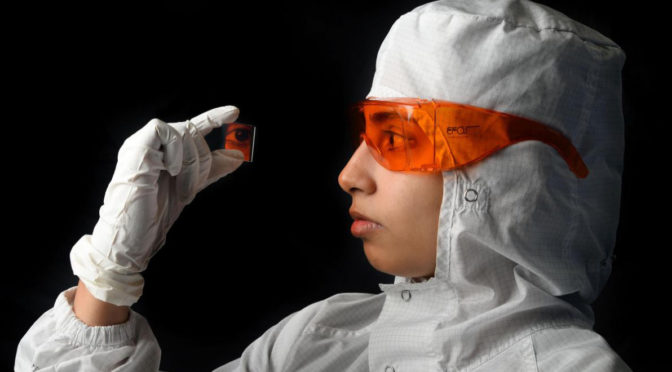
The RMIT scientist behind stretchy UV sensors has the chance to work with international partners and turn her flexible electronic devices into commercial products, after winning a Victoria Fellowship.

With a fascination for flexible electronic devices, Dr Madhu Bhaskaran has dedicated her research to bringing science fiction gadgets closer to real life.

“My research focus has been to design flexible electronic devices with highly functional characteristics while being optically transparent,” Bhaskaran, co-leader of the RMIT Functional Materials and Microsystems Research Group, says.

Her concepts and designs have been rewarded with a life-changing opportunity – a prestigious Victoria Fellowship awarded by the Victorian Government.

The fellowship recognises innovation and skill in science, technology, engineering and mathematics.

Bhaskaran is one of 12 Victorian Fellows in 2015, who each receive a travel grant of up to $18,000 for a short-term overseas study mission to assist in developing a commercial idea or to undertake specialist training or career development not available in Australia.

Together with Deputy Vice-Chancellor, Research and Innovation and Vice-President, Professor Calum Drummond – who won the Victoria Prize for Science and Innovation in the Physical Sciences – Bhaskaran represented RMIT at last week’s Victorian Endowment for Science, Knowledge and Innovation awards ceremony.

“I am thrilled to have won this fellowship as it is a wonderful way for me to expand my collaborative network and learn new aspects of my field of research,” she says.

“The state-of-the-art equipment at the MicroNano Research Facility at RMIT has made this research a possibility.”

Earlier this year, together with PhD researcher Philipp Gutruf, Bhaskaran made her mark in the media internationally with her incredible wearable sensor patches, which detect harmful UV radiation known to trigger melanoma and dangerous toxic gases such as hydrogen and nitrogen dioxide.

Much like a nicotine patch, the sensor can be worn on the skin and, in the future, will be able to link to electronic devices to continuously monitor UV levels and alert the user when radiation hits harmful levels.

The sensors are cheap and durable – attributes which could see flexible electronics and sensors eventually become an integral part of everyday life.

“This new class of electronics is promising for designing novel systems such as in vitro pH sensors, transient and printable electronic devices, sensory robotic skin, and wearable flexible electronic devices,” Bhaskaran says.

Functional oxides, or metal oxides, used in electronic devices, are known for their versatility and high performance, but are notorious for their fragility and high temperature synthesis.

“With the demand for flexible electronics, the challenge remains in the integration of these functional oxides with polymeric plastics like in bank notes,” Bhaskaran says.

“I have developed a unique transfer process which would help overcome this challenge, and with this process, I have also created gas and UV sensors.”

Bhaskaran says the Victoria Fellowship would give her a valuable opportunity to gain international exposure at leading research institutions in the US, UK, Switzerland, and would lead to discussions with industry partners to potentially commercialise the product.

“The insights gained by visiting these research groups and industries will enable me to realise practical technology and open up more opportunities for research funding and industry linkages benefitting RMIT and Victoria,” she says.

Flexible electronic devices

Bhaskaran was presented the 2015 Victoria Fellowship in Physical Sciences by Victorian Minister for Industry, Lily D’Ambrosio.

Be true to you: Applications are open to study the Master of Engineering (Micro-Nano Engineering) in July 2016.

– Chanel Bearder

This story was originally published by RMIT University on 19 October 2015. Read the original story here.


Irrigation innovation

This is an article in our nine-part series on Australia Asia innovation.

Water is the world’s most precious resource. Without proper supplies, farmers cannot meet the planet’s growing demand for food.

Yet global estimates suggest there are 275 million hectares of land whose irrigation systems desperately need modernisation: 55–60 million in China, 25 million in the US, and 2.5 million in Australia. The market has proved fertile for Rubicon Water.

At sites across the globe, Rubicon Water’s installations measure and control water flow, making hundreds of small changes daily to send precise amounts of water to farmers when needed – the magic of algorithms, wireless telemetry, solar power, sensors, smart gates and valves.

“Our systems have now been deployed in China, Spain, Chile, New Zealand, France, Mexico, Italy, USA and Canada,” says Melbourne engineer David Aughton, who – with four enterprising colleagues with expertise in software development and irrigation system operation – founded irrigation innovation company Rubicon Water in 1995.

Along the way, the group teamed up with the University of Melbourne’s Professor Iven Mareels and scientists of the CRC for Sensor Signal and Information Processing, and jointly developed the Total Channel Control System for automating and revitalising outdated irrigation systems.

“That big team effort is ongoing with the university in systems control engineering and smart software for intelligently moving water,” adds Aughton.

Small-scale pilot projects kicked off in 2002 in Victoria’s irrigation districts and in Coleambally, NSW, followed by large-scale deployments in 2005 and now deployments in Australia, China and the US.

Today, Rubicon Water delivers smart, green automation, sensor measuring and control technologies for drought-stricken irrigators from two offices in China, three in the US, and other strategically placed sales offices. Staff numbers have grown from 60 in 2008, to over 200 employees in 2014.

WisingUponWater_Rubicon
Rubicon is an Australian innovation success story involved in massive irrigation projects in China.

HQ: Melbourne

R&D: 15,000 products sold

Reach: Spain, Chile, New Zealand, France, Mexico, China, Italy, USA, Canada

At a glance: Established in 1995, Rubicon is a private, Australian-owned company with 200 employees and sales offices in the US, China, Spain, Mexico and New Zealand. It also has a research partnership with the University of Melbourne’s School of Engineering.

Aughton says that their state-of-the-art manufacturing plant in Shepparton has exported 15,000 Rubicon gates, meters and products globally.

In Australia, Rubicon has multi-million dollar modernisation contracts in the Goulburn–Murray districts, in Murray Irrigation in southern NSW, in the Ord Valley in Queensland, and is involved in massive irrigation projects in China. The Fen River Irrigation District in China’s Yellow River Basin, for example, covers 100,000 hectares and supplies water on rotation to hundreds of thousands of small landholders growing crops and vegetables.

Fen River Irrigation Authority Director, Li Ming Xing, says he “highly recommends” Total Channel Control, due in part to Rubicon saving 75% of the costs of alternative technologies. – Paul Hendy

Next: Microtechnology manufacturing success

Australia Asia innovation

This is the intro to our nine-part series on Australia Asia innovation. Read the next story here.

The massive industrialisation and rocketing populations of China, India and other rapidly developing nations have triggered a major shift from the previous century’s Euro- and US-centric economy to a predominantly Asian one. Australia is well placed to cash in on this market, thanks to some special advantages, such as proximity and shared time zones.

But that might not be enough, some academics warn. The University of Melbourne’s Professor Tim Lindsey, Malcolm Smith Professor of Asian Law, urges Australia to engage more effectively with these nations to avoid being a “bit player” in the Asian century.

Nevertheless, when we looked into the track record of Australian commercialisation in Asia, we found Australia had already achieved some major technological successes – nine of which are profiled in this in-depth series.

One of Australia’s most renowned innovation success stories, Cochlear Ltd – which has had strong partnerships with three successive Cooperative Research Centres (CRCs) – cites China as “a huge potential market”, according to CEO Dr Chris Roberts.

Meanwhile, VisionCRC, in partnership with Zhongshan Ophthalmic Centre in China, has demonstrated a new generation of optical products that can slow the progression of myopia (short-sightedness) in children aged 6-12.

Rubicon Water – an offshoot of the CRC for Sensor Signal and Information Processing and a partner of the University of Melbourne – has developed a water-management system in China’s drought-stricken Yellow River Basin that could improve water efficiency by up to 20% and be implemented at one-quarter of the cost of traditional systems.

Then there is MBD Energy, which is looking to tackle China’s unique $250 million algae problem along the Shandong coast between Shanghai and Beijing. MBD aims to turn those algal blooms into useful, natural soil conditioners.

Many other organisations built on CRC research or collaboration are looking to Asia for research and industry partnerships, clients and customers, taking Australia Asia innovation partnerships to extraordinary new heights. – Heather Catchpole

Next: Irrigation innovation